AI & Automation
AI Receptionist for Spray Tan Salons: Booking More Clients
See how an AI receptionist for spray tan salons captures leads, books appointments, answers prep questions, follows up, and protects valuable staff time.
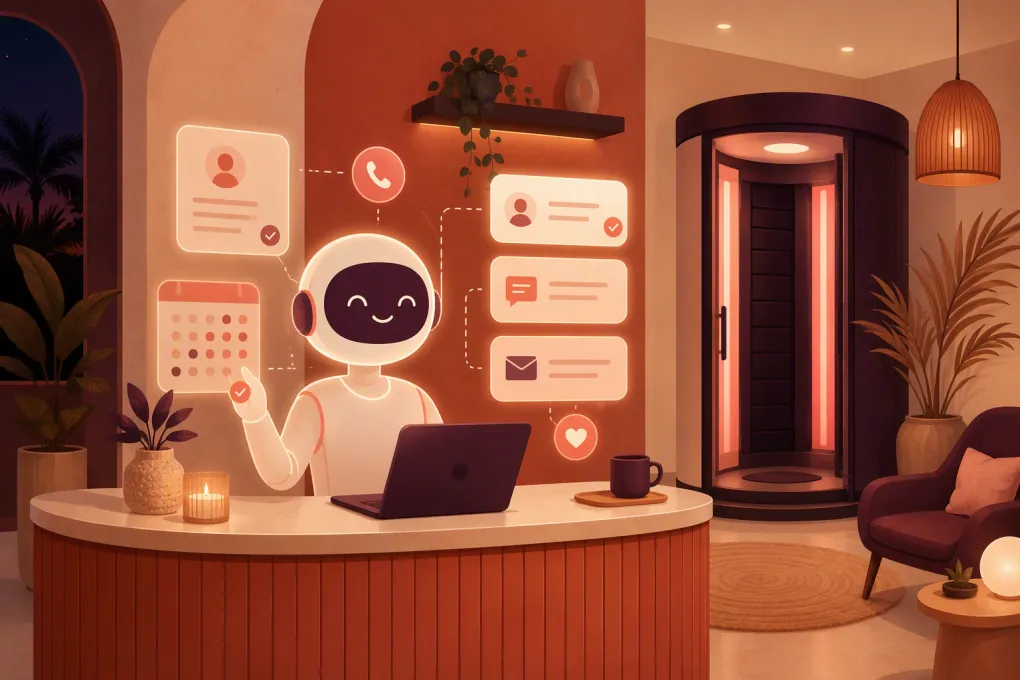 Watch · 20s
A spray tan inquiry rarely arrives at a convenient time. A prospect calls while your technician is with a client, sends an Instagram message after closing, or asks about prep shortly before an appointment. If the response is slow, that person can move on to another salon without ever entering your booking system.
An AI receptionist gives spray tan salons a consistent front desk that can respond around the clock. The useful version does more than answer common questions: it captures contact details, checks availability, guides clients toward the right service, books eligible appointments, follows up with undecided leads, and escalates anything requiring human judgment.
That matters in a business where operators must balance appointments, room turnaround, client preparation, retail sales, memberships, and incoming inquiries—often with a small team.
See how Fitty can handle spray tan inquiries while your team serves clients →
What an AI receptionist should handle for a spray tan salon
An AI receptionist is a phone or messaging agent connected to your approved business information and operating rules. Depending on the system and setup, it may communicate through calls, text messages, website chat, or other supported channels.
For a spray tan salon, the highest-value workflows are usually straightforward.
New-client questions
Prospects tend to ask practical questions before booking:
- What is the difference between your spray tan options?
- How long does an appointment take?
- When can I shower or rinse?
- Should I exfoliate or shave beforehand?
- What should I wear to the appointment?
- Do you offer mobile, express, bridal, group, or competition tans?
- How far ahead of an event should I book?
- What is your cancellation or rescheduling policy?
The AI should answer from salon-approved content rather than improvising. If an answer depends on skin conditions, pregnancy, allergies, medication, or another health concern, the receptionist should avoid medical guidance and transfer the question to a trained person.
Appointment booking
A capable AI receptionist should move the conversation toward an actual reservation. That means collecting the required client information, identifying the requested service, checking eligible times, and placing the appointment into the correct booking workflow.
Your rules should account for:
- New versus returning clients
- Standard versus express services
- Technician or room availability
- Appointment duration and cleanup buffers
- Group bookings
- Membership entitlements
- Deposits or payment requirements
- Location selection for multi-location salons
If the AI cannot safely complete a booking, it should preserve the lead and create a clear handoff instead of ending with “please call us later.”
Lead follow-up
Not every caller is ready to book during the first conversation. Some are comparing salons, checking dates with friends, or planning around an event.
A structured follow-up can keep the inquiry active. For example:
- Send the requested booking link or appointment options immediately.
- Follow up later if the prospect has not booked.
- Restate the relevant service, location, and next step.
- Stop automated outreach when the person books, opts out, or requests human help.
Follow-up should be useful, not relentless. The goal is to remove friction and make the next action obvious.
AI receptionist versus basic salon automation
Not every automated tool is an AI receptionist. A missed-call text or online form can help, but each approach handles a different part of the workflow.
| Approach | What it does well | Main limitation | Best use |
|---|---|---|---|
| Voicemail | Captures a message after hours | Requires staff to listen and call back | Low inquiry volume with reliable manual follow-up |
| Missed-call text | Acknowledges the caller quickly | Often sends the same response regardless of intent | Giving callers a booking link or callback expectation |
| Website booking form | Lets ready-to-book clients self-serve | Does not resolve uncertainty before booking | Returning clients who already know the service they want |
| Chatbot with fixed menus | Handles predictable paths | Can fail when questions do not match preset choices | Basic FAQs and lead collection |
| AI receptionist | Conducts a two-way conversation and can drive the next action | Requires accurate rules, testing, and supervision | Salons wanting broader inquiry coverage and follow-up |
| Human receptionist | Handles nuance, exceptions, and sensitive issues | Coverage depends on staffing and working hours | Complex cases, complaints, and high-touch client care |
The strongest operating model is usually not “AI or people.” It is AI for repetitive, rules-based interactions and staff for judgment-heavy situations.
Build a spray tan knowledge base before switching it on
An AI receptionist is only as dependable as the information it receives. Before launch, create one source of truth for services, policies, preparation instructions, and escalation rules.
Document every bookable service
For each service, define:
- Public-facing name and description
- Duration and required buffer
- Who can book it
- Available locations and technicians
- Preparation instructions
- Development or rinse guidance approved by your salon
- Price or pricing rule
- Deposit and cancellation requirements
- Situations that require staff review
Avoid vague labels that make sense internally but confuse clients. If “Signature Glow” and “Rapid Glow” have different rinse windows or eligibility rules, explain that distinction plainly.
Set boundaries for sensitive questions
Create mandatory escalation triggers. These may include adverse reactions, complaints, refund demands, accessibility needs, pregnancy-related questions, skin conditions, medication concerns, or anything that could be interpreted as medical advice.
The AI should acknowledge the question, avoid making a diagnosis or safety determination, collect the necessary contact details, and route it to the right person.
Keep policies synchronized
A stale knowledge base can create operational problems quickly. Update the receptionist whenever you change hours, prices, cancellation terms, membership rules, seasonal packages, or appointment availability.
Assign one team member to own these updates. For multi-location businesses, separate company-wide policies from location-specific details.
Design the booking conversation around intent
A strong conversation does not interrogate the prospect. It collects only what is needed to recommend the next step.
A practical new-client flow might be:
- Ask whether the tan is for an event or general use.
- If there is an event, ask for the event date.
- Explain the relevant service choices using approved language.
- Ask for the preferred location and appointment window.
- Check availability and offer valid options.
- Collect the required contact and booking information.
- Complete the reservation or send the approved checkout step.
- Confirm the service, date, time, location, and preparation instructions.
The receptionist should not force every lead through the same script. A returning member asking to reschedule needs a different path from a bridal party requesting coordinated appointments.
See how WTF Go and Fitty turn inquiries into managed booking workflows →
Use AI to reduce no-shows without creating message fatigue
Booking the appointment is only part of the job. Clients also need the right information at the right time.
Useful automated communications can include:
- Booking confirmation with location and service details
- Preparation instructions in advance of the visit
- A reminder that includes cancellation or rescheduling options
- Arrival instructions for unmanned or suite-based locations
- Approved aftercare guidance
- A rebooking prompt when appropriate
- Membership or package payment follow-up when money is due
Keep each message focused. Preparation instructions should not be buried beneath promotions. Clients should also have a clear way to ask a question or reach a person.
Fitty is designed to answer leads, manage booking conversations, follow up, and collect dues around the clock. Connecting these actions in one operating system helps prevent the gaps that appear when calls, messages, appointments, and payments live in separate tools.
Protect consent, privacy, and client trust
Automation does not remove the salon’s responsibility to communicate lawfully and handle client information carefully.
Before using automated calls or texts, review your consent language and opt-out process. US federal rules, including the Telephone Consumer Protection Act, may apply, along with state requirements. Call-recording laws also differ by state. Obtain qualified legal guidance for your exact workflows rather than treating software settings as legal advice.
Operationally, your system should:
- Identify the business clearly
- Honor opt-out requests promptly
- Limit access to client information
- Avoid collecting unnecessary sensitive details
- Keep conversation and booking records available for review
- Define how complaints and urgent issues reach a person
- Use approved payment workflows rather than requesting card details in open messages
Trust is part of the booking experience. A receptionist that is transparent, accurate, and easy to escape is more useful than one pretending to be human or trapping clients in a loop.
How to evaluate an AI receptionist for your salon
During a demo, test your real operating scenarios rather than accepting a polished generic script. Ask the system to handle:
- A new client who does not know which tan to choose
- A same-day appointment request
- A caller asking about an upcoming wedding
- A returning client who wants to reschedule
- A group inquiry spanning several appointment slots
- A health-related question that should be escalated
- A cancellation outside your allowed window
- A client choosing between two locations
- An incomplete booking that requires follow-up
Then evaluate the operational details:
- Can it take action in the booking workflow, or only capture a lead?
- Can staff see conversation history and takeover status?
- How are service rules and policies updated?
- Can follow-up stop automatically after booking or opt-out?
- Does it support each location’s hours, services, and availability?
- What happens when the AI is uncertain?
- How are payments or overdue balances handled?
- What implementation, training, and migration work is required?
Pricing also needs context. Compare the total workflow covered—not only the subscription fee. A lower-cost answering tool may still leave your staff manually booking, following up, and updating records.
A practical launch plan
Start with a controlled set of high-volume interactions instead of automating every edge case immediately.
- Review recent calls, messages, and front-desk questions.
- Identify the most common booking and FAQ intents.
- Clean up service names, durations, policies, and availability rules.
- Write approved answers and mandatory escalation triggers.
- Test normal requests, ambiguous wording, and difficult exceptions.
- Launch with staff reviewing transcripts and handoffs regularly.
- Correct unclear answers and missing rules at the source.
- Expand into follow-up, reminders, rebooking, and dues collection once the foundation is stable.
Track outcomes that reveal operational quality: completed bookings, unresolved conversations, handoff reasons, repeat questions, response coverage, cancellations, and opt-outs. The purpose is not to eliminate human contact. It is to ensure that routine inquiries become clear next actions while your team focuses on the client in front of them.
Frequently asked questions
Can an AI receptionist book spray tan appointments directly?
It can when connected to a compatible booking workflow and configured with accurate services, durations, availability, and booking rules. Otherwise, it may capture the lead and route the request for staff completion.
Can an AI receptionist answer spray tan preparation questions?
Yes, using salon-approved instructions for exfoliating, shaving, clothing, rinsing, and aftercare. Medical, pregnancy, allergy, or skin-condition questions should be escalated to a qualified person.
Will an AI receptionist replace salon staff?
It is better used to cover repetitive questions, booking steps, reminders, and follow-up. Staff should remain responsible for exceptions, complaints, sensitive questions, and high-touch client service.
Does an AI receptionist work for multi-location spray tan salons?
It can, provided the system supports location-specific hours, services, availability, policies, and escalation paths. Test cross-location booking scenarios before launch.
What should a spray tan salon automate first?
Start with missed inquiries, common FAQs, straightforward appointment booking, confirmations, and preparation reminders. Add more complex follow-up and payment workflows after the core information is accurate.
Keep reading
Run your gym on autopilot with WTF Go
Fitty — your AI receptionist — answers calls and DMs, fills classes, follows up with every lead, and collects dues while you coach.