AI & Automation
A Practical AI Receptionist for Spa Treatment Room Bookings
Learn how an AI receptionist for spa treatment room bookings handles inquiries, matches resources, reduces missed calls, and protects front-desk time.
 Watch · 20s
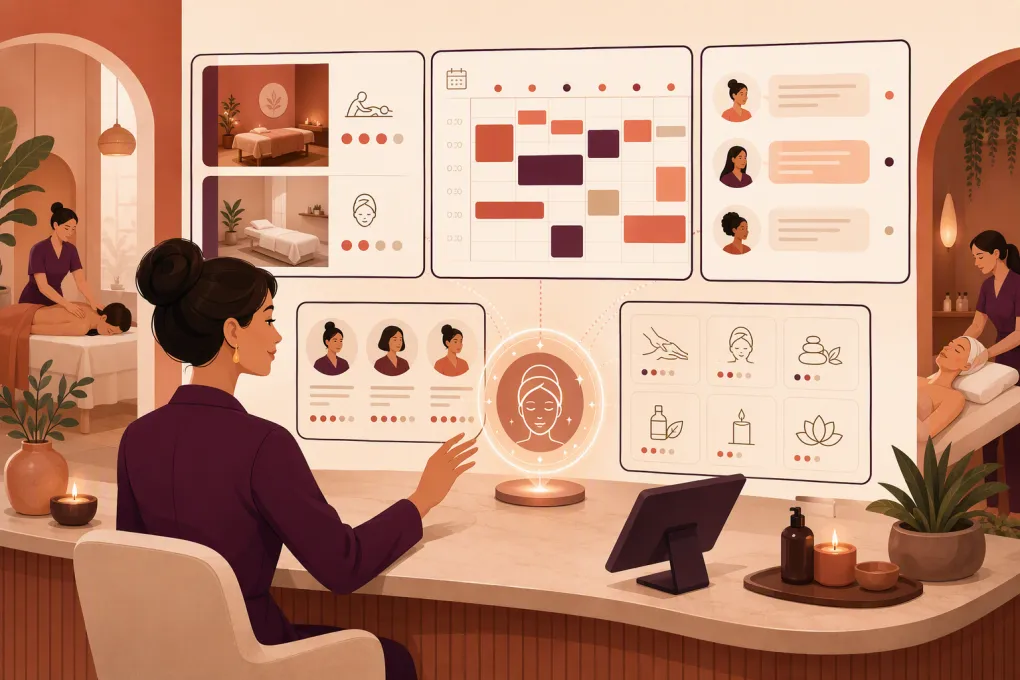
An AI receptionist for spa treatment room bookings has to do more than put a guest on a calendar. Every confirmed appointment may depend on the service, provider, room type, equipment, cleanup buffer, location and booking policy lining up at the same time.
That complexity is why a generic chatbot often falls short. It can answer basic questions, but it may not understand whether a couples massage needs a specific room, whether a facial requires dedicated equipment or whether a provider can perform the requested treatment.
The right AI receptionist handles the conversation while respecting the operational rules behind the calendar. It helps the guest choose, finds a valid opening, confirms the next step and knows when a staff member needs to take over.
See how Fitty can handle spa inquiries and booking conversations around the clock →
Why treatment room booking is a resource problem
A spa appointment usually involves several resources. Treating it as a simple provider calendar creates avoidable conflicts.
A valid booking might require:
- A provider qualified for the selected service
- A room configured for that treatment
- Specialized equipment or amenities
- Enough time for setup, sanitation and turnover
- A particular location in a multi-site operation
- Compliance with age, intake or preparation requirements
- A deposit, card authorization or prepaid package
Consider a guest requesting a hot stone massage. An available therapist does not necessarily mean the appointment can be booked. The spa also needs a compatible room, the required equipment and enough turnover time. The AI should search the combined availability rather than offering every gap on the therapist’s calendar.
This distinction matters because a booking that staff must later move is not successful automation. It transfers work to the front desk and damages the guest experience.
What an AI spa receptionist should actually handle
The AI should own repeatable booking conversations from inquiry through confirmation, without improvising around clinical or operational boundaries.
Identify the guest’s intent
Guests may contact a spa with a specific request or a broad outcome in mind. Common intents include:
- Booking a known treatment
- Asking which services are available
- Finding a same-day appointment
- Requesting a particular provider or gender preference
- Booking for two people
- Rescheduling or canceling
- Asking about packages, memberships or gift cards
- Checking preparation or arrival instructions
The AI should distinguish between providing approved service information and making a medical recommendation. If a guest asks whether a treatment is safe for a health condition, pregnancy or recent procedure, the conversation should be escalated according to the spa’s policy.
Collect only the information needed
A booking conversation should not feel like a lengthy intake form. Start with the minimum details required to search accurately:
- Desired service or service category
- Preferred date or time range
- Location, if applicable
- Provider preference, if any
- Whether the booking is for one person or multiple guests
Clinical intake, contraindication screening and consent may require a separate approved process. Avoid collecting sensitive health information in a general chat when it is not necessary for scheduling.
Offer valid appointment choices
The receptionist should return a short list of bookable options, not dump an entire day of availability into the conversation. Each option should already satisfy the spa’s configured provider, room, duration and buffer rules.
If the exact request is unavailable, useful alternatives include:
- Another time with the preferred provider
- The requested time with another qualified provider
- A nearby date at the same location
- Another location that can deliver the service
- A waitlist or staff follow-up
The AI should not silently substitute a different service. Guests need to understand what they are booking and what it costs before confirmation.
Complete the booking workflow
Depending on the spa’s policies, completion may involve:
- Confirming contact information
- Sharing the service duration and current price
- Collecting a deposit through a secure payment flow
- Applying an eligible package or membership benefit
- Obtaining acknowledgment of cancellation terms
- Sending confirmation and arrival instructions
Payment card details should be handled through an appropriate payment provider or hosted checkout rather than exposed in ordinary messages.
Build the scheduling rules before adding AI
AI cannot repair an inaccurate service menu or a calendar with inconsistent resource settings. Before allowing automated bookings, clean up the underlying operating rules.
Standardize the service catalog
For each treatment, document:
- Guest-facing service name
- Internal service code, if used
- Appointment duration
- Setup and cleanup buffers
- Eligible providers
- Eligible room types
- Required equipment
- Price and deposit policy
- Booking lead time
- Online booking eligibility
- Preparation and arrival instructions
Be careful with similar services that have different resource requirements. A standard facial and an equipment-based facial should not share identical booking rules merely because their durations match.
Map rooms as resources
Name rooms consistently and assign useful attributes. Instead of relying only on labels such as Room 1 or Room 2, record what each room supports.
Relevant attributes may include:
- Massage, facial, waxing or body-treatment use
- Couples capacity
- Accessible setup
- Shower or wet-room access
- Specialized tables or devices
- Location and floor
This allows the booking system to match the treatment to any compatible room without staff maintaining separate calendars manually.
Define escalation boundaries
Create explicit situations where the AI stops and routes the conversation to a person. Examples include:
- Questions involving medical suitability
- Requests outside published policies
- Group or event bookings
- Multiple services that cannot be sequenced automatically
- Complaints, refunds or disputed charges
- Accessibility needs requiring confirmation
- A guest who repeatedly rejects available alternatives
An effective AI receptionist is not one that answers everything. It is one that completes routine work and hands off exceptions with the conversation context intact.
Design the conversation around how guests actually book
Most guests do not communicate in clean database fields. They say things such as, “Do you have anything for a massage after work?” The AI must translate that request into structured booking criteria.
A practical conversation flow looks like this:
- Clarify the service. Ask whether the guest wants a particular massage or needs the approved service menu.
- Narrow the time window. Translate “after work” into a specific date and approximate range.
- Confirm preferences. Ask about location or provider only when those details affect the search.
- Search combined availability. Check the service, provider, room and buffer together.
- Present a few choices. Offer concise options with time, provider and price information.
- Confirm the policy. Surface deposit and cancellation terms before payment or final confirmation.
- Send the next step. Provide confirmation, intake instructions and arrival guidance.
The AI should retain context within the conversation. If the guest has already requested the downtown location, it should not ask for the location again.
Use automation beyond the initial booking
A spa loses operational value if the AI creates appointments but leaves every subsequent interaction to the front desk. The surrounding workflow matters just as much.
After-hours inquiries
Treatment research often happens when the spa is closed. An AI receptionist can respond immediately, answer approved questions and move a qualified guest toward an available appointment instead of leaving the inquiry in voicemail until the next shift.
Rescheduling and cancellations
Routine changes can be automated when the request fits policy. The system should verify the booking, show valid replacement times and apply the configured cancellation rules. Exceptions should go to staff rather than generating an unauthorized refund or fee waiver.
Follow-up and rebooking
Post-visit messages can provide approved aftercare information, request feedback or offer a path to rebook. Timing and content should vary by service. Avoid sending the same generic promotion after every treatment.
For SMS follow-up, maintain proper consent records, identify the business and honor opt-out requests. Automation does not remove the operator’s responsibility to follow applicable messaging rules.
Package and payment follow-up
When connected to the guest record, an AI agent can help answer questions about available packages, direct guests to approved payment steps and follow up on balances according to business policy. Staff should still control disputes, refunds and unusual account situations.
Measure whether the receptionist is helping operations
Do not judge the system only by how many conversations it handles. Review whether it creates accurate appointments and reduces manual cleanup.
Track operational measures such as:
- Inquiries that result in confirmed bookings
- Bookings completed outside staffed hours
- Conversations escalated to employees
- Room or provider conflicts created after automation
- Average staff response time for escalated cases
- Rescheduled and canceled appointments handled without staff
- Guests who abandon during service selection or payment
- Repeat questions the AI cannot answer
Audit conversation transcripts regularly. Look for incorrect service descriptions, unnecessary questions, poor alternatives and handoffs missing context. Update rules when services, providers, rooms or policies change.
A practical launch checklist
Start with a controlled set of common, low-complexity services rather than automating the entire menu at once.
Before launch:
- Clean up service names, durations and current pricing
- Assign qualified providers and compatible rooms
- Add setup and turnover buffers
- Publish deposit and cancellation rules
- Prepare approved answers to frequent questions
- Define medical, payment and complaint escalations
- Test single-service, couples and multi-location requests
- Test unavailable dates and provider preferences
- Verify confirmation, intake and reminder links
- Confirm that staff can see the full handoff context
Run test conversations using vague requests, misspelled service names and changing preferences. A guest may begin with a facial, switch locations and then ask for a Saturday afternoon. The workflow needs to remain accurate through the whole exchange.
The goal is not to remove people from spa hospitality. It is to prevent skilled employees from spending their shifts repeatedly checking calendars, answering basic availability questions and copying details between systems. With reliable resource rules and disciplined escalation, an AI receptionist gives guests a faster route to a valid booking while keeping staff available for the moments that require judgment.
Frequently asked questions
Can an AI receptionist book both a provider and a treatment room?
Yes, if the booking system supports resource-based scheduling and the provider, room, service duration and buffers are configured correctly. The AI should only offer times when every required resource is available.
Can an AI receptionist handle couples spa bookings?
It can when the system can coordinate two qualified providers, a compatible couples room and matching availability. Complex packages or special requests may still require staff review.
Should a spa AI answer questions about treatment safety?
It can share approved general information, but it should not diagnose conditions or make medical suitability decisions. Pregnancy, contraindication and post-procedure questions should follow the spa's escalation policy.
Does an AI spa receptionist replace front-desk employees?
It is better used to absorb repetitive inquiries, booking changes and follow-up. Employees remain important for exceptions, guest recovery, complex packages and situations requiring professional judgment.
What should a spa configure before enabling AI booking?
Start with accurate services, durations, prices, provider qualifications, room compatibility, buffers, policies and escalation rules. Automated booking will only be as reliable as this underlying data.
Keep reading

Run your gym on autopilot with WTF Go
Fitty — your AI receptionist — answers calls and DMs, fills classes, follows up with every lead, and collects dues while you coach.