AI & Automation
AI Receptionist for Spa Party Bookings: Operator's Guide
See how an AI receptionist for spa party bookings can qualify groups, coordinate packages, collect deposits, and keep every event inquiry moving forward.
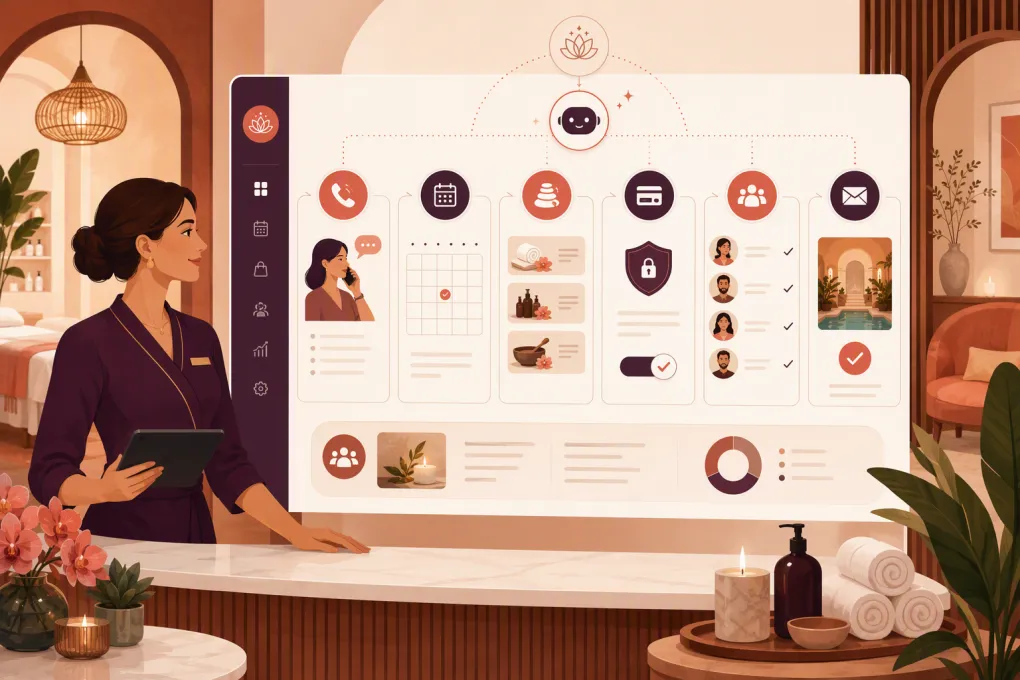 Watch · 20s
A spa party inquiry is rarely a simple appointment request. One person may be coordinating six guests, multiple services, a preferred date, dietary requests, accessibility needs and a budget—all before anyone is ready to pay.
If that inquiry arrives during a treatment, after closing or while the front desk is helping another guest, the conversation stalls. Staff return the call later, ask for missing details, check availability and wait for another response. Every round of phone tag gives the organizer more time to contact another spa.
An AI receptionist for spa party bookings can keep the inquiry moving without pretending every group event is a one-click reservation. The right setup gathers the facts, explains approved options, initiates the correct booking workflow and brings in a person when judgment is required.
Why spa party inquiries create front-desk bottlenecks
Individual bookings usually have a clear structure: one guest, one or more services and a defined appointment time. Parties introduce operational dependencies:
- The number of guests may change.
- Guests may want different treatments or simultaneous services.
- Staffing and room capacity can limit availability.
- Packages may have minimums, exclusions or fixed time windows.
- A deposit or signed agreement may be required.
- The organizer may not yet have every guest’s information.
- Food, alcohol, decorations or private-space requests may require approval.
A generic chatbot often fails here because it treats the request like a standard FAQ. A useful AI receptionist must recognize the event as a multi-step sales and operations workflow.
See how Fitty can keep after-hours spa party inquiries moving →
What an AI receptionist should handle
The goal is not to remove your event coordinator. It is to stop that coordinator from spending time on repetitive intake, reminders and status checks.
Respond immediately and identify the request
The receptionist should recognize phrases such as bridal party, birthday spa day, corporate wellness event, girls’ day or group booking. It can then switch from an individual appointment flow to a party-specific intake.
The first response should acknowledge the request and ask only the questions needed to determine the next step. Do not present a long form disguised as a conversation.
Qualify the party progressively
Start with the details that affect feasibility:
- Preferred date and an acceptable alternate date
- Approximate arrival or completion window
- Estimated guest count
- Desired services or package type
- Organizer’s name, phone number and email
- Any deadline for making a decision
Collect secondary details—guest names, service selections and special requests—after confirming that the event is viable. Progressive intake reduces friction while still giving staff enough information to evaluate the opportunity.
Answer from approved information
Your AI receptionist should use a controlled knowledge base containing current package descriptions, minimum group sizes, booking lead times, cancellation terms, gratuity policies and amenity rules.
It should never invent an answer when a policy is unclear. If a guest asks whether outside catering, alcohol, decorations or facility exclusivity is allowed, the receptionist should provide the approved policy or flag the question for staff.
Follow up without relying on staff memory
Many organizers are comparing dates, collecting preferences and waiting for friends to respond. Automated follow-up can remind them to:
- Confirm the estimated headcount
- Select a package
- Complete an agreement
- Pay through a secure link
- Submit the guest roster
- Finish required intake or waiver forms
Each message should reflect the booking’s actual status. Someone who has paid should not receive another deposit reminder, and someone awaiting staff approval should not be told the event is confirmed.
Build a spa party booking workflow that cannot overbook
Automation is only helpful when booking states are explicit. Define the stages in your system before letting an AI receptionist act on them.
A practical pipeline might include:
- New inquiry: Contact details exist, but feasibility has not been checked.
- Qualified: Date, estimated headcount and service preferences are known.
- Availability review: Staff, rooms or equipment still need verification.
- Tentative hold: Capacity is reserved temporarily under your written policy.
- Awaiting agreement or payment: The organizer has received the required secure links.
- Confirmed: Your stated confirmation requirements have been completed.
- Guest details pending: The event is confirmed, but individual selections or forms remain incomplete.
- Completed, canceled or lost: The final outcome is recorded for reporting and follow-up.
The AI should understand what it may do at each stage. For example, it may offer available consultation times or send a payment link, but only your booking rules should determine whether a party is confirmed.
Separate availability from capacity
An open room on the calendar does not necessarily mean you can serve a group. Capacity may depend on provider schedules, service durations, treatment-room types, turnover time and whether services must happen simultaneously.
Document these constraints in operational rules. If your systems cannot calculate group capacity reliably, have the AI collect the request and route it for review instead of promising the slot.
Define holds and payment clearly
If you use tentative holds, specify:
- Who can create a hold
- How long it lasts
- What the organizer must complete
- When the hold is released
- Whether payment is refundable or transferable
Payment card details should never be collected in an ordinary text or chat conversation. Send guests to a secure, hosted payment page provided by your payment processor or booking platform.
Write conversations for organizers, not database fields
A rigid sequence of questions makes the organizer do all the work. A better conversation explains why information is needed and offers a clear next step.
For example, the opening flow can:
- Acknowledge that the guest is planning a group visit.
- Ask for the preferred date, alternate date and approximate group size.
- Ask whether guests want the same package or individual services.
- Summarize what was captured.
- Explain whether availability can be checked automatically or requires staff review.
- Set an expectation for the next message.
Keep package explanations concise, then link to full details. If there are three relevant options, show those three—not the entire service menu.
The AI should also preserve context. An organizer who already provided a headcount should not have to repeat it when the conversation moves from web chat to text or from AI to a staff member.
Decide exactly when a human takes over
Complex requests need an escalation path. Create clear handoff triggers instead of asking the AI to improvise.
Route the conversation to staff when:
- The requested group exceeds defined capacity.
- The guest requests custom pricing or package changes.
- Availability depends on manual staff coordination.
- There is a complaint, refund request or payment dispute.
- The guest mentions an allergy, medical concern or contraindication.
- The request involves accessibility accommodations that require confirmation.
- The organizer wants alcohol, catering, decorations or private access outside your standard policy.
- The AI cannot answer confidently from approved information.
A good handoff includes the organizer’s contact information, requested dates, headcount, preferences, unresolved questions and conversation history. Staff should receive a usable summary rather than a notification that simply says a lead needs help.
Protect consent, payments and sensitive information
Spa conversations can cross into health and payment information. Keep those boundaries explicit.
- Use secure forms for health history, contraindications and signed waivers.
- Do not ask guests to send card numbers through ordinary chat or SMS.
- Confirm what data your AI, messaging and booking vendors store.
- Limit staff access according to role.
- Publish retention and deletion practices.
- Obtain appropriate consent for automated texts and provide a clear opt-out method.
- Review call-recording and communication-consent requirements in the states where you operate.
Do not assume that a product described as AI-enabled is automatically suitable for regulated or sensitive information. Review vendor agreements and security documentation based on the data your spa actually handles.
Measure whether the workflow helps
Avoid judging the system by conversation volume alone. Track the operational outcome of each inquiry:
- Time from inquiry to first response
- Percentage of inquiries with complete qualification details
- Qualified inquiry-to-confirmed booking conversion
- Time spent in each booking stage
- Number of manual follow-ups per party
- Deposit or agreement completion status
- Cancellation and no-show reasons
- Lost-booking reasons
- Handoff volume and unresolved-question categories
Review transcripts and handoffs regularly. Repeated questions usually point to an unclear package, missing policy or workflow gap. Update the source information rather than expecting the AI to work around bad inputs.
A practical rollout checklist
Start with one well-defined party type or location before automating every group request.
- Document your packages, limits, policies and escalation rules.
- Map the booking stages and assign an owner to each stage.
- Identify which actions can happen automatically and which need approval.
- Create secure payment, agreement and guest-intake links.
- Test normal requests, incomplete requests and unusual edge cases.
- Confirm that staff receive the full conversation context on handoff.
- Review early conversations and correct unclear answers quickly.
- Expand automation only after the booking status remains accurate across systems.
Fitty, WTF Go’s AI receptionist and agent, is built to answer leads, follow up and keep revenue-related conversations active around the clock. For party bookings, that means fewer inquiries sitting untouched while your team is in treatment rooms—and a structured path from initial question to staff review or confirmed next step.
See how Fitty fits your spa party booking process →
The best AI receptionist does not make group bookings feel robotic. It makes the process feel organized: prompt answers, fewer repeated questions, accurate expectations and a clear path to confirmation.
Frequently asked questions
Can an AI receptionist fully book a spa party?
It can handle qualification, approved package information, follow-up and defined booking steps. Complex capacity, custom pricing or special requests should be routed to staff before confirmation.
What information should the AI collect first?
Start with preferred and alternate dates, approximate guest count, timing, service preferences and the organizer's contact details. Collect individual guest selections and forms later.
Can an AI receptionist collect spa party deposits?
It can direct the organizer to an approved secure payment link and track the workflow status. Card details should not be requested through ordinary chat or text messages.
How should the AI handle medical questions or allergies?
It should avoid diagnosing or approving treatment, direct guests to secure intake processes and escalate medical concerns or contraindications to qualified staff.
Keep reading

Run your gym on autopilot with WTF Go
Fitty — your AI receptionist — answers calls and DMs, fills classes, follows up with every lead, and collects dues while you coach.