AI & Automation
AI Receptionist for Spa Missed Calls: Capture More Leads
Learn how an AI receptionist for spa missed calls can answer inquiries, qualify leads, book appointments, and follow up without adding front-desk work.
 Watch · 20s
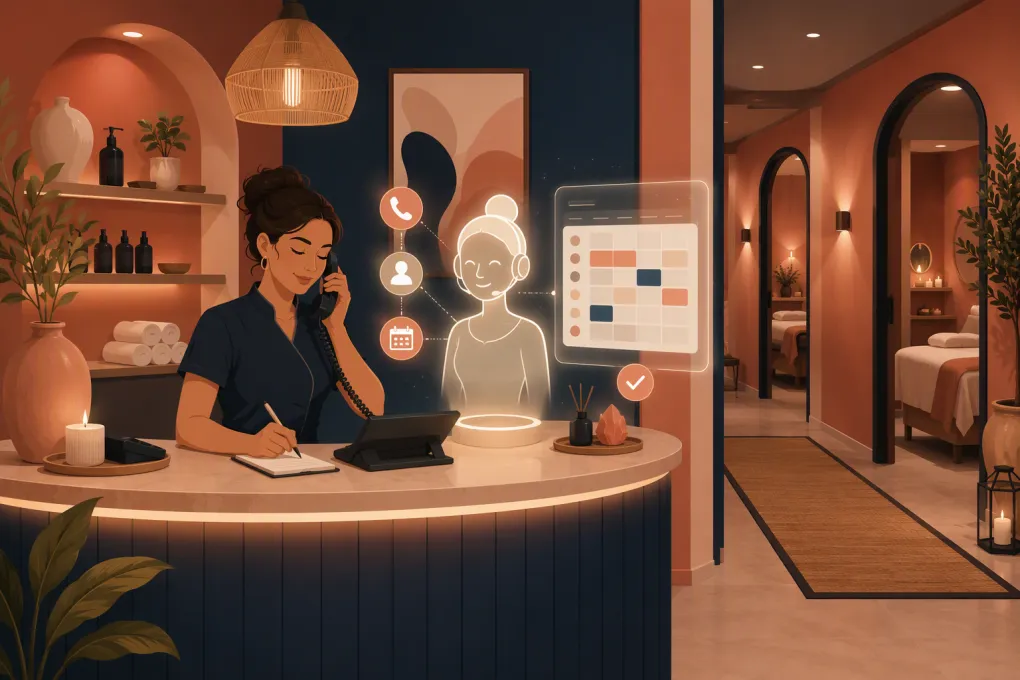
A missed spa call is rarely just a missed conversation. It may be a new client asking about a facial, a regular trying to reschedule, a gift-card buyer ready to spend, or someone comparing availability across several local spas.
Your front desk cannot answer every call while checking in clients, supporting providers, handling retail sales, and managing the schedule. Sending callers to voicemail protects the immediate client experience, but it also creates another queue that someone has to work later.
An AI receptionist for spa missed calls closes that gap. It can answer routine questions, identify what the caller needs, guide qualified leads toward the right service, and complete or initiate booking without forcing the front desk to abandon the client standing in front of them.
The objective is not to remove your team from client service. It is to stop making them choose between the client in the building and the potential client on the phone.
See how Fitty handles spa inquiries and booking conversations 24/7 →
What actually happens after a spa misses a call
Most spas already have a fallback process: voicemail, caller ID, an email notification, or a task for the next available employee. The weakness is not effort. It is that the process depends on a busy person noticing the call, finding context, and calling back when the lead is still available.
Common failure points include:
- The voicemail does not explain which service the caller wants.
- The return call arrives while the prospect is working or unavailable.
- The employee has to leave another voicemail.
- The caller has already booked with another spa.
- An existing client calls again, creating duplicate work.
- After-hours calls remain untouched until the next business day.
- Staff answer questions but forget to capture contact details or create a follow-up task.
A basic missed-call text can help, but it usually moves the burden to another channel. If the message only says, “Sorry we missed you,” the client still has to wait for a person.
A useful AI receptionist continues the conversation instead of merely acknowledging it.
What an AI receptionist should do with spa calls
The right system needs more than a pleasant voice. It should reliably complete a defined set of operational jobs.
Identify the reason for the call
The first step is routing the caller into a clear intent, such as:
- New appointment inquiry
- Existing appointment change
- Service or pricing question
- Membership or package question
- Gift card inquiry
- Provider preference
- Group or event request
- Complaint or manager request
- Medical, safety, or post-treatment concern
- Vendor or unrelated call
This matters because not every conversation should follow the same script. A new-client facial inquiry should move toward qualification and booking. A reaction after a treatment should be escalated according to your safety policy, not handled like a sales lead.
Answer approved questions accurately
Your AI receptionist should use information controlled by the business, including:
- Service descriptions and duration
- Published pricing or approved price ranges
- Hours and location details
- Parking and arrival instructions
- Cancellation and rescheduling policies
- Membership basics
- Age restrictions
- Preparation and aftercare instructions approved by management
- Accepted payment methods
Do not let an AI invent answers when information is missing. The correct response is to acknowledge the limitation and transfer, take a message, or create a follow-up task.
Qualify without turning the call into an interrogation
For a new lead, capture only what is needed to recommend the next step:
- Desired service or outcome
- New or returning client status
- Preferred location, if applicable
- Preferred day or time window
- Provider preference, if relevant
- Contact information
- Any booking prerequisite your spa has formally approved
Avoid open-ended medical screening through a general receptionist workflow. If a service requires clinical review, consultation, consent, or provider approval, route the caller into that process.
Connect the conversation to real availability
A receptionist is only useful if it works from the current schedule. It should respect service duration, room and equipment requirements, provider eligibility, buffers, location, and booking restrictions.
If direct booking is not appropriate, the AI can still offer a consultation, capture preferred times, or create a structured task for the team. That is better than a free-form voicemail with no service or scheduling context.
A practical call flow for missed and after-hours calls
Start with a narrow workflow before attempting to automate every phone scenario.
1. Open clearly
Use the spa name, set expectations, and provide any AI disclosure required by your policies or applicable law. For example:
“Thanks for calling [Spa Name]. I’m the virtual receptionist. I can help with services, availability, and booking. What can I help you with?”
Do not pretend the caller is speaking with a human.
2. Confirm the caller’s intent
Let the caller explain the need naturally, then confirm it: “You’re looking to book a massage at our downtown location. Is that right?”
This gives the caller a chance to correct service or location assumptions before the system touches the calendar.
3. Collect the minimum required details
Ask for contact and booking information one field at a time. Repeat critical details such as phone number, date, location, and selected service.
4. Offer a concrete next step
Depending on your setup, that may be:
- Book an available appointment
- Send a secure booking link
- Schedule a consultation
- Add the lead to a callback queue
- Transfer to an on-call employee
- Record a structured message for the appropriate manager
5. Confirm and follow up
The final message should state exactly what happened. If an appointment was booked, confirm the service, date, time, location, and relevant policy. If follow-up is required, explain who will respond and through which channel without promising an unrealistic response time.
How to set up the system without creating new problems
Automation amplifies whatever process you give it. Before turning it on, clean up the source information and define ownership.
Build one approved knowledge base
Create a single operational reference for service names, prices, durations, locations, policies, provider rules, and common questions. Assign one person to approve changes.
If the website says one thing, the booking software says another, and the front-desk document says something else, the AI cannot reliably choose the correct answer.
Define hard escalation rules
List the calls that must go to a person. Typical examples include:
- Adverse reactions or safety concerns
- Requests for diagnosis or medical advice
- Refunds, charge disputes, or serious complaints
- Accessibility needs requiring confirmation
- Minors and services with special consent requirements
- Bridal parties, corporate events, or large group bookings
- Media, legal, or law-enforcement inquiries
Also decide what happens when no employee is available. A structured priority task with the transcript and caller details is more actionable than a generic voicemail alert.
Test real-world scenarios
Before launch, have employees call as different types of clients. Test:
- A first-time caller who does not know which service to choose
- A returning client using a different phone number
- A caller who changes dates midway through booking
- A fully booked day
- Two services requiring different providers or rooms
- A cancellation-policy question
- A complaint
- A medical question the system should decline to answer
- A caller asking for a human
- Background noise, an accent, or an interrupted call
Check what appears in the client record and calendar, not just whether the conversation sounds good.
Roll out in stages
A sensible first phase is after-hours calls and calls the team cannot answer. Review transcripts, booking outcomes, escalations, and incorrect responses. Expand the scope only after the workflow is stable.
Privacy, consent, and payment guardrails
Spa calls can contain sensitive personal information. Your workflow should minimize what is collected and control where it is stored.
Review applicable requirements with qualified legal and compliance professionals, especially if your spa provides medical services or operates across multiple states. Relevant considerations may include call-recording consent, automated text-message consent, marketing opt-outs, health-information handling, retention policies, and AI disclosure requirements.
For payments, use a secure payment workflow and established processor rather than asking callers to leave complete card details in a recording or free-text message. Limit employee access to transcripts and client records according to job responsibilities.
An AI receptionist should also separate operational messages from marketing. An appointment confirmation is not automatically permission to send ongoing promotional texts.
How to measure whether it is working
Do not judge the system only by the number of calls answered. Review whether calls reach a useful and accurate outcome.
Track:
- Total calls handled after hours or when staff were unavailable
- New leads identified
- Appointments booked or booking links completed
- Qualified callback tasks created
- Transfers and escalations
- Calls abandoned before resolution
- Incorrect answers or booking errors
- Duplicate client records
- Reschedules, cancellations, and no-shows tied to the workflow
- Opt-outs, complaints, and requests for a human
Listen to a sample of successful and unsuccessful conversations. The failed calls often reveal a missing policy, confusing service name, calendar restriction, or escalation gap that can be fixed.
Choosing an AI receptionist for your spa
Ask vendors to demonstrate your actual scenarios rather than a generic demo. Give them a service menu and request a live test involving multiple locations, provider preferences, an unavailable time, a policy question, and a human handoff.
Evaluate whether the system can:
- Work with your booking and customer records
- Use business-approved information
- Recognize new versus existing clients
- Preserve context during transfers and follow-up
- Respect location, provider, and resource rules
- Provide usable call summaries or transcripts
- Escalate safely
- Support consent and access controls
- Show outcomes your managers can review
Also calculate the operational burden. A low-cost tool that creates duplicate records, vague tasks, or constant corrections may simply move work from the phone to the cleanup queue.
WTF Go is designed as an operating system for gyms, studios, spas, and wellness businesses. Fitty, its AI receptionist and agent, handles lead conversations, booking workflows, follow-up, and dues collection so customer communication does not live in a disconnected pile of calls and messages.
Explore WTF Go and see how Fitty fits into your spa’s lead-to-booking workflow →
The goal is a completed next step
A missed-call strategy should not stop at answering more calls. It should move each caller toward the correct outcome: a booking, a consultation, an informed handoff, or a clearly assigned follow-up.
Keep the first workflow focused, give the AI approved information, establish strict escalation rules, and review actual conversations. Done well, an AI receptionist gives your front desk room to serve the client in front of them without leaving the next client waiting in voicemail.
Frequently asked questions
Can an AI receptionist book spa appointments directly?
It can when connected to an appropriate booking workflow and configured with accurate service, provider, room, location, and availability rules. Complex or restricted services may still require a consultation or employee approval.
Is an AI receptionist better than a missed-call text back?
A text back acknowledges the call, while an AI receptionist can continue the conversation, answer approved questions, qualify the lead, and guide the caller toward booking or escalation.
Should a spa disclose that callers are speaking with AI?
Clear disclosure is a sound operating practice, and specific requirements may vary by jurisdiction. Spas should review AI, call-recording, and communications rules with qualified counsel.
Can an AI receptionist handle medical spa calls?
It can handle approved administrative tasks, but it should not diagnose conditions or provide unapproved medical advice. Clinical questions, adverse reactions, and restricted-service decisions should be escalated to qualified staff.
Will an AI receptionist replace spa front-desk employees?
The stronger use case is handling routine, missed, and after-hours conversations so employees can focus on in-person clients, exceptions, complaints, and higher-touch service.
Keep reading
Run your gym on autopilot with WTF Go
Fitty — your AI receptionist — answers calls and DMs, fills classes, follows up with every lead, and collects dues while you coach.