AI & Automation
How an AI Receptionist for Spa Appointment Bookings Works
Learn how an AI receptionist for spa appointment bookings handles calls, answers service questions, fills calendars, and reduces daily front-desk workload.
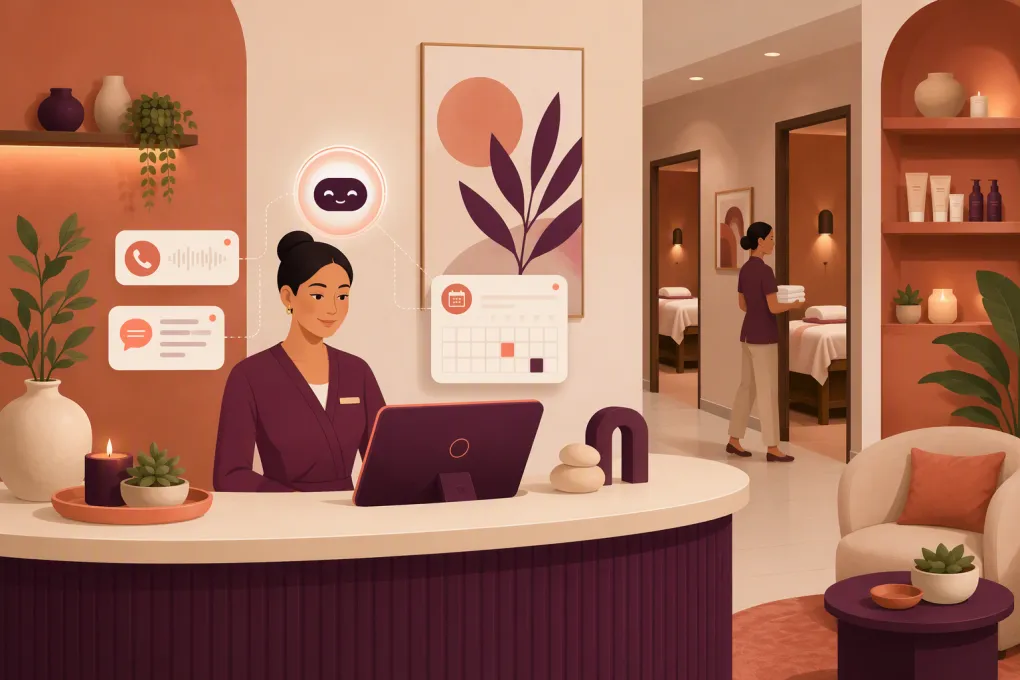 Watch · 20s
Every unanswered call to a spa has a short shelf life. A prospective client may be ready to book a massage, facial, or package, but if the front desk is helping someone else, the caller can move to the next spa before anyone returns the voicemail.
An AI receptionist for spa appointment bookings closes that gap. It can respond to calls and messages, explain services, gather booking details, offer eligible appointment times, follow up with undecided prospects, and route sensitive or unusual requests to a person.
The value is not replacing hospitality. It is making sure hospitality does not disappear when the phone rings during a treatment, after closing, or while the front desk is handling check-ins.
See how Fitty can handle spa booking conversations around the clock →
What an AI spa receptionist actually does
A useful AI receptionist is more than a recorded menu or a basic website chatbot. It should hold a two-way conversation and move the client toward a defined outcome.
For appointment bookings, that usually includes:
- Answering common questions about services, duration, preparation, and general policies
- Identifying whether the client wants a massage, facial, body treatment, consultation, or other service
- Asking for relevant preferences, such as therapist gender or treatment type
- Checking availability based on configured booking rules
- Booking, rescheduling, or canceling eligible appointments
- Collecting contact information and required booking details
- Explaining deposits, cancellation policies, and arrival instructions
- Following up when a prospect asks a question but does not book
- Escalating requests that require staff judgment
The receptionist may work through phone, text, web chat, or a combination of channels. The exact capabilities depend on how it connects to the spa’s scheduling, payment, and customer management systems.
Why spa appointment booking is harder than calendar access
Giving AI access to open time slots is not enough. Spa scheduling involves dependencies that a simple calendar tool may miss.
Services require the right provider
Not every esthetician or massage therapist performs every service. Some treatments require certifications, specialized training, or specific equipment. The AI must only offer appointments with eligible providers.
Rooms and equipment can limit capacity
A provider may appear available while the required treatment room, device, or table is already in use. Resource availability needs to be part of the booking logic when it affects capacity.
Add-ons change appointment length
An enhancement may add treatment or cleanup time. If the system treats every add-on as a simple line item, it can create overlaps and rushed room turnover.
New and returning clients may follow different rules
A new client may need an intake form, consultation, patch test, or additional arrival time. A returning client may be able to book immediately. Medical spa services can require even stricter workflows.
Client preferences affect conversion
Some guests want a particular provider, a couples appointment, adjacent services, or a specific time window. A good AI receptionist asks clarifying questions instead of forcing the client through an inflexible booking tree.
The booking rules to define before going live
AI performs best when it is given clear operating rules. If your staff regularly makes exceptions without documenting them, automation will expose that ambiguity.
Build a booking playbook that covers the following areas.
Service rules
For every service, document:
- Public service name and common alternative names
- Plain-language description
- Appointment duration and required turnaround time
- Eligible providers, rooms, and equipment
- Available add-ons
- New-client restrictions
- Contraindications that require human review
- Required consultation, intake, or preparation
- Whether the service can be booked directly
The AI should explain services without diagnosing conditions or making clinical promises. Requests involving pain, adverse reactions, pregnancy concerns, medications, or suitability for a medical treatment should follow an approved escalation path.
Scheduling rules
Define how the receptionist should handle:
- Same-day appointments
- Minimum and maximum advance booking windows
- Provider requests
- Couples or group bookings
- Back-to-back services
- Waitlists
- Late arrivals
- Rescheduling and cancellations
- No-show restrictions
- Appointment buffers
Be explicit about which rules are firm and which can be reviewed by staff.
Payment and policy rules
The AI should state your current policy accurately rather than improvise. Give it approved language for deposits, cancellation windows, memberships, packages, gift cards, gratuities, refunds, and expired credits.
If payment collection is supported in your workflow, use a secure payment process rather than asking clients to send card details in an ordinary message.
Explore how WTF Go combines booking conversations, follow-up, and payment workflows →
A practical AI booking conversation
A strong conversation is short enough to keep the client’s attention but thorough enough to prevent a bad booking.
A typical flow might look like this:
- Identify intent. Is the person trying to book, change an appointment, compare services, or ask a policy question?
- Clarify the service. Ask one useful question at a time. For example, determine whether the client wants relaxation, skin care, or consultation guidance without making a medical assessment.
- Check eligibility. Confirm any required consultation, new-client limitation, or provider restriction.
- Gather preferences. Ask about date range, time of day, location, and provider preference.
- Offer valid options. Present a small set of bookable times rather than dumping the entire calendar into the conversation.
- Confirm the details. Repeat the service, provider, location, date, start time, duration, and applicable policy.
- Complete the booking. Capture the required contact information, deposit, or intake step.
- Send instructions. Provide a confirmation and relevant arrival or preparation information.
- Schedule follow-up. If the client does not complete the booking, follow up without repeatedly messaging someone who has opted out.
That final step matters. Many prospects are not rejecting the service; they are interrupted, uncertain about timing, or waiting to confirm with someone else. A defined follow-up sequence gives the spa another chance to help without relying on a receptionist’s memory.
Where humans should stay in the loop
Automation should handle repeatable work, not every possible situation. Define immediate handoff triggers for:
- Complaints, refund disputes, or threatened chargebacks
- Possible adverse reactions or medical concerns
- Accessibility requests that need coordination
- Bridal parties, corporate events, and complex group bookings
- High-value custom packages
- Requests for exceptions to cancellation or deposit policies
- Clients who repeatedly ask for a person
- Any conversation the AI cannot interpret confidently
The handoff should include a concise summary, client contact details, requested service, preferred timing, and the unresolved question. Making the client repeat the full conversation defeats much of the benefit.
During business hours, route urgent cases to an assigned employee. After hours, set an accurate expectation for when a person will respond. Never claim that a staff member is immediately available when nobody is monitoring the escalation.
How to implement an AI receptionist without disrupting the spa
Start with a controlled scope rather than automating every service on day one.
1. Review recent inquiries
Look at calls, messages, emails, and front-desk notes. Group them by intent: new booking, rescheduling, service questions, pricing, policies, directions, gift cards, memberships, and complaints. This shows what the AI must handle first.
2. Clean up service and staff data
Remove outdated service names, duplicate appointment types, incorrect durations, and former team members. Confirm provider eligibility and room requirements. Automation cannot compensate for an unreliable source calendar.
3. Launch with predictable services
Choose services with straightforward durations and eligibility rules. Keep complex treatment plans, large groups, and exception-heavy appointments under human control until the core workflow is stable.
4. Test real scenarios
Do not test only the ideal booking. Try misspelled service names, vague requests, fully booked days, provider changes, late-night inquiries, cancellations, add-ons, and clients who change their mind midway through the conversation.
5. Review transcripts and outcomes
Check whether the AI understood the request, offered valid times, stated policies correctly, and completed or escalated the conversation. Update the underlying rules instead of patching one response at a time.
6. Expand gradually
Once the initial services are reliable, add more appointment types, locations, follow-up sequences, and payment workflows. Multi-location spas should test location-specific staff, hours, inventory constraints, policies, and directions separately.
Privacy and compliance considerations
Collect only the information needed to complete the workflow. Restrict employee access, use appropriate account permissions, and establish retention rules for calls, messages, and transcripts.
Medical spas need additional care. Depending on the business structure, services, and information being handled, health privacy requirements may apply. Confirm obligations with qualified legal or compliance counsel, review vendor agreements, and avoid placing sensitive health information into tools that are not approved for that use.
AI should also identify itself honestly. Clients should know when they are interacting with an automated receptionist and have a clear way to reach a person.
How to measure whether it is working
Track operational outcomes, not just the number of conversations. Useful measures include:
- Answered versus missed inquiries
- Booking completion by channel and service
- Time from inquiry to first response
- Escalation volume and reasons
- Invalid or corrected bookings
- Follow-up responses
- Cancellations and reschedules handled without staff intervention
- Staff time spent correcting automation errors
- Opt-outs and communication complaints
Review these by location, service, and time of day. A high conversation count means little if the AI books the wrong provider or creates extra cleanup work.
What Fitty brings to spa booking operations
Fitty, WTF Go’s AI receptionist and agent, is designed to keep lead and client conversations moving when staff cannot respond immediately. It can answer inquiries, support booking workflows, follow up with prospects, and help collect amounts due based on the business’s configured process.
The larger advantage is operational continuity. The conversation, follow-up, scheduling, and customer record can live within one operating system instead of being split across a phone service, chatbot, spreadsheet, and disconnected reminder tool.
That does not remove the need for good policies or trained staff. It gives those policies a consistent front line and gives the team more time for the in-person experience clients actually came to receive.
See how Fitty can support your spa’s appointment and follow-up workflow →
Frequently asked questions
Can an AI receptionist book spa appointments after hours?
Yes, if it has access to current availability and the spa's booking rules. It should offer only eligible services, providers, rooms, and times.
Can an AI receptionist handle cancellations and rescheduling?
It can handle routine changes when they fall within configured policies. Exceptions involving fees, disputes, or restricted clients should be sent to staff.
Will an AI receptionist replace spa front-desk staff?
It is better used to cover repetitive inquiries, overflow, and after-hours demand. Staff remain essential for complex requests, exceptions, complaints, and the in-person guest experience.
Is an AI receptionist appropriate for a medical spa?
It can support administrative workflows, but medical spas must evaluate privacy, consent, vendor agreements, and applicable health information requirements before sharing sensitive data.
What should a spa prepare before adding AI booking?
Clean service data, provider eligibility, room constraints, appointment durations, deposit rules, cancellation policies, escalation triggers, and approved answers to common questions.
Keep reading
Run your gym on autopilot with WTF Go
Fitty — your AI receptionist — answers calls and DMs, fills classes, follows up with every lead, and collects dues while you coach.