AI & Automation
AI Receptionist for Skin Care Clinics: Operator’s Guide
Learn how an AI receptionist for skin care clinics can answer leads, book appointments, follow up, and protect the client experience around the clock.
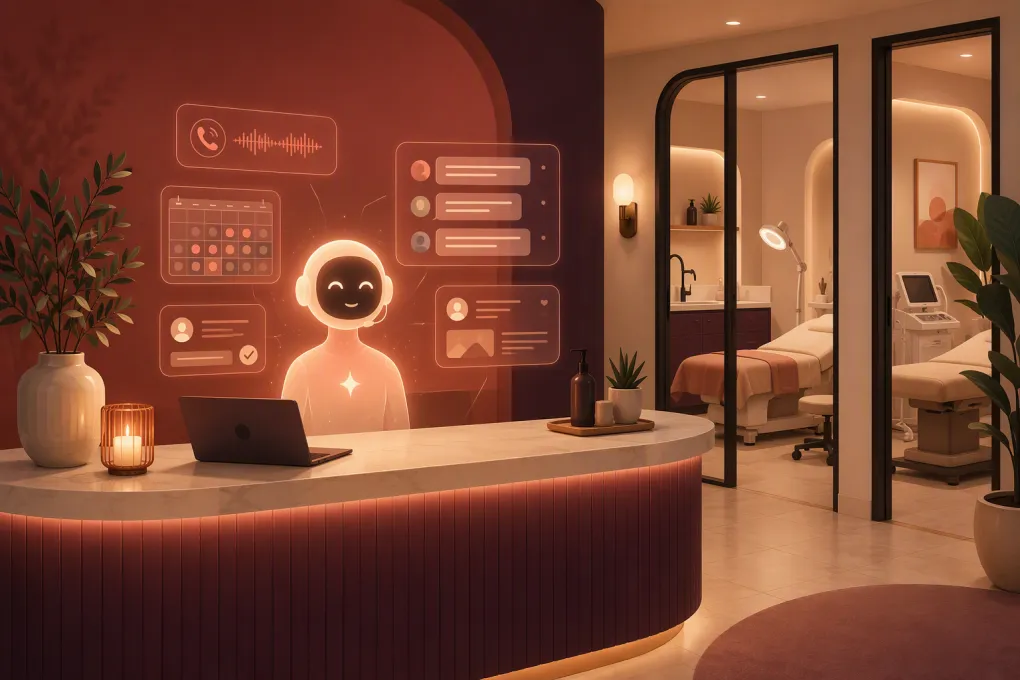 Watch · 20s
A prospective client rarely waits patiently for a skin care clinic to call back. They contact the next provider, book through whichever link works, or lose interest entirely. Meanwhile, your front desk is checking in clients, answering treatment questions, managing providers and trying to keep the schedule intact.
An AI receptionist gives clinics another layer of coverage. It can respond to common inquiries, capture lead details, book appropriate appointments, follow up and handle routine account conversations. The goal is not to remove human hospitality. It is to keep repetitive communication from overwhelming the people responsible for delivering it.
For skin care clinic owners, the key question is not whether AI can answer a phone. It is whether the system can follow your booking rules, respect clinical boundaries and hand the right conversations to a qualified person.
See how Fitty handles skin care inquiries and bookings after hours →
What an AI receptionist should handle
A useful AI receptionist works across the stages between initial interest and an attended appointment. It should do more than take a message.
Answer routine questions immediately
Most clinics receive variations of the same questions:
- What services do you offer?
- Do I need a consultation first?
- How long does the appointment take?
- Where are you located?
- What should I do before my appointment?
- Can I reschedule?
- Do you offer memberships or packages?
The AI should answer from clinic-approved information rather than improvising. Service descriptions, operating hours, parking instructions, cancellation terms and preparation guidance should all come from a maintained knowledge base.
Questions requiring clinical judgment must be escalated. An AI receptionist should not decide whether a treatment is medically appropriate, diagnose a skin concern or promise a specific outcome.
Capture and qualify new leads
A name and phone number are not enough to route every inquiry correctly. Depending on your services, the receptionist may need to identify:
- The service or concern the person is asking about
- Whether they are a new or existing client
- Whether a consultation is required
- Preferred location, provider or appointment window
- How they heard about the clinic
- Whether they want a call from a licensed professional
Keep qualification short. Prospects should not have to complete a lengthy interview before seeing availability. Collect only what is needed to determine the next step, then move them toward booking.
Book within clinic rules
Appointment booking is where generic answering services often break down. Skin care clinics may have provider-specific services, room or equipment constraints, consultation requirements and different durations for new versus returning clients.
Your AI receptionist needs rules for:
- Which providers can perform each service
- Whether new clients must begin with a consultation
- Appointment duration and cleanup buffers
- Equipment or treatment-room availability
- Age or consent restrictions
- Deposits, cards on file and cancellation policies
- Services that cannot be booked automatically
If the system cannot confidently satisfy the rules, it should create a clear task for staff instead of forcing an incorrect booking.
Follow up without relying on staff memory
Many leads require more than one response. Someone may ask about a facial during lunch, open the booking link later and forget to finish.
An AI receptionist can continue the conversation with approved follow-up sequences. A practical sequence might include an immediate response, a later reminder and a final check-in that gives the lead an easy way to stop messages or ask for a person.
Follow-up should change once the prospect books, declines or opts out. Continuing to send sales messages after an appointment is scheduled makes the automation feel careless.
Support payments and memberships
For clinics with recurring memberships, unpaid dues can create awkward front-desk conversations. Automation can notify members, provide an approved payment path and escalate unresolved accounts.
Fitty is designed to answer leads, book appointments, follow up and collect dues within the broader WTF Go operating system. That gives operators one workflow instead of separate tools for initial inquiries and ongoing member communication.
See how Fitty connects lead response, booking and dues follow-up →
Where humans must stay involved
Automation works best when its limits are explicit. Define the conversations that require a staff member, manager or licensed clinician.
Common escalation triggers include:
- Reports of a reaction, injury or unexpected symptom
- Questions about contraindications or medication interactions
- Requests for diagnosis or treatment recommendations
- Complaints, refund demands or disputed charges
- Accessibility accommodations that require coordination
- Uncertainty about informed consent
- Threats, harassment or urgent safety concerns
Create separate routing for urgent and non-urgent issues. A post-treatment concern should not sit in the same queue as a question about parking. Provide emergency language approved by your clinical and legal advisors, and never position the AI as an emergency service.
The handoff should include the transcript, contact details and reason for escalation. Requiring clients to repeat the entire conversation defeats much of the benefit.
Privacy, consent and compliance considerations
Skin care businesses sit across a wide spectrum, from cosmetic facial studios to medical practices. Your obligations depend on the services you provide, the information you collect and whether your organization is subject to healthcare privacy laws.
Before deployment, determine:
- Whether conversations may contain protected health information
- Which systems receive or store message and call data
- Whether vendors will sign any required agreements, including a business associate agreement when applicable
- Who can access transcripts and recordings
- How long data is retained
- How clients can request corrections or deletion where required
- Whether calls must be disclosed as recorded in your jurisdiction
Do not assume that calling a product an AI receptionist makes it appropriate for every healthcare workflow. Ask vendors directly about data handling, security controls and contractual commitments. Have qualified counsel review requirements specific to your clinic.
Marketing texts and automated calls also require careful consent management. Document opt-in sources, honor opt-outs promptly and separate operational messages from promotional campaigns. The AI should identify the business clearly and provide a straightforward path to a human.
How to build the receptionist’s playbook
Good performance starts with operational documentation. If your staff gives inconsistent answers, AI will expose that inconsistency quickly.
1. Audit real inquiries
Review recent calls, texts, website forms and direct messages. Group them by intent, such as new-service inquiry, booking, rescheduling, preparation, membership billing or post-treatment concern.
Use actual client language to identify synonyms. A prospect may use an informal treatment name that differs from your booking menu.
2. Create a controlled answer library
For each common question, write one approved answer with links or next steps. Keep answers concise and avoid treatment claims that your team would not make directly.
Assign an owner to review the library whenever services, hours, pricing policies or providers change.
3. Document booking logic
Build a matrix showing each service, eligible providers, appointment length, required resources, prerequisites and escalation rules. Test combinations that commonly create errors, including new clients requesting advanced treatments or clients selecting the wrong location.
4. Define the voice
A clinic receptionist should sound clear and reassuring, not overly casual or robotic. Specify how the AI should greet clients, explain delays and acknowledge uncertainty.
A useful rule is: answer directly, offer the next action and avoid pretending to know what has not been confirmed.
5. Test difficult scenarios
Do not test only successful bookings. Try misspelled service names, multiple questions in one message, requests outside business hours, unavailable providers, cancellations inside the penalty window and questions requiring clinical escalation.
Have front-desk and treatment staff participate. They will find operational gaps that a software demonstration will not.
Measuring whether the AI is helping
Track outcomes tied to the client journey rather than the number of conversations handled.
Useful operating measures include:
- Time from inquiry to first response
- Percentage of qualified inquiries that reach a booking step
- Bookings requiring manual correction
- Unresolved or incorrectly routed escalations
- No-shows and late cancellations by booking source
- Opt-outs or complaints related to follow-up
- Staff time spent on repetitive communication
Review transcripts regularly during the first few weeks. Look for inaccurate answers, dead ends, unnecessary questions and places where clients repeatedly request a person. Update the playbook before expanding automation into more sensitive workflows.
Choosing an AI receptionist for a skin care clinic
Evaluate the full workflow, not the quality of one sample conversation. Ask each provider to demonstrate how the system handles your real scheduling rules and exceptions.
Your evaluation checklist should cover:
- Phone, text and web inquiry coverage
- Integration with your operating and booking workflows
- Provider-, room- and service-specific scheduling rules
- Appointment changes and cancellations
- Lead follow-up that stops when status changes
- Membership or dues workflows, if applicable
- Transcript visibility and staff handoff
- Role-based access and data-retention controls
- Multi-location routing
- Implementation, training and ongoing support
Also ask what happens when the AI does not know the answer. A trustworthy system should escalate cleanly rather than invent information.
WTF Go combines core business operations with Fitty, its AI receptionist and agent. For clinics trying to reduce fragmented handoffs between inquiries, scheduling, follow-up and recurring dues, that integrated approach can be more useful than adding another isolated inbox.
Explore WTF Go and put Fitty through your clinic’s real booking scenarios →
A practical rollout plan
Start with high-volume, low-risk workflows: operating hours, directions, basic service information, lead capture and straightforward appointment requests. Run the AI alongside staff review until answers and routing are dependable.
Next, add approved follow-up and broader booking scenarios. Introduce billing or sensitive workflows only after privacy, escalation and access requirements are settled.
The strongest rollout is controlled, visible and reversible. Give your team ownership of the playbook, review exceptions every week and make it easy for clients to reach a person. Done well, an AI receptionist does not make the clinic feel less personal. It gives staff more room to be personal where it matters.
Frequently asked questions
Can an AI receptionist book skin care appointments?
Yes, if it can access availability and follow your rules for providers, rooms, service durations, consultations and deposits. Complex or uncertain requests should be escalated to staff.
Can an AI receptionist answer treatment questions?
It can provide clinic-approved service information and preparation instructions. Diagnosis, contraindications, reactions and treatment recommendations should be routed to a qualified professional.
Is an AI receptionist appropriate for a medical skin clinic?
Potentially, but the clinic must evaluate privacy, security, data handling and any applicable healthcare requirements. Confirm contractual protections with the vendor and obtain qualified legal guidance.
Will an AI receptionist replace front-desk staff?
It is better used to cover repetitive inquiries, after-hours response, booking and follow-up. Staff remain essential for sensitive conversations, clinical escalation, exceptions and in-person hospitality.
What should a clinic automate first?
Start with hours, directions, common service questions, lead capture and simple appointment requests. Add more complex booking, follow-up and payment workflows after testing the initial playbook.
Keep reading

Run your gym on autopilot with WTF Go
Fitty — your AI receptionist — answers calls and DMs, fills classes, follows up with every lead, and collects dues while you coach.