AI & Automation
AI Receptionist for Red Light Therapy Studios: Operator Guide
Learn how an AI receptionist for red light therapy studios handles leads, explains sessions safely, books appointments, follows up, and collects dues.
 Watch · 20s
A prospect sees your red light therapy ad at 9:30 p.m. They want to know what a session feels like, whether they need an appointment, and which package makes sense. If nobody responds until the next morning, that lead may already be looking elsewhere.
An AI receptionist closes that coverage gap. It can answer approved questions, capture lead details, book available sessions, follow up with prospects, and help members resolve routine account issues. But in a modality where customers often ask health-related questions, the system also needs strict boundaries. The goal is not to create an AI clinician. It is to create a reliable front desk that never leaves an inquiry sitting unanswered.
What an AI receptionist should actually do
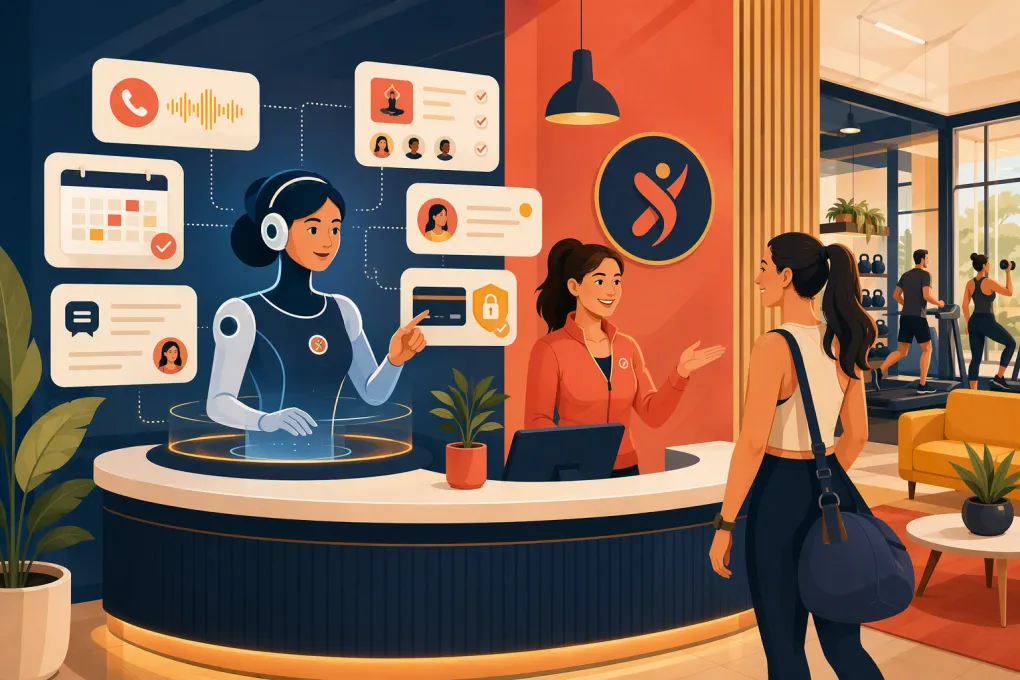
A useful AI receptionist is more than a website chat bubble. It should support the recurring workflows that consume staff time and affect revenue:
- Respond to phone, web, or messaging inquiries based on the channels you use
- Explain session length, preparation, pricing, memberships, and studio policies
- Check availability and book the correct appointment type
- Collect contact information without creating duplicate records
- Send confirmations, reminders, and follow-up messages
- Route medical, technical, or sensitive questions to a person
- Share secure payment links for purchases or overdue membership dues
- Record the conversation so staff can see what happened next
The key phrase is approved information. Your AI should answer from a controlled studio knowledge base, not improvise claims about treatment outcomes.
See how Fitty handles after-hours red light therapy inquiries →
The highest-value workflows to automate
Start with narrow, repetitive workflows rather than trying to automate the entire customer journey at once.
| Customer situation | AI receptionist response | Human escalation trigger |
|---|---|---|
| New lead asks how sessions work | Give the approved overview, answer operational questions, and offer available appointments | Questions requiring medical judgment |
| Prospect asks about pricing | Explain current drop-in, package, or membership options from the source of truth | Custom discounts, disputed terms, or unusual account requests |
| Customer wants to book | Confirm the service, location, duration, eligibility rules, and available time | No suitable availability or a required intake issue |
| Member needs to reschedule | Apply the published cancellation policy and offer eligible times | Policy exception or repeated late cancellations |
| Lead does not book | Follow up with a direct booking link and a clear next step | Lead requests personal advice or asks to stop contact |
| Membership payment fails | Send an approved notice and secure payment path | Dispute, hardship request, or repeated processing failure |
This structure keeps automation focused on work that is predictable and auditable. Staff still own judgment calls, exceptions, and relationship-sensitive conversations.
Build a red light therapy source of truth
An AI receptionist will only be as reliable as the information behind it. Before launch, document the answers your team currently gives across calls, texts, email, and the front desk.
Your source of truth should cover:
- Exact service names and appointment durations
- First-visit and returning-client booking rules
- Current pricing, package expiration, and membership terms
- What customers should wear or bring
- Your approved policy on eyewear and device use
- Cleaning, late-arrival, cancellation, and no-show policies
- Age restrictions or guardian requirements
- Accessibility information
- Location details, parking, entrances, and staffed hours
- Equipment-specific instructions supplied by the manufacturer
- Approved descriptions of benefits and limitations
- Questions that must always go to a staff member
Assign one operator to own this information. When pricing or policy changes, update the source before promoting the change. Otherwise, the AI, website, ads, and employees can give conflicting answers.
Put firm boundaries around health questions
Red light therapy prospects commonly ask whether a service is appropriate for a condition, medication, pregnancy, recent procedure, or skin concern. An AI receptionist should not diagnose, determine contraindications, or promise a health outcome.
Use a safe response pattern
For questions requiring individualized judgment, configure the AI to:
- Acknowledge the question without answering clinically.
- State that it cannot determine whether the service is appropriate for that person.
- Provide only the studio’s approved general information.
- Recommend speaking with the appropriate healthcare professional when relevant.
- Route the conversation to trained staff when studio input is needed.
For example, instead of telling a prospect that red light therapy is safe with a particular medication, the receptionist can explain that it cannot assess medication interactions and offer to have a staff member follow up.
Also define urgent-language rules. Messages involving severe symptoms, injury, or an emergency should not enter a normal sales sequence. The system should display or deliver your approved emergency direction and stop routine automation.
Be deliberate about privacy and communications compliance. Avoid collecting unnecessary health information in conversational channels. Whether HIPAA applies depends on your business relationships and operations; do not assume that it automatically does or does not. Review vendor agreements, data handling, call-recording rules, texting consent, opt-outs, and applicable federal and state requirements with qualified counsel.
Make booking accurate, not merely available
A booked appointment is only useful if it lands on the right calendar with the right resources. Your setup should distinguish between service types, first visits, memberships, locations, rooms, and equipment capacity.
Before confirming an appointment, the AI may need to verify:
- Is this a first session or a return visit?
- Which studio location does the customer want?
- Does the selected service require an intake form?
- Is the room or device actually available?
- Does the customer’s package cover the appointment?
- What cancellation terms should be acknowledged?
The confirmation should include the time, location, preparation instructions, policy summary, and an easy way to reschedule. This reduces avoidable front-desk cleanup and gives customers one clear record of what they booked.
See how WTF Go connects lead conversations with studio booking →
Follow up without sounding like a message blast
Many prospects are interested but not ready to book during the first conversation. The AI receptionist should preserve context and make the next action easy.
A practical sequence might include:
- An immediate response that answers the original question
- A follow-up after no booking, referencing the service discussed
- A later reminder with a direct scheduling link
- A stop condition when the person books, opts out, or asks for staff
Do not keep sending the same generic promotion. Follow-up should reflect whether the person asked about a first session, membership, package, location, or available time.
The same principle applies to overdue dues. A good workflow explains what needs attention, links to a secure payment process, and provides a human path for disputes or account changes. The AI should not request full card details in ordinary chat or text.
Explore how Fitty follows up with leads and helps collect dues →
How to roll out an AI receptionist safely
Treat implementation like a front-desk operating project, not an install-and-forget software task.
1. Audit real inquiries
Review recent call reasons, messages, emails, and front-desk questions. Group them into booking, pricing, preparation, policy, account, and health-related categories. Remove sensitive information from any training examples.
2. Define automation and escalation lanes
Label each inquiry type as fully automated, automated with conditions, or human-only. Name the person or team responsible for each escalation and set expectations for how handoffs appear in their workflow.
3. Test realistic edge cases
Do not test only easy questions. Try expired packages, full schedules, two locations with different hours, minors, medication questions, cancellation disputes, and customers who change topics halfway through a conversation.
4. Launch in stages
Start with a contained workflow, such as after-hours lead response and first-session booking. Review conversations, correct weak answers, and then add rescheduling, follow-up, or collections.
5. Review the system every week
Check unanswered questions, incorrect routing, abandoned bookings, staff overrides, opt-outs, and policy confusion. Update the knowledge base whenever the business changes.
Measure operator outcomes, not AI activity
Conversation volume alone does not tell you whether the receptionist is helping. Compare performance against your own pre-launch baseline using metrics such as:
- Time to first response
- Qualified inquiry-to-booking conversion
- Booking completion and abandonment
- Appointment show rate
- Human handoff rate and reason
- Reschedule and cancellation resolution
- Overdue account resolution
- Incorrect-answer or policy-exception frequency
Review conversation samples alongside the numbers. A high booking count does not compensate for inaccurate claims or poor customer handoffs.
The right role for AI in a red light therapy studio
An AI receptionist should make your operation more responsive and consistent while keeping people in control of sensitive decisions. Give it accurate studio information, direct access to real availability, clear communication permissions, and strict medical boundaries.
WTF Go brings lead management, booking, follow-up, membership workflows, and Fitty into one operating system. For a red light therapy operator, that means fewer disconnected handoffs between the first question, the first appointment, and the ongoing customer relationship.
Frequently asked questions
Can an AI receptionist answer medical questions about red light therapy?
It should provide only approved general information, not diagnose conditions, evaluate medications, or determine whether treatment is appropriate. Individual health questions should be escalated to staff or an appropriate healthcare professional.
Can an AI receptionist book different red light therapy services?
Yes, if it is connected to accurate availability and configured for each service's duration, resource, location, intake, and eligibility rules.
Does an AI receptionist replace the front desk?
Not entirely. It can handle repetitive inquiries, booking, follow-up, and routine account tasks, while staff manage exceptions, sensitive conversations, and customer relationships.
Can AI follow up on failed membership payments?
It can send approved notices and direct members to a secure payment process. Disputes, account changes, and hardship requests should be handed to a person.
What should a studio prepare before launching an AI receptionist?
Create an accurate source of truth for services, pricing, policies, preparation, locations, booking rules, approved claims, and escalation triggers. Then test real-world edge cases before expanding automation.
Keep reading

Run your gym on autopilot with WTF Go
Fitty — your AI receptionist — answers calls and DMs, fills classes, follows up with every lead, and collects dues while you coach.