AI & Automation
AI Receptionist for Pole Dance Studios: Owner’s Guide
See how an AI receptionist for pole dance studios captures leads, books intro classes, answers FAQs, follows up, and reduces front-desk gaps every day.
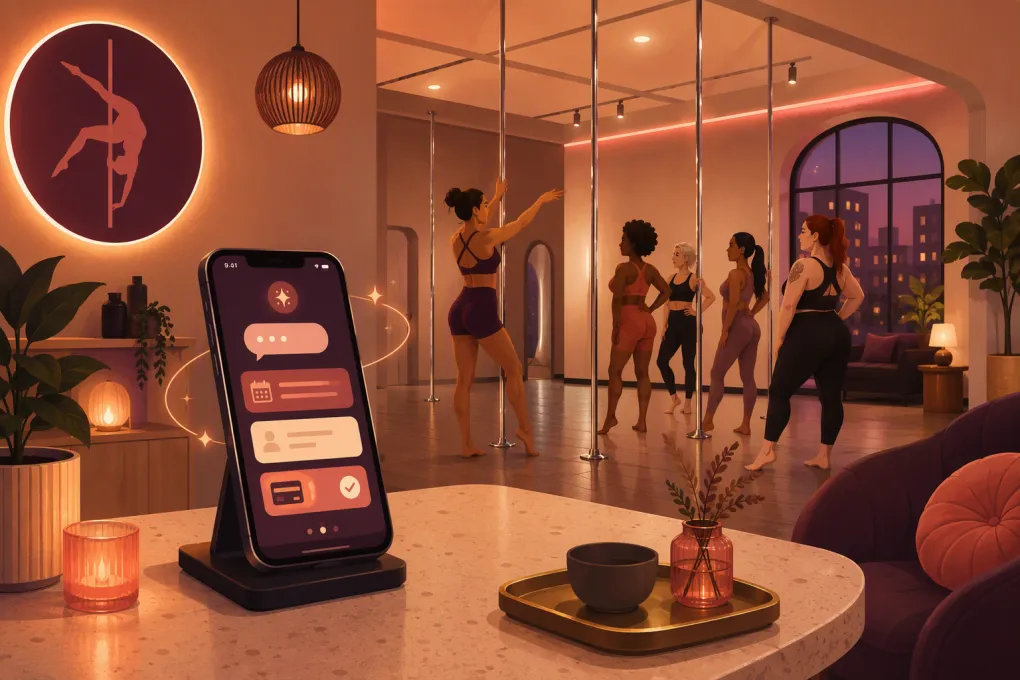 Watch · 20s
A prospective student finds your pole studio at 10:30 p.m. She has never taken a class, does not know what to wear, and is nervous about showing up alone. If nobody answers until the next morning, that interest may disappear—or go to the studio that replies first.
An AI receptionist gives studio owners a way to respond without keeping a human at the desk around the clock. The right system can answer common questions, identify what a lead needs, book the appropriate class, follow up when someone goes quiet, and help collect outstanding dues.
But pole studios need more than a generic chatbot. Your receptionist must understand prerequisites, class formats, safety policies, parties, private lessons, waivers, membership questions, and the concerns of first-time students.
See how Fitty handles after-hours pole studio inquiries and bookings →
Why pole studios lose leads at the front desk
Most independent studios do not have a dedicated receptionist covering every open hour. The person answering calls may also be teaching, spotting a student, cleaning equipment, checking waivers, or closing the studio.
That creates predictable gaps:
- Calls go to voicemail during classes.
- Instagram and website inquiries sit unanswered.
- Prospects receive inconsistent answers from different staff members.
- Beginners book classes above their level.
- Party inquiries require several rounds of basic questions.
- Trial students are not contacted after their first visit.
- Failed payments and overdue balances consume owner time.
The problem is not simply call volume. It is response timing and workflow consistency. A lead should not have to wait for an instructor to finish teaching before learning whether the intro class requires prior experience.
An AI receptionist can manage the repeatable parts while routing unusual, sensitive, or high-value conversations to a person.
What an AI receptionist for pole dance studios should do
Answer beginner questions without creating more anxiety
First-time pole students often need reassurance and practical information before they are ready to book. Your AI receptionist should answer from studio-approved information rather than generating generic advice.
Useful topics include:
- What to wear and bring
- Whether upper-body strength is required
- Intro class prerequisites
- Age requirements
- Grip aid and jewelry policies
- Arrival and late-entry rules
- Parking and entrance instructions
- Waiver requirements
- Accessibility questions
- Whether classes are beginner-friendly
- Studio policies on spectators, filming, and phones
Tone matters. Answers should be direct, welcoming, inclusive, and free of assumptions about gender, body type, fitness level, or motivation.
For example, instead of promising that every beginner will perform a particular move, the receptionist can explain that the instructor will provide level-appropriate progressions and direct safety questions to the teaching team.
Book the correct service
A useful AI receptionist does not merely send a schedule link. It helps the person choose the right path and then completes the booking when the system and studio rules allow it.
A pole studio may offer:
- Introductory pole classes
- Level-based technique classes
- Choreography or heels classes
- Conditioning and flexibility sessions
- Open pole or supervised practice
- Private lessons
- Workshops
- Membership consultations
- Group celebrations and pole parties
Each option has different booking logic. Open practice may require prior instruction. Intermediate classes may have prerequisites. Parties may need a deposit, participant estimate, preferred date, and private-event agreement.
Your AI should ask only the questions needed for the next step. A beginner looking for a first class does not need to complete a party inquiry form. A party organizer should not be pushed into a standard group class.
Most importantly, the AI must use your booking platform or another reliable source of truth. It should never invent availability or override capacity, instructor, prerequisite, or cancellation rules.
Follow up while interest is still active
Many prospects ask a question but do not book immediately. They may need to compare schedules, confirm childcare, speak with a friend, or wait for payday.
A structured follow-up sequence can reconnect with them without requiring the owner to remember every conversation. The sequence might:
- Answer the original question immediately.
- Send the most relevant class or appointment option.
- Check whether the prospect needs help choosing.
- Remind them before an expiring intro offer, if applicable.
- Stop when they book, decline, or opt out.
Follow-up should reflect the inquiry. Someone asking about a bachelorette party needs event-planning help, not reminders about beginner memberships. Someone worried about attending alone may need a clear explanation of the first-visit experience.
Explore how Fitty answers leads, follows up, and books classes 24/7 →
Support payment and dues collection
Payment follow-up is necessary, but it can strain relationships when handled inconsistently. An AI receptionist can help notify members about a failed payment or outstanding balance and direct them to an approved payment process.
Keep the workflow controlled:
- State what the notice concerns without exposing unnecessary account details.
- Use secure payment links or your compliant billing workflow.
- Do not request full card details through ordinary text or chat.
- Define when repeated failures should reach a staff member.
- Pause inappropriate promotional messages while a billing issue is unresolved.
- Keep a record of attempts and member responses.
Fitty can help with dues collection as part of the wider WTF Go operating system, giving owners one less repetitive queue to manage manually.
Where AI should hand the conversation to a person
Automation needs clear limits. An AI receptionist should escalate rather than improvise when a conversation involves:
- Injuries, pain, pregnancy, or medical suitability
- Harassment, discrimination, or member conduct
- Refund disputes and chargebacks
- Exceptions to cancellation or late-entry policies
- Instructor-specific complaints
- Accessibility accommodations requiring coordination
- Advanced-level placement uncertainty
- Custom party requests or complex private events
- Emergencies or immediate safety concerns
Create a handoff rule for each category. Define who receives it, what information they need, and the expected response window. The owner should see the conversation history so the customer does not have to repeat everything.
AI should also identify itself appropriately. A student should not be led to believe they are speaking with a human employee when they are not.
How to build the workflow before switching it on
1. Audit real inquiries
Review recent calls, emails, direct messages, and website forms. Group them by intent: first class, schedule, pricing, membership, private lesson, party, policy, billing, or complaint.
Use the language prospects actually use. A customer may ask whether a class is suitable for someone with no strength rather than asking for a prerequisite list.
2. Create one approved knowledge source
Document current answers for:
- Class descriptions and levels
- Prices and purchase options
- Intro offers
- Membership terms
- Cancellation and no-show policies
- Dress and grip guidance
- Arrival instructions
- Waivers and age restrictions
- Private lessons and parties
- Billing contacts
Assign one person to approve changes. If staff members provide conflicting answers, the AI will not solve the underlying policy problem.
3. Map each inquiry to a next action
An answer without a next step still leaves work for the lead. Decide whether each intent should end in a booking, payment link, lead form, staff handoff, or simple answer.
For example:
- New student → recommend eligible intro options → book
- Private lesson → collect goal and availability → book or escalate
- Party inquiry → collect date, group size, and contact details → staff follow-up
- Failed payment → provide secure resolution path → confirm or escalate
4. Set booking guardrails
Specify prerequisites, age limits, capacity rules, booking windows, waitlist behavior, cancellation cutoffs, and services that require manual approval.
Test edge cases. Ask what happens when a class is full, a student requests an ineligible level, or two people try to claim the final spot.
5. Write escalation rules
Do not rely on a vague instruction to contact the owner if needed. Define triggers such as injury language, refund requests, upset customers, policy exceptions, and repeated misunderstanding.
6. Test as different customer types
Run test conversations as:
- A nervous first-timer
- A returning student
- A parent asking about age requirements
- A tourist seeking a drop-in class
- A party organizer
- A member with a failed payment
- A student asking for medical advice
Check the accuracy, tone, booking outcome, and handoff—not just whether the AI produced a fluent answer.
7. Launch in stages
Start with common questions and introductory bookings. Review conversations regularly, correct weak answers, and then add party leads, private lessons, follow-up, and billing workflows.
How to measure whether it is working
Avoid judging the system only by how many messages it sends. Review operational outcomes such as:
- Qualified inquiries that become bookings
- Time from inquiry to first response
- After-hours bookings completed
- Conversations requiring human intervention
- Incorrect bookings or policy answers
- Leads that opt out of follow-up
- Failed payments resolved
- Staff time spent on repetitive reception work
Read actual conversation samples. A high booking count does not excuse placing beginners in the wrong class or mishandling a safety question.
Questions to ask before choosing a provider
Before committing to an AI receptionist, ask:
- Can it use our live schedule and booking rules?
- Can we control exactly what it says about levels, pricing, and policies?
- Does it support lead follow-up as well as first response?
- How are conversations handed to staff?
- Can it help with billing and dues workflows?
- What customer data is stored, and who can access it?
- How are marketing consent, opt-outs, and message records handled?
- Can we review transcripts and correct answers?
- What happens if the booking or payment system is unavailable?
- Can it support multiple locations with different schedules and policies?
For US operators, review consent and opt-out practices before automating promotional texts or calls. Your provider should support your compliance process, but the studio remains responsible for how customer communications are used.
The goal is a better first experience
A pole studio’s reception workflow is part of the product. It shapes whether a nervous beginner feels prepared, whether a party organizer trusts you with an event, and whether an existing member gets a clear answer when something goes wrong.
The best AI receptionist removes waiting and repetitive administration without flattening your studio’s personality. It handles the predictable questions, moves qualified leads toward the right booking, follows up consistently, and knows when a human needs to step in.
WTF Go brings those workflows together, while Fitty serves as the always-available AI receptionist that answers leads, books classes, follows up, and helps collect dues.
See how WTF Go and Fitty can run your pole studio’s front desk workflows →
Frequently asked questions
Can an AI receptionist book pole dance classes automatically?
Yes, when it is connected to accurate availability and configured with your class levels, prerequisites, capacity rules, and booking policies. Services requiring approval should be routed to staff.
Will an AI receptionist replace my studio staff?
It should replace repetitive reception tasks, not human judgment. Instructors and staff should still handle safety concerns, complaints, policy exceptions, medical questions, and complex event requests.
Can AI manage pole party and private lesson inquiries?
AI can collect details such as date, group size, goals, and availability. Standard services may be booked automatically, while custom events can be passed to a staff member with the conversation context.
How should an AI receptionist handle beginner safety questions?
It should provide approved studio guidance, explain prerequisites, and avoid medical or individualized safety advice. Questions involving injury, pregnancy, pain, or suitability should be escalated.
Can Fitty follow up on missed leads and overdue dues?
Yes. Fitty is designed to answer leads, follow up, book classes, and help collect dues 24/7 as part of the WTF Go operating system.
Keep reading

Run your gym on autopilot with WTF Go
Fitty — your AI receptionist — answers calls and DMs, fills classes, follows up with every lead, and collects dues while you coach.