AI & Automation
AI Receptionist for Pilates Studio Missed Calls & Leads
Learn how an AI receptionist for Pilates studio missed calls can answer prospects, book intro sessions, follow up, and protect your front desk capacity.
 Watch · 20s
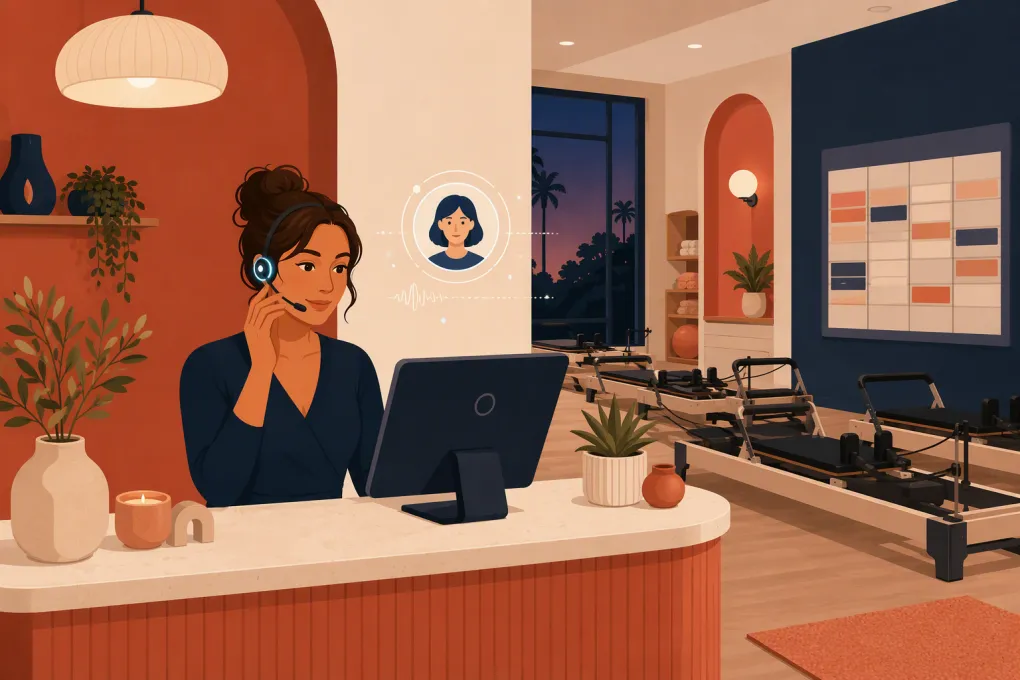
Searching for an AI receptionist for Pilates studio missed calls usually means the same operational problem: prospects are calling while instructors are teaching, the front desk is helping members, or the studio is closed. By the time someone returns the call, the prospect may have booked an intro at another studio.
The fix is not simply answering every call. A useful AI receptionist must move the caller toward the correct next step without creating scheduling problems for your team. That means answering common questions, identifying what the prospect needs, booking eligible sessions, capturing unresolved requests, and following up when a booking is not completed.
Why Pilates studios miss high-intent calls
Pilates studios have a coverage problem that traditional front desks struggle to solve.
Calls often arrive during classes, when answering would disrupt the client experience. Instructors may also be responsible for opening, closing, cleaning equipment, handling check-ins, and documenting client needs. Smaller studios rarely have someone available solely to monitor the phone.
The timing of the calls makes the problem worse. Prospects frequently contact studios before work, during lunch, in the evening, or on weekends. These are also the periods when the studio may be busiest or unstaffed.
A missed call can involve:
- A new prospect asking which intro option to book
- Someone comparing private and group Pilates
- A client trying to reschedule
- A caller asking about reformer experience requirements
- A member with a billing or account question
- A prospective client asking about an injury, pregnancy, or physical limitation
- Someone needing directions, parking details, or access instructions
Sending all of those callers to voicemail creates work for later. It also forces the prospect to wait when they were ready to act.
See how Fitty handles Pilates inquiries when your team cannot answer →
What an AI receptionist should do with a missed call
An AI receptionist should operate like a structured front-desk workflow, not an unrestricted chatbot. Its job is to resolve approved requests and route everything else accurately.
Answer studio-specific questions
Generic answers are not enough. The receptionist should use current information about your studio, including:
- Class formats and experience levels
- Intro offers and eligibility rules
- Private, duet, and group session options
- Studio hours and location information
- Parking and building access
- Grip sock or equipment policies
- Cancellation and late-arrival rules
- Membership and package basics
- What a first-time client should expect
Create one approved source of truth for these answers. If policies are scattered across old emails, social profiles, and staff notes, automation will expose those inconsistencies quickly.
Qualify without interrogating the caller
The goal is to gather only the information needed to recommend a safe next step. A practical new-lead flow might ask:
- Are you interested in private sessions or group classes?
- Have you used a Pilates reformer before?
- Is this your first visit to the studio?
- What days or times generally work for you?
- Do you have an injury, limitation, or other concern an instructor should discuss with you?
The final question requires care. An AI receptionist should not diagnose an issue, promise that Pilates is appropriate, or interpret medical information. It can flag the concern and arrange a conversation with a qualified team member.
Book the correct starting service
A good receptionist does not merely send every caller to the schedule. It applies your booking rules.
For example, your studio may allow experienced clients to enter certain group classes while directing complete beginners to an orientation or private session. Another studio may require instructor approval for advanced classes. These rules should be documented before the AI is allowed to book.
The booking workflow should confirm:
- The exact service or class
- Date and start time
- Location for multi-site operators
- Any prerequisite or eligibility rule
- What the client should bring
- Applicable cancellation terms
- The next action required to secure the reservation
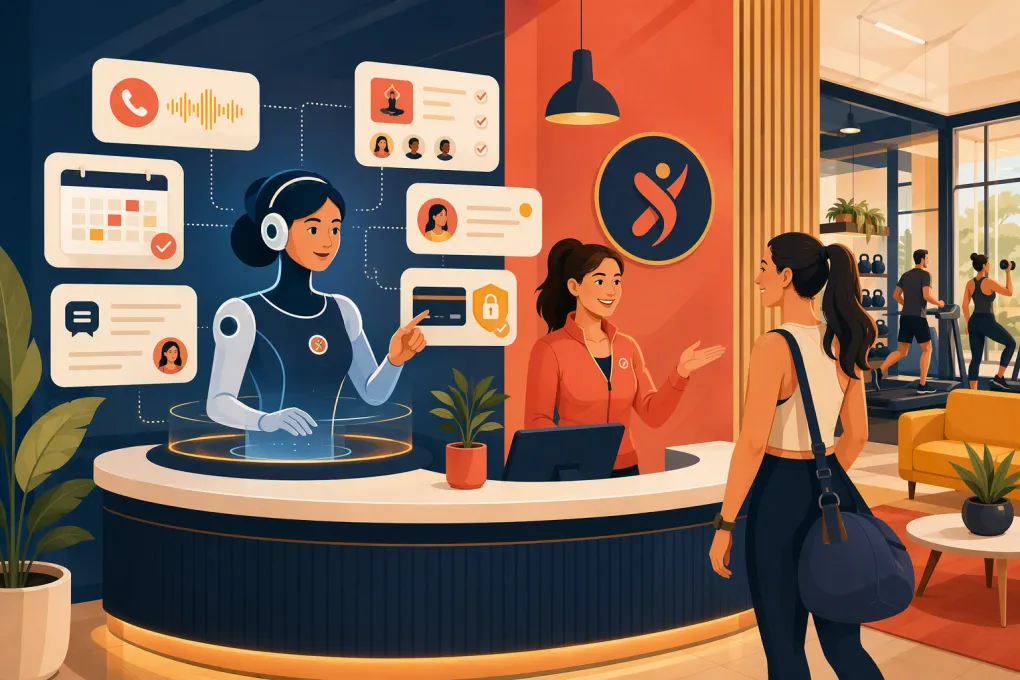
Fitty is WTF Go’s AI receptionist and agent. It can answer leads, book classes, follow up, and handle dues workflows around the clock, so a caller can move forward without waiting for the next staffed shift.
See how Fitty can turn an unanswered Pilates inquiry into a booked next step →
AI receptionist vs. voicemail and answering services
There are several legitimate ways to cover missed calls. The right choice depends on whether you need message capture, live conversation, or direct action inside your operating workflow.
| Option | Answers immediately | Handles studio-specific questions | Can complete bookings | Follow-up capability | Main limitation |
|---|---|---|---|---|---|
| Voicemail | No | No | No | Manual | Adds callbacks and gives the prospect no immediate resolution |
| Call forwarding to staff | Sometimes | Usually | Usually | Manual | Interrupts classes and depends on staff availability |
| Human answering service | Usually | Depends on training and scripts | Sometimes | Depends on service scope | Quality and booking access vary; policy updates require coordination |
| Basic phone menu | Yes | Only prerecorded topics | Rarely | Limited | Creates friction when the caller’s need does not match a menu option |
| AI receptionist | Yes | Yes, when configured with approved information | Yes, when connected to the booking workflow | Can automate approved sequences | Requires careful setup, testing, governance, and escalation rules |
A human service may be appropriate for highly sensitive or unusual conversations. AI is strongest when the call follows a repeatable path: answer, qualify, book, confirm, follow up, or escalate.
Many studios will benefit from a hybrid model. Let AI handle routine calls and route exceptions to a designated person with a useful summary.
Build the workflow before turning on automation
The quality of an AI receptionist depends heavily on the operating rules behind it. Start by reviewing recent call logs, voicemail messages, inbox questions, and front-desk notes. Group requests by type rather than trying to script every possible sentence.
Define the approved outcomes
For each call category, decide what the receptionist is allowed to do:
- New prospect: Explain approved options and book an intro
- Existing client: Help with routine booking requests within policy
- Cancellation: Apply the published cancellation process
- Billing question: Explain basic account information or escalate
- Past-due balance: Direct the client into an approved payment workflow
- Injury or medical concern: Collect minimal details and route to a person
- Complaint: Acknowledge the issue and create an urgent staff task
- Emergency: Direct the caller to appropriate emergency services rather than treating the AI as an emergency channel
Do not leave these decisions to the system. An operator should own every allowed action and escalation path.
Write clear booking guardrails
List the rules an experienced front-desk employee already knows but may never have documented. Examples include:
- Which service a first-time client can book
- Whether previous reformer experience changes the recommendation
- Which classes require instructor approval
- Whether waitlists are available
- How close to class time online booking closes
- Which promotions apply to new local clients
- When a reservation requires payment
- Which requests must be handled by a manager
This exercise improves more than automation. It also makes staff training and multi-location consistency easier.
Decide when a human takes over
Escalation rules should be specific. Avoid a vague instruction to transfer difficult calls. Define what counts as difficult.
Human follow-up is usually appropriate when the caller:
- Reports pain, an injury, or a health concern
- Disputes a charge
- Requests a refund or policy exception
- Makes a complaint about an instructor or client
- Needs an accommodation outside the documented workflow
- Asks a question the approved knowledge base cannot answer
- Becomes distressed, confused, or repeatedly rejects the available options
The handoff should include the caller’s contact information, reason for calling, what was already discussed, and the promised response window. That prevents the client from repeating the entire conversation.
Follow-up is where missed-call recovery succeeds or fails
Answering is only the first step. Some prospects will ask questions but stop before booking. Without a follow-up process, those conversations become another form of missed lead.
Build follow-up around the caller’s actual status:
- Booked: Send the appropriate confirmation and arrival instructions
- Interested but undecided: Send a direct path back to the recommended service
- Requested a human: Assign the task with context and a deadline
- No suitable availability: Offer approved alternatives or a waitlist process
- Payment incomplete: Remind the client through an approved dues or payment workflow
- Not eligible for the requested class: Explain the correct prerequisite and how to book it
Keep messages operational. The prospect should know what to do next without reading a long sales sequence.
Fitty brings these steps into the same operating system instead of leaving staff to reconcile calls, bookings, lead notes, and dues tasks manually.
Explore Fitty for Pilates lead follow-up, booking, and dues collection →
Protect client trust and reduce avoidable risk
AI call handling needs the same controls you would apply to employees and vendors.
Tell callers they are interacting with an automated assistant when required or appropriate. Review call-recording and consent requirements for every state in which you operate or receive calls. Requirements vary, so obtain legal guidance rather than relying on a generic script.
For outbound automated calls or texts, review consent obligations and applicable federal and state rules. A prior inquiry does not automatically make every type of future outreach appropriate.
You should also:
- Collect only the information needed for the workflow
- Avoid gathering detailed medical histories through a general reception channel
- Limit staff access to call transcripts and summaries
- Set a retention policy for recordings and conversation data
- Use secure payment processes rather than requesting card details in an unsecured conversation
- Review vendor security, access controls, and data-handling terms
- Test how the receptionist responds when it does not know an answer
The correct response to uncertainty is not improvisation. It is a clear handoff.
Measure whether the receptionist is improving operations
Do not judge the system only by the number of calls answered. Review whether those calls reached appropriate outcomes.
Useful operational measures include:
- Calls answered by time of day
- New leads captured from calls
- Eligible callers who completed a booking
- Conversations requiring staff follow-up
- Time from escalation to human response
- Bookings that required manual correction
- Common unanswered questions
- Cancellations, refunds, or complaints connected to incorrect information
- Past-due conversations that reached the approved payment step
Review call outcomes weekly during the initial rollout. Listen for confusing language, outdated policies, dead ends, and overly broad answers. Update the knowledge base whenever pricing, schedules, instructors, locations, or studio rules change.
A practical rollout plan
Start narrow instead of automating the entire front desk at once.
- Document your most common call categories.
- Choose one primary conversion goal, such as booking an intro session.
- Create approved answers and booking rules.
- Define escalation triggers and ownership.
- Test routine, unusual, and adversarial questions.
- Launch during a controlled period or for after-hours coverage first.
- Review transcripts, summaries, and booking outcomes.
- Correct gaps before adding billing, retention, or broader service workflows.
The objective is not to remove people from client service. It is to stop routine phone coverage from competing with the experience happening inside the studio. When the workflow is built correctly, prospects get an immediate next step, instructors stay focused on clients, and the front desk handles exceptions instead of chasing every missed call.
Frequently asked questions
Can an AI receptionist book Pilates classes directly?
Yes, when it is connected to the studio's booking workflow and configured with eligibility, scheduling, payment, and cancellation rules. Requests outside those rules should be escalated to staff.
Can an AI receptionist handle questions about injuries?
It can collect limited information and arrange human follow-up, but it should not diagnose conditions or decide whether Pilates is medically appropriate.
Should a Pilates studio use AI or a human answering service?
AI works well for repeatable tasks such as FAQs, lead qualification, booking, and follow-up. Human services may be preferable for sensitive or highly variable conversations, and a hybrid approach can cover both.
How should a studio test an AI receptionist before launch?
Test common inquiries, booking edge cases, policy exceptions, medical questions, billing disputes, and unknown questions. Confirm that every unresolved situation creates a clear human handoff.
Can Fitty follow up after a Pilates studio misses a lead?
Fitty can answer leads, book classes, follow up, and support dues collection workflows 24/7 within WTF Go's operating system.
Keep reading

Run your gym on autopilot with WTF Go
Fitty — your AI receptionist — answers calls and DMs, fills classes, follows up with every lead, and collects dues while you coach.