AI & Automation
AI Receptionist for Pilates Class Cancellations Playbook
Use an AI receptionist for Pilates class cancellations to protect revenue, refill spots, update waitlists, and give members fast, clear, immediate answers.
 Watch · 20s
A Pilates cancellation is not just a calendar change. It can create an empty reformer, trigger a late-cancel fee, move someone off a waitlist, generate a billing question, and start a tense conversation—all within a few minutes.
If those requests sit in voicemail, Instagram DMs, text threads, and email until the front desk responds, the studio loses its chance to refill the spot. An AI receptionist for Pilates class cancellations can handle the first response immediately, apply the studio’s rules consistently, and escalate the exceptions that need a person.
The goal is not to let AI invent policy. It is to turn your existing cancellation policy into a reliable workflow.
See how Fitty can handle Pilates cancellation requests while your team is teaching →
Why Pilates cancellations require a real workflow
Pilates studios have tighter capacity constraints than many general fitness businesses. A reformer class may have a fixed number of stations, and one late cancellation can represent a meaningful share of the available inventory.
The operational problem usually includes several connected tasks:
- Confirm the member’s identity and reservation.
- Determine whether the request falls inside the cancellation window.
- Cancel the correct class without touching another booking.
- Apply the published credit, fee, or forfeiture rule.
- Offer a replacement class when appropriate.
- Notify or book the next eligible waitlisted member.
- Record what happened for the front desk and future disputes.
- Escalate medical, technical, or policy exceptions.
A basic chatbot that only says “someone will get back to you” does not solve this. It acknowledges the message but leaves the time-sensitive work untouched.
A useful AI receptionist must connect the conversation to the booking and member record. It also needs clear limits on what it can change, waive, or promise.
What the AI receptionist should do
Recognize the member’s intent
Members rarely use the exact language your software expects. They might say:
- “I can’t make the 6:00.”
- “Please take me out of reformer tonight.”
- “My child is sick—can you move me to Saturday?”
- “I canceled online, but it still shows in the app.”
- “Will I lose the class credit?”
The AI should identify whether the member wants to cancel, reschedule, check a cancellation, dispute a charge, or ask about policy. Those are different workflows and should not all lead to the same canned answer.
Verify the reservation
Before changing a booking, the receptionist should match the person to a member record and confirm the relevant class. If there are multiple upcoming reservations, it should ask a focused question such as: “Do you mean today’s 6:00 p.m. Reformer Foundations class or Saturday’s 9:00 a.m. class?”
Do not let the system guess based on the first class it finds. A wrong cancellation creates more work than a delayed one.
Apply the policy consistently
Translate the studio’s policy into explicit rules. Define:
- The standard cancellation cutoff.
- What happens to a class credit before the cutoff.
- What happens inside the late-cancel window.
- Whether unlimited memberships have a late-cancel charge.
- How no-shows differ from cancellations.
- Whether introductory offers follow different rules.
- Who can authorize an exception.
- How recurring reservation cancellations are handled.
The AI should state the consequence before completing the action when a fee or forfeited credit applies. That gives the member a clear choice and reduces “I didn’t know” disputes.
Complete the transaction
Once the member confirms, the system should update the booking record rather than merely sending a note to staff. A complete response might confirm:
- Which class was canceled.
- Whether the credit was returned or forfeited.
- Whether a fee applies under the studio’s policy.
- Whether the member was moved to another class.
- Where the member can review the updated schedule.
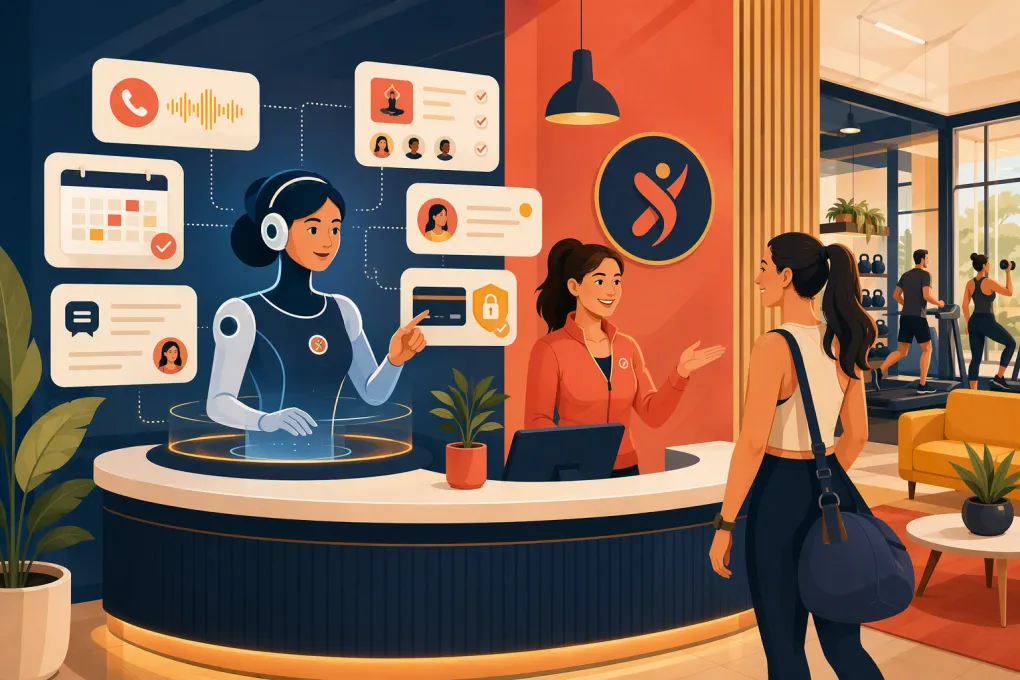
Fitty, WTF Go’s AI receptionist, is designed to answer members and leads, book classes, follow up, and handle payment-related conversations around the clock. When the booking, communication, and member record live in one operating system, the cancellation does not have to become another front-desk task.
See how Fitty can turn cancellation messages into completed booking actions →
Build the cancellation workflow step by step
1. Map every intake channel
List where cancellation requests currently arrive: phone, voicemail, SMS, website chat, email, social DMs, booking app, and in-person conversations. Decide which channels the AI will actively handle and which ones should direct members to a supported channel.
Avoid creating a policy that says cancellations are accepted only through one channel while staff routinely honor requests elsewhere. Inconsistent enforcement trains members to argue.
2. Create one source of truth
The booking system should determine whether a reservation exists, when the request arrived, and whether it met the cutoff. Staff notes and message timestamps can provide context, but they should not replace a reliable booking record.
Make sure the AI uses the studio’s local time zone and accounts for location-specific schedules. This is especially important for multi-location operators with different policies or class inventories.
3. Write decision rules, not vague guidance
“Use judgment for emergencies” is not an automation rule. Define the situations that require escalation, such as:
- A member reports an injury or medical emergency.
- The booking system and the member’s confirmation disagree.
- The member says they canceled earlier but has no cancellation record.
- A charge appears to have been applied twice.
- The request involves a private session, workshop, or prepaid series.
- The member asks for an exception the AI is not authorized to grant.
- The class was canceled or changed by the studio.
The AI can gather the necessary facts before handing the conversation to a manager. That saves the manager from starting from zero.
4. Connect cancellations to the waitlist
A cancellation workflow should immediately expose the opening to the waitlist. The exact process depends on your operating model:
- Automatic booking: The next eligible member is added and notified.
- Timed offer: The next member gets a limited window to accept.
- Broadcast offer: Several members are alerted, and the first eligible response gets the spot.
- Staff approval: The team reviews eligibility before filling the opening.
Choose one approach and communicate it clearly. Members become frustrated when “waitlisted” sometimes means automatically enrolled and sometimes means they must respond.
The AI also needs to answer common follow-ups: “Did I get in?”, “How long do I have to accept?”, and “Will I be charged if I miss a class I was added to from the waitlist?”
5. Prepare approved response language
Write short templates for the most common outcomes. For example:
Cancellation before the cutoff:
“Your reservation for Tuesday’s 5:30 p.m. reformer class has been canceled. Your class credit has been returned to your account.”
Cancellation inside the cutoff:
“This reservation is inside the studio’s late-cancellation window. If I cancel it now, the published late-cancel rule will apply. Would you like me to continue?”
Manager review required:
“I’ve documented the class, request time, and billing issue for the studio manager. I won’t make another account change while it is being reviewed.”
Use the language that matches your actual policy and system behavior. Never promise a refund, waiver, or account credit unless the system is authorized to complete it.
Protect the member experience without weakening policy
Fast service and firm policies are not opposites. Most cancellation friction comes from uncertainty: the member does not know whether the request was received, whether a fee applies, or whether the booking is still active.
An AI receptionist can reduce that uncertainty by responding immediately and explaining the outcome. It should remain calm when a member is frustrated, but it should not negotiate outside its authority.
Give members a productive next step whenever possible:
- Offer available classes that fit the member’s level.
- Add the member to an appropriate waitlist.
- Send the relevant policy language.
- Route a documented exception to the right manager.
- Provide a secure path to resolve an outstanding balance when booking is blocked.
This turns the interaction from “request denied” into “here is what can happen next.”
Track whether the workflow is working
Do not evaluate the system only by counting conversations. Review operational outcomes:
- Cancellation requests completed without staff intervention.
- Requests escalated and the reason for escalation.
- Open spots refilled from the waitlist.
- Average time between cancellation and an offered replacement spot.
- Repeated disputes about cutoff times, fees, or credits.
- Incorrect cancellations or booking changes.
- Members who cancel and do not rebook.
- Channels that still create manual cleanup.
Review transcripts and exception logs regularly. If the same question keeps reaching staff, improve the rule, policy wording, or system connection instead of adding another canned response.
For multi-location studios, compare workflows by location. A policy difference may be intentional, but the AI must know which rule applies before answering.
Common mistakes to avoid
Automating an unclear policy
If staff members interpret the cancellation window differently, AI will expose the inconsistency. Settle the policy first, then automate it.
Treating cancellation and rescheduling as identical
Moving a member may involve canceling one reservation and booking another. Confirm both actions and explain any difference in credit or fee treatment.
Giving the AI unlimited exception authority
Create narrow permissions. Routine requests can be completed automatically; refunds, repeated waivers, medical exceptions, and unusual billing cases should follow an approval path.
Ignoring failed actions
A friendly response is not enough if the booking update fails. The workflow needs a clear failure message, an internal alert, and protection against telling the member a cancellation succeeded when it did not.
Forgetting the recovery opportunity
Every cancellation is also a chance to preserve attendance. Offer a suitable replacement class before the conversation ends, especially when the member is canceling for a scheduling reason rather than dissatisfaction.
Make cancellations a controlled operation
Pilates class cancellations will never disappear. The operational drag around them can.
A well-configured AI receptionist gives members an immediate answer, applies the studio’s rules, opens inventory for the waitlist, and sends only genuine exceptions to staff. That protects teaching time without turning the member experience into a rigid support maze.
The best place to start is one high-volume workflow: standard single-class cancellations. Define the rules, connect the booking record, test every outcome, and then expand into rescheduling, waitlists, private sessions, and billing exceptions.
Explore WTF Go and see how Fitty can manage booking conversations 24/7 →
Frequently asked questions
Can an AI receptionist cancel a Pilates class without staff approval?
Yes, when it is connected to the booking record and the request fits predefined rules. Exceptions such as disputed charges, medical circumstances, or refund requests should be escalated.
Can AI apply late-cancellation fees?
It can communicate and execute the studio’s configured policy if the booking and payment systems support that action. The member should be told the consequence before confirming the cancellation.
Will an AI receptionist automatically fill the canceled spot?
It can trigger the studio’s chosen waitlist workflow, such as automatic booking or a timed offer. The exact process should match the rules members were given when they joined the waitlist.
What happens when the AI cannot find the member’s reservation?
It should verify identifying details, ask which class the member means, and avoid changing the account until the booking is confirmed. Unresolved mismatches should be documented and sent to staff.
How should a Pilates studio start automating cancellations?
Start with standard single-class cancellations, document the cutoff and credit rules, connect the booking source of truth, and test routine, late, disputed, and failed-action scenarios before expanding.
Keep reading


Run your gym on autopilot with WTF Go
Fitty — your AI receptionist — answers calls and DMs, fills classes, follows up with every lead, and collects dues while you coach.