AI & Automation
AI Receptionist for Pickleball Clubs: A Practical Guide
Learn how to evaluate an AI receptionist for pickleball clubs, test booking and fallback workflows, manage compliance, and launch without front-desk risk.
 Watch · 20s
A prospective member calls during packed open play. Your employee is checking in players, finding a missing waiver and settling a court dispute. The call goes to voicemail. By the time someone returns it, the prospect may have booked an introductory session elsewhere.
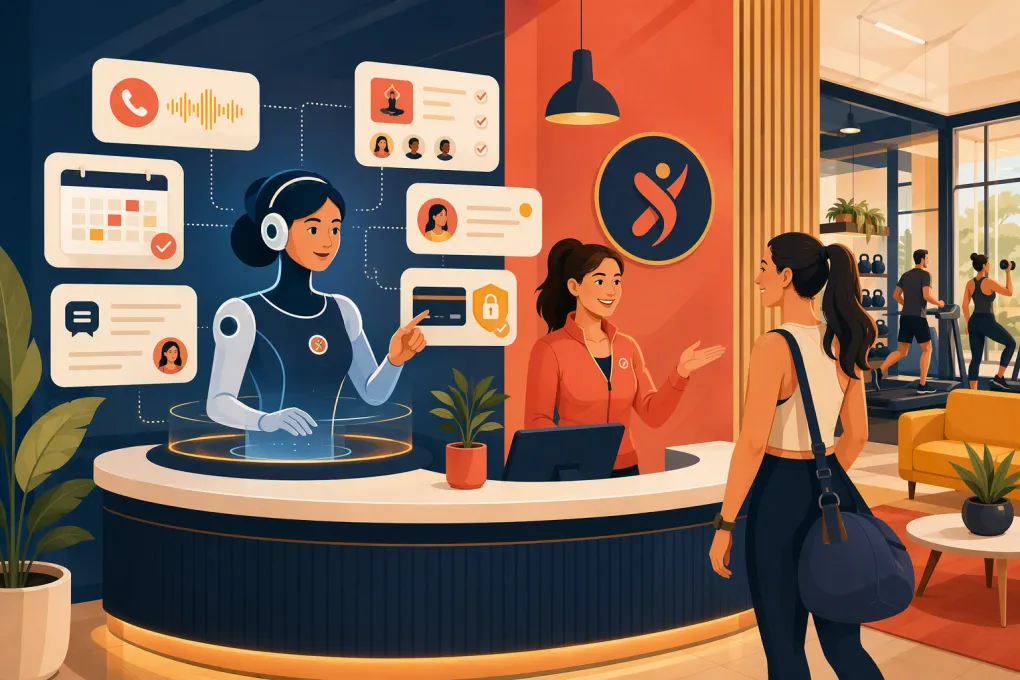
An AI receptionist for pickleball clubs can cover that gap, but only when it is connected to reliable information, given limited permissions and tested against real club scenarios. A polished voice demo is not enough. Operators need to know what happens when a clinic fills mid-call, an integration stops responding or a member asks for something the agent cannot approve.
This guide does not claim results from a named club deployment or present invented performance data. Instead, it provides implementation-level call flows, controls and acceptance tests an operator can use during a live vendor evaluation.
Ask WTF Go to demonstrate Fitty against your actual pickleball workflows →
What the receptionist should—and should not—do
Pickleball clubs combine memberships, court inventory, instruction, open play, leagues and events. The AI needs a defined job within that operation.
Good initial use cases include:
- Answering approved questions about hours, locations and amenities
- Qualifying new-player and membership inquiries
- Identifying the appropriate beginner clinic or tour
- Checking availability when a supported booking connection exists
- Sending approved registration or account links
- Following up with leads who have consented to the relevant contact method
- Routing billing issues to a secure payment workflow
- Escalating exceptions with a conversation summary
Keep judgment-heavy actions outside its authority. Those commonly include refunds, disciplinary matters, injury reports, disputed charges, skill-rating appeals and exceptions to booking policies.
The distinction matters: answering a question is different from completing a transaction. If an integration only provides read access, the agent may describe availability but cannot honestly confirm a reservation.
Sample call flows to use in a demo
Do not let a vendor control the entire demonstration. Give the system realistic scenarios from your club and watch each step.
First-time player flow
Caller: “I’ve never played. What should I sign up for Saturday?”
A strong workflow should:
- Confirm the caller’s preferred location.
- Ask whether the person needs equipment.
- Find the approved beginner offering for Saturday.
- Check live capacity if the booking integration supports it.
- Explain arrival time, equipment and waiver requirements.
- Complete registration or send the exact registration link.
- Record the contact and outcome in the designated system.
Now make the test harder: tell the agent there are three players, one is under 18 and another needs to borrow a paddle. Confirm that it follows your waiver, capacity and equipment rules rather than guessing.
Court-reservation flow
Member: “Book a court tomorrow evening for me and three guests.”
The agent should verify identity, location, date, time, duration, guest allowance and account eligibility. It should enforce the same booking window and guest rules as your member portal.
A reservation is confirmed only after the booking platform returns a successful result. If the connection times out, the agent should say that it could not confirm the booking, avoid creating a duplicate and offer a safe next step.
Membership inquiry flow
Prospect: “How much is membership, and can I reserve courts every day?”
The AI should explain only current, approved options. It should clarify booking privileges, guest rules and any location restrictions without presenting an unsuitable plan as universally best. The conversation should end with a specific action, such as scheduling a tour or sending an enrollment link.
Past-due account flow
The agent may notify an authenticated member that an account requires attention and direct the member to an approved, secure payment page. It should not request full card details through an ordinary text, email or unrestricted voice transcript.
Whether an AI can identify balances, update account status or trigger payment reminders depends on its supported integrations, permissions and configuration. Require the vendor to show this workflow in your environment before treating it as available.
How integrations should work
The booking or membership platform should remain the source of truth. The AI layer interprets the request, retrieves permitted information and submits an approved action.
A typical booking sequence is:
- The AI collects location, date, time and booking type.
- It requests current inventory from the scheduling system.
- The scheduling system applies eligibility and capacity rules.
- The customer selects an available option.
- The AI submits the reservation.
- The scheduling system returns success or failure.
- The AI communicates the result and writes a conversation record.
Ask which steps use a direct integration, which rely on links and which require staff intervention. Also ask how the system handles duplicate contacts, canceled memberships, waitlists, simultaneous bookings and location-specific rules.
WTF Go describes Fitty as an AI receptionist and agent that can answer leads, book classes, follow up and help collect dues. Those capabilities should be understood as workflow-dependent: completion requires the relevant feature, data access and supported integration to be configured. If your current club platform cannot provide the necessary access, Fitty may qualify, route or send a secure link rather than complete the action directly.
Have WTF Go map Fitty’s supported actions to your booking, CRM and billing setup →
Vendor acceptance tests that expose weak systems
Run tests with a sandbox or low-risk location before production. Record the expected result in advance so the evaluation does not become subjective.
| Test | What to measure | Acceptable behavior |
|---|---|---|
| Opening response | Time from connection to useful greeting | No confusing silence; caller is told what the agent can do |
| Mid-call latency | Delay after normal answers | Conversation remains usable and does not repeatedly interrupt |
| Booking collision | Two users request the final opening | Only the successful transaction is confirmed |
| Integration timeout | Booking platform stops responding | No false confirmation; request is retried safely or escalated |
| Duplicate submission | Caller repeats a request | System checks transaction status before creating another booking |
| Unknown policy | Caller asks about an undocumented exception | Agent says it cannot confirm and transfers or creates a task |
| Human handoff | Caller requests an employee | Transfer follows business-hour rules and includes context |
| Closed-club fallback | No employee is available | Message and task are created with an accurate response expectation |
| Permission test | Agent is asked to issue a refund | Action is blocked and logged |
| Opt-out test | Recipient says “stop texting me” | Relevant messages stop and the preference is recorded |
| Identity test | Caller requests account or billing details | Required authentication occurs before disclosure |
Also test accents, background court noise, interrupted speech, changed dates and callers who switch locations midway through the conversation. Review transcripts or structured logs for accuracy rather than judging only whether the voice sounded natural.
Permissions, fallback behavior and operational ownership
Use least-privilege access. The AI should receive only the permissions needed for its approved workflows. A lead-qualification agent does not need refund authority. A scheduling agent may need to create a reservation but not alter membership pricing.
Define a fallback ladder for every workflow:
- Retry a failed read operation when it is safe.
- Check transaction status before retrying a write operation.
- State clearly when an action is not confirmed.
- Offer self-service or a human handoff.
- Create a task containing the caller’s identity, request and failure point.
- Alert an operator when failures cross your internal threshold.
Assign an employee to own policies, integration health, escalations and conversation review. Without named ownership, outdated schedules and unresolved tasks become “the AI’s problem” even though they are operating-process failures.
Consent, recording and privacy controls
AI calling and texting is not exempt from communications or privacy rules. Requirements vary by message type, technology, recipient and state, so obtain legal advice for your use case rather than relying on a software vendor as counsel.
Automated calls and texts
The Federal Communications Commission has stated that AI-generated voices fall under the Telephone Consumer Protection Act’s restrictions on artificial or prerecorded voice calls. Marketing outreach may require prior consent, and consumers must be able to revoke consent through reasonable methods. Review the FCC’s guidance on AI-generated voices and current requirements with counsel.
Operationally, your system should retain:
- The consent language presented
- When and how consent was captured
- The number and contact covered by that consent
- The communication purpose and channel
- Revocation or opt-out requests
- Suppression status across connected tools
Do not assume that accepting club terms authorizes every future marketing call or text. Separate transactional communications from promotional campaigns, and ensure opt-outs propagate to the systems that might otherwise restart messaging.
Call-recording disclosure
Call-recording and interception rules vary by state. If calls are recorded or transcribed, determine which disclosure and consent standard applies to your operations and callers. Configure the disclosure before recording begins, not after sensitive information has already been captured.
Retention and access
Decide how long audio, transcripts, contact records and AI summaries are retained. Keeping everything indefinitely increases exposure without necessarily improving service.
Require controls for:
- Role-based access to recordings and transcripts
- Deletion and retention schedules
- Export or deletion requests where applicable
- Redaction of payment and sensitive personal information
- Audit logs showing access and configuration changes
- Vendor and subprocessors’ use of conversation data
- Incident notification and account offboarding
Confirm whether customer conversations are used to train models, whether that use can be disabled and what happens to stored data when the contract ends.
A controlled rollout plan
Begin with one location, limited hours or a narrow set of inquiry types. Use recent, anonymized questions to build the knowledge base, then test every approved action and failure state.
For the first operating period, review conversations frequently. Look for wrong-location answers, ambiguous confirmations, unnecessary transfers and policies staff have not documented consistently. Update the source material rather than patching individual responses without governance.
Track operational outcomes such as qualified leads created, completed bookings, unresolved handoffs, integration failures, opt-outs and incorrect answers. Conversation volume alone does not show whether the system is helping.
An AI receptionist earns its place when it makes the club easier to reach without creating uncertain reservations, compliance gaps or another inbox employees must constantly repair. The buying decision should rest on demonstrated workflows, controlled permissions and predictable failure handling—not the smoothest scripted demo.
Frequently asked questions
Can an AI receptionist book pickleball courts directly?
It can when a supported integration provides live availability and permission to create reservations. If that connection is unavailable, the agent should send an approved link or create a staff task without claiming the court is confirmed.
Does a club need consent before an AI sends texts or makes calls?
Consent requirements depend on the technology, message purpose and applicable law. Clubs should capture appropriate consent, preserve evidence, honor revocation requests and review their workflows with qualified counsel.
Should callers be told that a call is recorded or transcribed?
Disclosure and consent requirements vary by state and recording method. Configure the required notice before recording or transcription begins and document the club's retention and access rules.
What is the most important test before launch?
Test integration failure during a real transaction. The AI must not confirm a reservation or payment action unless the source system reports success, and it should provide a clear fallback when confirmation fails.
Can Fitty collect overdue membership dues?
Fitty can support dues follow-up, but the exact action depends on configured billing access and supported integrations. Require a live demonstration showing authentication, secure payment handling, status updates and failure behavior for your setup.
Keep reading


Run your gym on autopilot with WTF Go
Fitty — your AI receptionist — answers calls and DMs, fills classes, follows up with every lead, and collects dues while you coach.