AI & Automation
AI Receptionist for Personal Training Studios Explained
Learn how an AI receptionist for personal training studios handles leads, booking, follow-up, and dues—and what to check before choosing one for 24/7.
 Watch · 20s
A prospective client finds your studio after dinner, asks whether you work with beginners, and wants to book an assessment. If nobody answers until the next morning, the lead may already be talking to another trainer.
That is the practical case for an AI receptionist for personal training studios. It is not about adding a novelty chatbot to your website. It is about covering the repetitive front-desk work that determines whether inquiries become consultations, consultations become clients, and existing clients stay on schedule.
For owner-operated studios, the problem is especially sharp. The person coaching a session may also be responsible for answering leads, moving appointments, sending intake instructions, and chasing failed payments. Those tasks do not stop when a coach steps onto the floor.
See how Fitty handles personal training inquiries and booking 24/7 →
What an AI receptionist should actually do
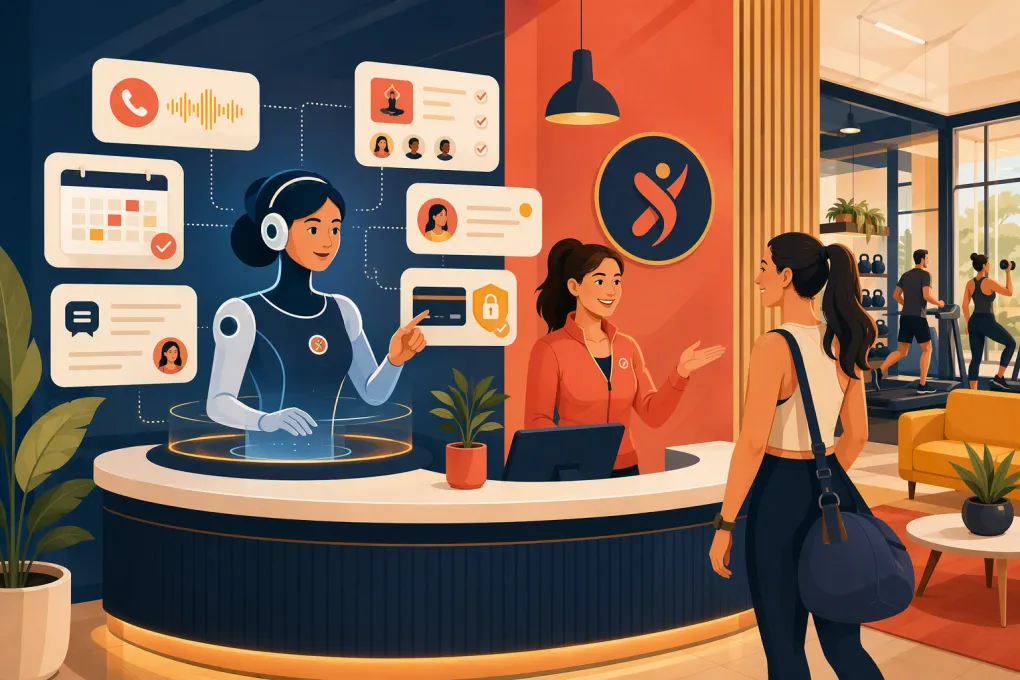
A useful AI receptionist sits between your communication channels and your operating system. It understands common requests, takes approved actions, records the interaction, and escalates when human judgment is required.
For a personal training studio, the core workflows should include:
- Answering questions about services, hours, location, trainers, and policies
- Capturing a lead’s name, contact information, goals, and preferred times
- Booking consultations, assessments, trials, or eligible sessions
- Sending confirmations, reminders, and pre-visit instructions
- Following up when a prospect does not book or misses an appointment
- Handling routine rescheduling and cancellation requests
- Sending secure payment links or dues reminders
- Routing sensitive, unusual, or high-value conversations to a person
The key phrase is approved actions. An AI receptionist should work from your real schedule, services, policies, and availability. It should not improvise pricing, promise results, diagnose injuries, or place clients into sessions that are not appropriate for them.
Where it creates the most operational value
Responding while interest is active
Personal training leads often have questions before they are ready to book. They may want to know whether your studio is beginner-friendly, whether a consultation is free, or whether you offer semi-private training.
An AI receptionist can answer those questions immediately and move the conversation toward a defined next step. Instead of ending with “someone will contact you,” it can offer available consultation times, collect relevant details, and complete the booking.
That makes the response useful rather than merely fast.
Booking the right appointment type
Personal training scheduling is more complicated than putting a name on a calendar. Your system may need to distinguish among:
- Introductory calls
- Movement assessments
- Goal-setting consultations
- Trial sessions
- One-on-one training
- Semi-private sessions
- Recurring client appointments
Each type may have different durations, trainer requirements, prerequisites, and booking rules. Your AI receptionist needs access to those rules so it does not offer a trial where an assessment is required or book a new lead into a returning-client slot.
A strong setup also prevents schedule conflicts by reading live availability rather than relying on a static list of times.
Following up without relying on staff memory
Lead follow-up often fails because it lives in sticky notes, inboxes, or an owner’s head. Automation can create a consistent sequence based on what actually happened.
For example:
- A lead asks about strength training but does not book.
- The receptionist answers the question and offers consultation times.
- If the lead goes quiet, it sends an approved follow-up.
- If the lead books, the prospecting sequence stops.
- The system sends confirmation and preparation instructions.
- If the prospect misses the appointment, it offers a path to reschedule.
This sequence should react to the lead’s status. Sending “ready to book?” after the person has already scheduled is a quick way to make automation feel careless.
See how WTF Go connects lead conversations, scheduling, and follow-up →
Recovering routine payment issues
Failed or overdue payments create awkward work for coaches and desk staff. An AI agent can handle the first layer by notifying the client, explaining the next approved step, and providing a secure way to update payment information.
It should not ask clients to send card details through ordinary text or chat. Look for a system that uses secure payment links and keeps sensitive payment data within the appropriate payment environment.
Payment automation also needs clear escalation rules. Disputes, repeated failures, refund requests, and financial hardship conversations should move to an authorized staff member.
A practical workflow for new personal training leads
An effective lead workflow can be straightforward:
1. Identify the request
Determine whether the person wants personal training, semi-private training, a class, membership information, or help with an existing account.
2. Qualify only what matters
Ask concise questions that affect the next step, such as:
- What are you hoping to work on?
- Have you trained with a coach before?
- Do you prefer one-on-one or small-group training?
- Which days or times generally work?
- Are there limitations you want the trainer to know about?
The AI should not attempt to evaluate medical conditions. If someone reports pain, a recent procedure, or a potentially urgent issue, the conversation should be escalated under your written policy.
3. Recommend the approved starting point
If every new client begins with an assessment, say so clearly and offer assessment times. If your studio uses an introductory call first, book that instead.
4. Complete the booking
Capture the required information, write the appointment into the live calendar, and send the studio’s cancellation policy and arrival instructions.
5. Trigger the correct follow-up
Booked leads should receive appointment communications. Unbooked leads should enter a prospect follow-up sequence. Missed consultations should receive a rescheduling option. Each status requires a different message.
What to evaluate before choosing a system
Do not choose an AI receptionist based on a polished demo alone. Test whether it can run your actual workflows.
Scheduling depth
Ask whether it can:
- Read live trainer availability
- Recognize different appointment types
- Respect buffers, capacity limits, and prerequisites
- Apply cancellation and rescheduling rules
- Prevent double bookings
- support multiple locations if you operate more than one studio
Conversation controls
You should be able to define what the AI may answer, what it may do, and when it must escalate. Confirm that staff can review conversation history and take over without forcing the client to repeat everything.
CRM and follow-up logic
A conversation is not useful if the resulting data disappears into a separate inbox. The system should create or update the contact record, record the source and outcome, and change follow-up based on booking status.
Payment handling
Confirm that payment requests use secure links and that access is limited by staff role. Ask how the platform records payment attempts, failures, and follow-up activity.
Consent and communication compliance
Automated texting does not eliminate your responsibility to obtain appropriate consent and honor opt-out requests. Your setup should preserve consent records, identify the business, and stop automated promotional messages when a recipient opts out. Have qualified counsel review your practices if you are unsure how federal or state requirements apply.
Reporting and accountability
At minimum, an operator should be able to inspect:
- Inquiry response time
- Leads contacted
- Consultations booked
- Booking and show outcomes
- Unbooked lead follow-up
- Missed-appointment recovery
- Payment reminder outcomes
- Conversations escalated to staff
Track these by source, location, and appointment type where possible. A single top-line total can hide whether one campaign or workflow is creating low-quality appointments.
How to implement an AI receptionist without creating chaos
Start with a narrow, high-value workflow rather than automating every client interaction at once.
Document the source of truth
Write down your current services, prices, appointment types, hours, policies, trainer availability rules, and escalation contacts. If staff members give different answers to the same question, fix that before training the system.
Launch with common inquiries
Begin with lead questions, consultation booking, confirmations, and basic rescheduling. Review real conversations to find missing answers and unclear rules.
Add follow-up by status
Build separate paths for leads who booked, did not book, canceled, or failed to show. Define when automation stops and a person takes over.
Add billing workflows carefully
Use secure payment links, role-based permissions, and documented escalation. Keep refunds, disputes, and exceptions under human control.
Review performance regularly
Read conversation samples, not just dashboards. Look for incorrect answers, unnecessary friction, repeated escalation topics, and leads who reached a dead end. Update the operating rules as your services and policies change.
Where Fitty fits
Fitty is the AI receptionist inside WTF Go, an operating system built for gyms, studios, spas, and wellness businesses. It is designed to answer leads, book appointments or classes, run follow-up, and help collect dues around the clock.
The advantage of putting the receptionist inside the operating system is continuity. The conversation, contact, schedule, follow-up status, and payment workflow do not have to live in disconnected tools. That reduces duplicate work and gives staff a clearer record when they step in.
Fitty should not replace a coach’s judgment or a manager’s handling of sensitive situations. It should absorb the repetitive front-desk load so your team can focus on consultations, coaching, and client relationships.
Explore Fitty for your personal training studio →
The standard to aim for
The best AI receptionist is not the one that sounds the most futuristic. It is the one that reliably moves the right person to the right next step while following your rules.
For a personal training studio, that means answering promptly, booking the correct service, keeping follow-up aligned with client status, protecting sensitive information, and handing exceptions to a human. If a system can do those things inside the same platform your staff already uses to operate the business, it becomes more than an answering tool. It becomes part of the front desk.
Frequently asked questions
Can an AI receptionist book personal training consultations?
Yes, if it connects to live availability and is configured with your appointment types, prerequisites, buffers, and trainer rules. It should confirm the booking in the same scheduling system staff use.
Will an AI receptionist replace my front-desk staff?
It is better used to cover repetitive inquiries, booking, reminders, and routine follow-up. Staff should still handle sensitive conversations, exceptions, disputes, and situations requiring judgment.
Can an AI receptionist follow up with gym leads by text?
It can automate approved text follow-up, but the studio remains responsible for proper consent, business identification, and honoring opt-out requests. Follow-up should also stop or change when the lead books.
What information does an AI receptionist need before launch?
Provide accurate services, pricing, hours, booking rules, trainer availability, policies, common answers, and escalation contacts. Clear source information prevents the system from giving inconsistent guidance.
Can Fitty help with overdue personal training payments?
Fitty can support dues follow-up and direct clients toward an approved payment step. Sensitive payment details should be handled through secure payment systems rather than ordinary text or chat.
Keep reading

Run your gym on autopilot with WTF Go
Fitty — your AI receptionist — answers calls and DMs, fills classes, follows up with every lead, and collects dues while you coach.