AI & Automation
AI Receptionist for Padel Clubs: Practical Operator Guide
Learn how an AI receptionist for padel clubs manages calls, bookings, follow-up, payments, integrations, and staff handoffs without creating front-desk chaos.
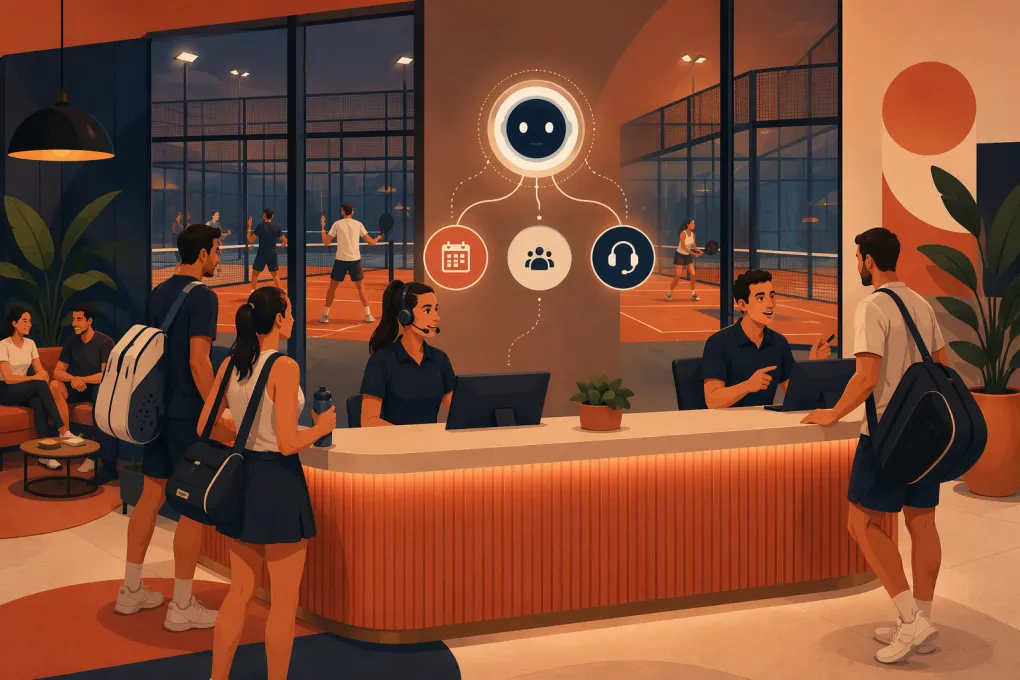 Watch · 20s
A padel club does not receive neat, single-purpose inquiries. One caller wants a court for four. Another is alone and needs open play. A member wants to use credits for guests. A beginner asks whether a clinic includes equipment. Meanwhile, the front desk is checking in players and handling a court that should have cleared five minutes ago.
An AI receptionist for padel clubs can take pressure off that operation, but only if it is connected to accurate information and given narrow decision rules. Installing a voice bot without defining inventory, account permissions, and handoff ownership simply creates a faster way to make booking mistakes.
The practical objective is straightforward: automate common requests while preserving a clear route to a person for exceptions.
See how Fitty can support after-hours calls and padel lead follow-up →
Where padel reception breaks down
Padel creates reception complexity because customers use similar language for different products. A caller asking to “book a game” might mean:
- Reserve an entire court for a private group
- Join an open-play session as one player
- Enter a league match already on the schedule
- Find a lesson or beginner clinic
- Arrange a social or corporate event
Those are not interchangeable transactions. They may have different capacities, eligibility rules, cancellation terms, and payment requirements.
From an operator’s standpoint, the most dangerous failure is not an awkward AI voice. It is a plausible but incorrect action: treating open play as court rental, promising inventory that is not live, or telling a member that credits cover a guest when they do not.
That is why a padel deployment should be designed around operational intents and decision rules—not a long list of generic FAQs.
What the AI should and should not do
Good first-phase use cases are frequent, structured, and reversible:
- Answering approved questions about hours, parking, equipment, attire, and amenities
- Distinguishing private court rental from open play, lessons, and clinics
- Capturing names, contact details, experience level, preferred location, and timing
- Reading live availability when a supported booking connection is configured
- Sending the correct booking, waiver, tour, or payment link
- Following up with leads who have consented to receive messages
- Escalating disputes, special events, safety issues, and policy exceptions
Keep higher-risk decisions with authorized employees. The AI should not invent discounts, override booking windows, waive cancellation fees, interpret contracts, settle payment disputes, or decide whether an injured player can safely return.
Integration architecture: connect the conversation to the operation
An AI receptionist is useful only when its actions reach the systems your team actually uses. Before launch, map each conversation outcome to a system of record.
Booking platform
The booking platform should remain authoritative for courts, sessions, coaches, capacity, waitlists, and account eligibility.
There are three practical integration levels:
- Direct booking: The AI can read live inventory and create or modify eligible reservations through a supported native integration or API.
- Availability plus link: The AI can identify the correct product or schedule, then send a customer to the booking platform to complete the transaction.
- Capture and handoff: If live inventory is unavailable, the AI records the request and routes it to staff without promising a slot.
Do not describe level two or three as automated booking. Test whether the connection supports cancellations, guest additions, credits, waitlists, and multi-location inventory—not merely schedule viewing.
CRM and member records
Every lead should create or update one record using a reliable identity key such as a verified phone number or email address. Define the fields the AI may write:
- Inquiry type
- Padel experience level
- Preferred club and time
- Membership interest
- Requested next step
- Consent and opt-out status
- Conversation summary
- Assigned owner
Set duplicate rules before launch. Otherwise, one prospect who calls, texts, and submits a form can become three records with three follow-up sequences.
Telephony
Decide whether the AI receives a dedicated number, answers the club’s main line, or handles calls forwarded after a set number of rings. Confirm:
- Business-hours and after-hours routing
- What happens if the AI service is unavailable
- Whether calls can transfer to a front desk, manager, or voicemail
- Caller identification behavior during transfers
- Recording notices and retention settings
- Which employee owns missed transfer callbacks
A common operating model is overflow first: staff get a brief opportunity to answer, then the AI takes the call. After-hours calls can route directly to the AI, with urgent categories following a separate escalation path.
Payments and dues
Use a payment processor or club billing system that provides a secure, tokenized payment path. The AI should send an approved link or initiate a supported workflow—not ask customers to speak or text card details.
For overdue dues, define the difference between a reminder and a dispute. The AI can explain that a balance is outstanding and provide the approved payment route. It should hand off questions about incorrect charges, freezes, hardship, refunds, or contract terms.
Handoff ownership
Every escalation needs a named role and response expectation. “Send to staff” is not a workflow.
| Request | Primary owner | AI action |
|---|---|---|
| New membership lead | Membership sales | Create or update lead, summarize intent, assign owner |
| Court-booking exception | Front desk | Capture date, time, players, location, and reason |
| League or tournament question | Program manager | Answer approved basics, route unresolved details |
| Failed payment or disputed charge | Billing owner | Send secure path for ordinary failures; escalate disputes |
| Private event | Events or general manager | Capture group size, date range, and contact information |
| Injury, threat, or urgent safety concern | On-duty manager or emergency route | Stop normal flow and use the documented escalation procedure |
Fitty capabilities, prerequisites, and limits
Fitty is WTF Go’s AI receptionist and agent for handling inquiries, lead follow-up, eligible bookings, and dues workflows. Those capabilities depend on configuration; they are not automatic simply because the AI is turned on.
For live booking, Fitty needs access to an authoritative schedule or an approved booking workflow, plus rules covering eligibility, duration, location, capacity, and payment. Without that access, it should provide the appropriate link or create a staff task rather than claim a reservation is confirmed.
For follow-up, the club needs accurate contact data, approved message sequences, consent controls, opt-out handling, and ownership rules. Fitty can run the configured process, but it cannot repair an unclear offer or decide how aggressively a club should contact a lead.
For dues collection, Fitty can support approved reminders and direct members to a secure payment process when configured. It is not a collections agency, should not negotiate account terms, and should route billing disputes or hardship conversations to an authorized employee.
Sample call flow: “I want to play tonight”
This question exposes whether the receptionist understands a padel operation. A useful flow looks like this:
- Identify party size. Ask whether the caller has four players or is looking to join others.
- If four players: Ask for location, preferred time, and desired duration. Check live court inventory only if the connection supports it.
- If fewer than four: Ask whether the caller wants open play, player matching, a clinic, or a private court anyway.
- Check eligibility. Confirm membership requirements, level restrictions, guest rules, and booking windows from approved data.
- Present valid options. Offer only inventory or links matching the caller’s party size and eligibility.
- Handle payment correctly. Use the configured checkout process. Do not collect payment credentials in the conversation.
- Confirm the outcome. State whether the reservation is confirmed, pending staff review, or awaiting customer checkout.
- Escalate exceptions. Transfer or create a task if the customer requests a policy override, private event, refund, accessibility accommodation, or unavailable inventory.
A critical decision rule is that “link sent” does not equal “booking confirmed.” The confirmation language should depend on whether the booking platform returned a successful reservation.
A deployment-grade launch checklist
Week 1: Map demand
Review recent calls, texts, emails, and desk questions. Tag each by intent: private court, open play, lesson, membership, event, payment, cancellation, or general information. Record the desired outcome and system involved.
Week 2: Build rules and content
Create approved answers and identify the source of truth for every variable item. Write explicit rules for:
- Member versus nonmember access
- Advance-booking windows
- Court duration and extensions
- Peak and off-peak restrictions
- Guest fees and limits
- Credits, packs, and entitlements
- Open-play level requirements
- Cancellations, no-shows, and refunds
- Rentals, balls, and demo rackets
- Weather procedures for outdoor courts
Week 3: Connect and test
Test the booking platform, CRM writes, phone transfers, secure payment links, and staff notifications. Use real operational scenarios in a controlled environment, but do not use unnecessary customer data.
One recurring failure mode to test is stale policy content. For example, the website may show one cancellation window while staff use another. The AI cannot resolve that governance problem; an operator must choose the authoritative policy before launch.
Week 4: Launch with limited authority
Start with after-hours or overflow answering. Allow FAQs, lead capture, and link delivery first. Enable direct booking only after the club verifies inventory accuracy, confirmation behavior, duplicate prevention, and cancellation handling.
Assign one manager to review transcripts and outcomes daily during the initial launch. That owner should correct knowledge, investigate failed handoffs, and decide when additional intents are safe to automate.
Measure resolved demand, not AI activity
Call volume and conversation counts do not show whether the system helps the club. Track operational outcomes instead:
- Calls answered rather than abandoned or sent to voicemail
- Leads with usable contact information and a clear next step
- Booking links sent versus completed reservations
- Confirmed trials, clinics, tours, or memberships
- Duplicate or incorrect CRM records
- Booking corrections caused by automation
- Transfers that reached the correct owner
- Escalations without timely staff action
- Opt-outs, complaints, and disputed messages
- Questions the approved knowledge base could not answer
The transcript review is particularly valuable. If callers repeatedly use language the flow does not recognize—such as asking for a “mix-in” instead of open play—update the intent model and approved responses.
Use AI to protect hospitality, not imitate it
Padel clubs grow through community, matching players well, and creating reasons to return. Those jobs still require people. The AI’s role is to prevent routine demand from burying the employees responsible for that experience.
A well-configured receptionist can answer immediately, identify what the player actually wants, and move the request into the correct system. A poorly configured one creates confident answers without operational authority.
That distinction comes down to integration depth, decision rules, and ownership. See how Fitty can support a controlled front-desk workflow for your padel club →
Frequently asked questions
Can an AI receptionist book padel courts directly?
Yes, if it has supported access to live inventory and permission to create reservations under the club's rules. Otherwise, it should send the correct booking link or route the request to staff without claiming confirmation.
Can Fitty follow up with every padel lead automatically?
Fitty can run configured follow-up workflows when contact data, approved messaging, consent, opt-out handling, and ownership rules are in place. Clubs should determine which leads qualify and when a person should take over.
How does an AI receptionist handle overdue membership dues?
It can send approved reminders and direct members to a secure payment workflow when properly configured. Billing disputes, freezes, hardship requests, refunds, and contract questions should go to authorized staff.
Should a padel club replace its front desk with AI?
AI is better used for overflow, after-hours coverage, repetitive questions, and structured workflows. Employees should retain ownership of hospitality, exceptions, disputes, safety matters, and complex sales.
What should a padel club test before launch?
Test live availability, booking confirmation, CRM deduplication, phone transfers, payment links, consent controls, staff notifications, and padel-specific scenarios such as solo players seeking open play.
Keep reading

Run your gym on autopilot with WTF Go
Fitty — your AI receptionist — answers calls and DMs, fills classes, follows up with every lead, and collects dues while you coach.