AI & Automation
AI Receptionist for Microneedling Clinics: Booking Guide
Use an AI receptionist for microneedling clinics to answer treatment questions, handle objections, book consults, and follow up without crossing clinical lines.
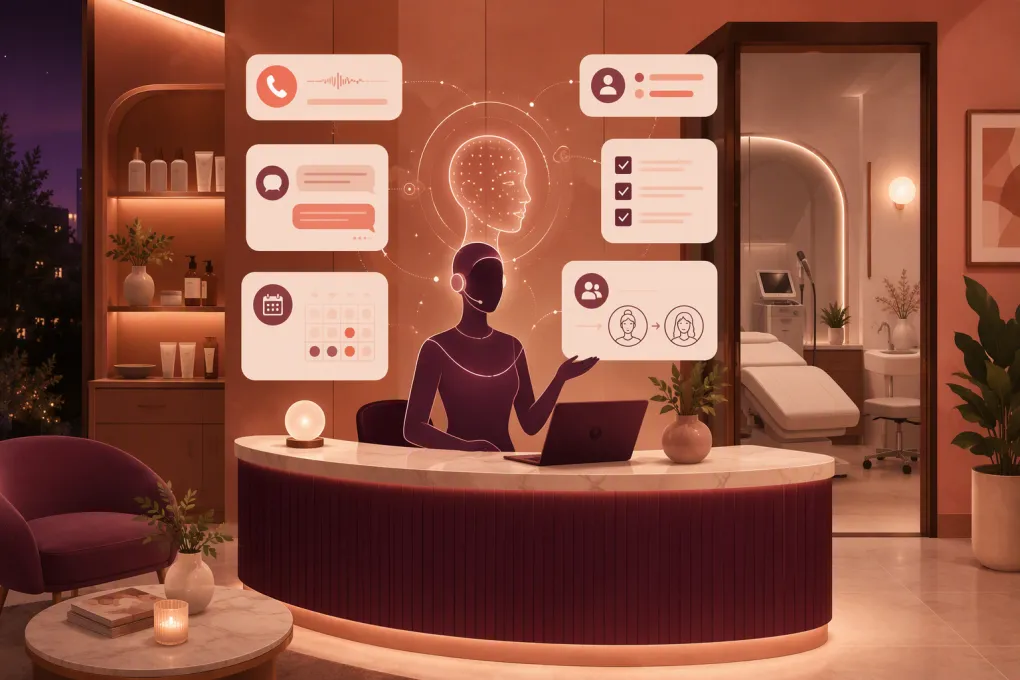 Watch · 20s
A strong microneedling lead is often one unanswered question away from booking. They want to know whether they need a consultation, what downtime looks like, how pricing works, or whether the treatment is appropriate for their skin concern. If your answer arrives the next morning, they may already be speaking with another clinic.
An AI receptionist can close that response gap—but only if it is configured for microneedling rather than handed a generic med spa FAQ. It needs to recognize treatment-specific intent, answer approved nonclinical questions, handle common objections, offer the correct appointment, and transfer anything involving suitability or complications.
That is a conversion workflow, not just a chatbot.
See how Fitty can support microneedling lead response and follow-up →
Where microneedling inquiries lose momentum
Most booking friction happens at a small number of decision points:
- The lead asks about price and receives no useful answer.
- The clinic requires a consultation but does not explain why.
- The prospect is unsure about downtime before an event.
- The requested time or provider is unavailable.
- The lead asks a clinical question that sits unanswered in a general inbox.
- A website form captures contact details but does not start a conversation.
- Staff answer once but never follow up after the lead says, “I’ll think about it.”
An AI receptionist should be designed around these moments. Its job is to give the prospect a safe, specific next step without making clinical promises.
A microneedling-specific conversion workflow
A practical workflow can be divided into five stages.
1. Identify intent before sending information
Do not open with a wall of treatment details. Ask one short routing question:
“Are you looking to book microneedling, compare treatment options, or ask about an existing appointment?”
For a new microneedling inquiry, collect only what is needed to advance the conversation:
- New or returning client
- Treatment area or general concern
- Consultation versus treatment request
- Preferred location, if applicable
- Preferred days or times
- Preferred contact method
Do not ask the AI to diagnose acne scars, hyperpigmentation, hair loss, or another concern. It can record what the prospect wants to address and route that information to the provider.
2. Answer the question that is blocking the booking
Build approved responses for the questions your front desk repeatedly receives:
- Is a consultation required?
- What does the clinic charge, or what variables affect price?
- How long is the appointment?
- What downtime should a prospect plan for?
- Can someone book before a wedding, vacation, or photo shoot?
- Who performs the treatment?
- Are packages available?
- What is the deposit and cancellation policy?
- Which questions require a clinician?
Use provider-approved language for downtime and results. Avoid guarantees and universal timelines because individual responses vary.
3. Offer the correct next step
The AI should not merely send a booking link. It should explain what the person is booking and then offer eligible times.
Examples include:
- New-client microneedling consultation
- Returning-client treatment
- Face, neck, scalp, or body consultation
- Follow-up assessment
- Provider callback for a suitability question
If the clinic requires clearance before treatment, the AI must not bypass that rule to improve booking numbers.
4. Recover the conversation when the lead hesitates
A hesitation is not necessarily a rejection. Configure responses for common objections, then provide a low-friction next action.
5. Continue permission-based follow-up
If the lead does not book, follow up with useful information rather than repeating “Are you ready?” Every message should let the person book, ask for help, or opt out.
Sample conversations for common microneedling objections
These scripts are templates, not clinical guidance. Replace the bracketed language with policies approved by your clinic and clinical leadership.
Price-first inquiry
Lead: “How much is microneedling?”
AI receptionist: “Pricing depends on [approved variables, such as treatment area or selected service]. Our [consultation/treatment] starts with [clinic-approved pricing language]. Would you like to see consultation times, or would you prefer that I explain what is included?”
Why it works: it answers instead of dodging, while avoiding an inaccurate quote.
Concern about downtime
Lead: “I have an event next weekend. Will my face still be red?”
AI receptionist: “Recovery can vary, so I can’t predict how your skin will respond. Because your event is close, I can arrange a provider conversation before you schedule treatment. Would you prefer a consultation on Tuesday or Wednesday?”
Why it works: it recognizes purchase intent, avoids individualized medical advice, and turns uncertainty into a consultation.
“I need to think about it”
Lead: “Thanks. I need to think about it.”
AI receptionist: “Of course. Is your main question about cost, timing, expected recovery, or whether microneedling is appropriate for your concern? I can answer clinic-policy questions or arrange a provider callback for clinical ones.”
Why it works: it uncovers the real objection without pressuring the prospect.
Requested time is unavailable
Lead: “I can only come Friday afternoon.”
AI receptionist: “Friday afternoon is currently unavailable for that appointment type. I can offer [eligible alternatives], add your request to the clinic’s cancellation process if available, or check another provider/location. Which option works best?”
Why it works: it avoids a dead end. Only offer waitlists, locations, or providers your clinic actually supports.
Potential contraindication or clinical concern
Lead: “Can I get microneedling if I’m taking medication for my skin?”
AI receptionist: “That needs to be reviewed by a qualified provider. I can collect your contact details and arrange a clinical callback or consultation. Please do not send sensitive medical details unless the clinic has directed you to an approved secure channel.”
Why it works: the AI recognizes the boundary and creates a safe handoff.
Booking-friction fixes that operators can implement
Match the calendar to the conversation
Audit every bookable service. Each one should have a clear duration, provider eligibility, room or device requirement, buffer, deposit rule, and new-client restriction.
If “Microneedling,” “Collagen Induction,” and device-specific treatments appear as separate services, define how the receptionist distinguishes them. Internal naming that makes sense to staff may confuse prospects.
Ask fewer questions before showing availability
Do not recreate a complete medical intake inside the opening conversation. Collect basic routing information, book the appropriate consultation, and use your approved intake process afterward.
Provide alternatives automatically
When the first choice is unavailable, offer the closest eligible times, another qualified provider, or another location. Do not simply say, “No appointments found.”
Explain deposits before requesting payment
State the amount or approved pricing language, whether it is applied to the appointment, and the relevant cancellation terms before presenting a payment step. If the AI or connected system cannot securely process the payment, route the prospect to the clinic’s approved payment workflow.
Build a human escape route
Include phrases such as “talk to the front desk,” “provider question,” and “call me” in your handoff logic. Automation should not trap a lead in a loop.
Explore how WTF Go and Fitty can help connect lead response, booking, and follow-up →
How to configure and test the workflow
A credible launch does not require an invented case study. It requires documented inputs and a repeatable test process.
Create five operating documents:
- Service matrix: appointment names, durations, providers, locations, prerequisites, and approved pricing language.
- Answer library: provider-approved responses for downtime, preparation, aftercare, results language, packages, and policies.
- Escalation map: named owners and expected handling for clinical questions, adverse reactions, complaints, refunds, and urgent language.
- Booking rules: deposits, buffers, consultation requirements, rescheduling limits, and room or equipment constraints.
- Consent rules: allowed channels, disclosure language, quiet hours, opt-out handling, and recordkeeping requirements.
Before launch, test at least these scenarios:
- New lead asking only for price
- Lead requesting treatment without a required consultation
- Prospect planning around an event
- Existing client reporting a reaction
- Unavailable provider or location
- Duplicate lead already in the system
- Lead opting out of messages
- Lead asking whether the AI is human
- Lead trying to share sensitive medical information
- Calendar or payment connection unavailable
Review the resulting appointment, contact record, transcript, consent status, and staff notification. A polished reply is not enough if the underlying record is wrong.
After launch, examine real conversations regularly. Track response time, booked consultations, handoff reasons, unanswered questions, booking corrections, opt-outs, complaints, and appointments requiring staff repair. Optimize against completed, correctly booked appointments—not conversation volume.
What Fitty does—and what to verify before buying
Fitty is WTF Go’s AI receptionist/agent within its operating system for gyms, studios, spas, and wellness businesses. It is designed to answer leads, support booking, continue follow-up, and help with dues or payment-related workflows around the clock.
Your exact deployment depends on your WTF Go configuration. Before signing up, ask the team to demonstrate the workflow using your own microneedling services and confirm:
- Which inbound and outbound channels are supported for your account
- Whether your current calendar, CRM, phone, messaging, and payment tools connect directly
- Whether you will use WTF Go’s native workflows, an integration, or a manual handoff
- How appointment types, provider rules, locations, and buffers are configured
- How transcripts, consent records, opt-outs, and failed messages are stored
- What happens when a calendar, integration, or payment step fails
- How clinical questions and urgent language reach a human
- Which features require additional setup or services
Do not assume compatibility with a specific third-party platform unless WTF Go confirms it. Fitty should also not be treated as a clinician, emergency service, or substitute for medical screening.
A sensible rollout starts with one inquiry source and one appointment type. Validate the records and handoffs, add follow-up, and then expand to other services or locations.
Ask WTF Go to map Fitty to your microneedling consultation workflow →
Consent, AI disclosure, and outreach compliance
Automated calls and texts are regulated differently depending on the channel, message purpose, technology, consent obtained, and jurisdiction. Marketing outreach can carry different requirements from a direct response to an appointment request.
Have qualified counsel review your workflow under applicable federal and state rules, including telephone and text marketing requirements, do-not-call obligations, call-recording laws, privacy rules, and healthcare requirements.
Operationally, your clinic should:
- Record how, when, and where consent was obtained.
- Preserve the exact language shown when the person submitted their number.
- Distinguish transactional appointment messages from promotional outreach.
- Honor STOP and other valid opt-out requests promptly across connected systems.
- Apply appropriate calling hours and internal suppression lists.
- Disclose call recording when required.
- Decide when and how the system identifies itself as an AI assistant.
- Avoid deceptive language that implies the AI is a licensed provider or human employee.
- Review state-specific rules before launching campaigns across multiple locations.
- Use approved systems for sensitive health information and execute required vendor agreements where applicable.
AI disclosure rules continue to develop. A straightforward introduction such as “I’m the clinic’s automated assistant” reduces confusion, but legal sufficiency depends on the use case and jurisdiction.
The best AI receptionist for a microneedling clinic is not the one that talks the most. It is the one that removes a specific booking obstacle, knows when to stop, and leaves staff with a clean record and a clear next action.
Frequently asked questions
Can an AI receptionist book microneedling treatments directly?
Yes, when the clinic permits direct booking and the system has accurate appointment, provider, buffer, deposit, and eligibility rules. If a consultation or clinical clearance is required, the AI should book that step instead.
Can AI answer questions about microneedling downtime?
It can share provider-approved general information, but it should not predict an individual's recovery. Event timing, medications, skin conditions, and suitability questions should be escalated to a qualified provider.
What should I ask before connecting Fitty to my clinic?
Confirm supported channels, calendar and CRM connections, payment handling, consent records, escalation behavior, outage handling, and the exact method used to configure services and locations.
Do automated microneedling follow-up texts require consent?
Consent requirements depend on the message, technology, relationship, and jurisdiction. Preserve consent records, separate transactional from promotional outreach, honor opt-outs, and have qualified counsel review the workflow.
Should an AI receptionist disclose that it is AI?
Transparent identification reduces confusion and may be required in some contexts or jurisdictions. The assistant should never imply that it is a licensed clinician or provide individualized medical advice.
Keep reading
Run your gym on autopilot with WTF Go
Fitty — your AI receptionist — answers calls and DMs, fills classes, follows up with every lead, and collects dues while you coach.