AI & Automation
AI Receptionist for Med Spas: Workflows and Buyer's Guide
Learn how an AI receptionist for med spas handles calls, qualifies leads, books consultations, follows up, and supports staff without losing the human touch.
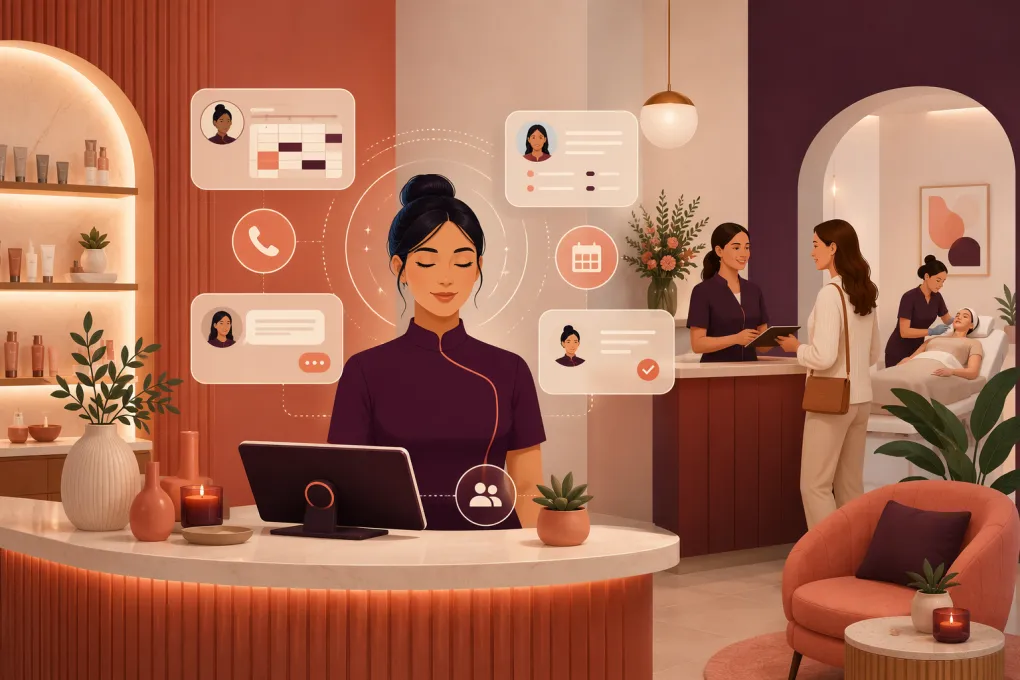 Watch · 20s
A med spa rarely loses a lead because the treatment menu is missing one more service. Leads are usually lost in the operational gaps: an unanswered call during a procedure, a website inquiry that sits overnight, a slow follow-up, or a booking conversation that becomes too complicated for the prospect.
An AI receptionist for med spas is designed to close those gaps. It can respond immediately, answer approved questions, collect lead details, book eligible appointments, follow up, and route sensitive or complicated conversations to staff.
That does not mean replacing your front desk or letting software make clinical decisions. The useful model is simpler: automate repetitive reception work while giving employees clear control over exceptions.
See how Fitty can respond to med spa leads around the clock →
What an AI receptionist should actually do
A capable AI receptionist should handle specific workflows rather than merely producing conversational responses. For a med spa, those workflows typically fall into five categories.
1. Capture and qualify new leads
Every inquiry should create a usable record. At a minimum, the receptionist can collect:
- Name and preferred contact method
- Service or treatment interest
- Preferred location, provider, date, or time
- Whether the person is a new or returning client
- Whether a consultation is required
- The source of the inquiry, when available
- Consent needed for future calls or texts
Qualification should stay operational. An AI can ask which service someone is interested in, but it should not decide whether a medical treatment is appropriate.
For example, it can say that a consultation is required before booking a particular treatment. It should not tell a prospect that the treatment is safe for them based on symptoms, medications, pregnancy status, or medical history.
2. Answer approved questions consistently
Prospects repeatedly ask about hours, locations, parking, preparation, general service categories, financing options, consultation policies, memberships, and appointment availability. Those are strong automation candidates when the answers come from an approved knowledge base.
Build that knowledge base from controlled sources:
- Current website content
- Treatment and service policies
- Provider schedules and location details
- Cancellation and deposit rules
- Membership or package terms
- Staff-approved pre- and post-appointment instructions
Assign an owner to every answer and review the content whenever a policy, provider, service, or price changes. An outdated answer delivered confidently is worse than a quick human handoff.
3. Book the right appointment
Med spa scheduling involves more than placing a name into an open slot. The system may need to account for:
- Consultation requirements
- New-client versus returning-client appointment types
- Provider credentials and service eligibility
- Treatment room or equipment availability
- Location-specific menus
- Appointment duration and cleanup buffers
- Deposit or card-on-file policies
- Restrictions on booking multiple services together
Start by mapping each service to an allowed appointment type. If a prospect asks for something outside that map, the AI should collect the request and send it to staff instead of improvising.
This is where integration quality matters. A receptionist that can talk about availability but cannot read or update the real calendar may create duplicate work and booking errors.
4. Follow up without depending on staff memory
Many med spa leads are interested but not ready to book during the first conversation. A structured follow-up sequence can keep those opportunities from disappearing.
A practical sequence might include:
- An immediate response confirming the request
- A follow-up offering available consultation times
- A reminder if the lead started but did not finish booking
- A final message that gives the lead a simple way to continue or opt out
The content should reflect the inquiry. Someone asking about a facial should not receive the same follow-up as someone requesting an injectable consultation.
Fitty, WTF Go’s AI agent, is built to answer leads, book eligible services, follow up, and support payment collection workflows 24/7. That gives operators one system for moving a conversation toward a scheduled visit instead of stacking separate inbox, chatbot, and reminder tools.
Explore Fitty for med spa lead response and booking →
5. Escalate to a person at the right moment
Good automation knows when to stop. Create explicit handoff rules for:
- Medical or diagnostic questions
- Treatment reactions, complications, or urgent concerns
- Medication and contraindication questions
- Complaints, refund requests, and adverse experiences
- Pricing exceptions or negotiation
- Complex package balances
- Accessibility or language needs the system cannot support
- Any request the AI cannot answer from approved information
The handoff should include the conversation summary, contact details, service interest, and requested next step. Staff should not have to ask the client to repeat the entire story.
For urgent medical concerns, configure a clear instruction that directs the person to the practice’s designated clinical contact or emergency services, as appropriate. An AI receptionist is not a triage clinician.
AI receptionist compliance requires operational planning
Med spas sit at the intersection of hospitality, retail, and healthcare. Your legal and compliance obligations depend on how the business is structured, what information is collected, and which services are provided.
Before launching, review these areas with qualified advisors:
HIPAA and health information
Not every med spa has the same HIPAA status, but many handle protected or sensitive health information. Determine whether the receptionist vendor will create, receive, maintain, or transmit protected health information on your behalf. If so, assess whether an appropriate business associate agreement and security controls are required.
Minimize data collection. The receptionist usually does not need a detailed medical history to schedule a consultation.
Calling and texting consent
Automated calls and text messages can trigger federal and state requirements. Capture consent properly, identify the business, honor opt-outs, and avoid treating a purchased lead list as blanket permission for unlimited automated outreach.
Call recording and transcription
State laws differ on recording consent. If calls are recorded or transcribed, disclose that practice as required and establish retention and access policies.
Payments
If the receptionist accepts deposits, membership payments, or outstanding balances, use a compliant payment processor. The AI should not expose full payment credentials in transcripts or staff notifications.
These are implementation issues, not boxes to check after launch. Ask prospective vendors to explain data storage, access controls, retention, incident response, payment handling, and contractual commitments in plain language.
How to evaluate an AI receptionist for your med spa
A polished demo is not enough. Test the system against real reception scenarios before committing.
Use a structured test script
Create sample inquiries such as:
- A new lead wants an injectable appointment without a consultation
- A returning client wants to move an appointment to another location
- Someone asks whether a treatment is safe with a specific medication
- A prospect wants two services requiring different resources
- A client asks for a refund after a poor experience
- A lead messages after hours and wants the earliest available consultation
- A caller changes topics halfway through the conversation
Score whether the system gives an approved answer, completes the workflow, or escalates correctly. Do not reward it for sounding human if the operational result is wrong.
Check the underlying controls
Ask each vendor:
- Can staff control exactly which services the AI may book?
- Does it use live schedule availability?
- Can it account for providers, rooms, equipment, and locations?
- How are policies and answers updated?
- Can staff review conversations and correct responses?
- What happens when an integration is unavailable?
- How does the system identify urgent or clinical language?
- Can it transfer or assign a conversation to a person?
- How are consent, opt-outs, and communication history stored?
- What implementation and migration support is included?
Also confirm the pricing model. AI receptionist products may charge by location, user, conversation, minute, message volume, or feature package. Model the cost using your actual inquiry patterns instead of comparing only the advertised entry price.
A practical rollout plan
Do not automate every conversation on day one. A staged rollout makes errors easier to find and limits operational risk.
Phase 1: After-hours lead capture
Start with calls and messages that would otherwise wait until the next business day. Let the AI answer basic questions, capture details, and book only straightforward consultation types.
Phase 2: Booking and reminders
Add live scheduling after confirming service rules, provider calendars, resources, buffers, and cancellation policies. Test rescheduling and cancellation as carefully as new bookings.
Phase 3: Follow-up and payment workflows
Build service-specific follow-up sequences. Then add approved deposit, membership, or balance-collection workflows if the platform and processor support your requirements.
Phase 4: Broader front-desk coverage
Once staff trust the routing and booking logic, extend coverage to common daytime inquiries. Keep humans available for clinical questions, exceptions, complaints, and high-value consultations that need personal attention.
WTF Go combines operating workflows with Fitty, so lead response, booking, follow-up, and dues collection do not have to live in disconnected tools. Before going live, confirm the exact scheduling, payment, migration, and compliance setup required by your med spa.
See how WTF Go can support your med spa’s front desk workflows →
Measure outcomes, not conversation volume
The goal is not to maximize the number of AI conversations. Track whether reception work is becoming faster, more accurate, and easier to manage.
Useful measures include:
- Time from inquiry to first response
- Percentage of inquiries receiving a response
- Qualified leads that schedule
- Appointment completion and no-show patterns
- Booking corrections caused by automation
- Conversations requiring staff handoff
- Follow-ups completed as scheduled
- Opt-outs and communication complaints
- Deposits or balances successfully processed
- Staff time spent resolving AI-created errors
Review transcripts and outcomes regularly during the rollout. Look for repeated unanswered questions, incorrect booking paths, abrupt handoffs, and policies clients find confusing. Those patterns should feed back into your knowledge base and workflow rules.
An AI receptionist for med spas works best as an accountable operating system, not an unsupervised digital employee. Give it accurate information, narrow permissions, live scheduling data, and clear escalation rules. It can then protect response time and reduce repetitive work while your team handles the conversations that require clinical judgment, empathy, or discretion.
Frequently asked questions
Can an AI receptionist book med spa appointments?
Yes, if it connects to the med spa's scheduling system and follows configured rules for providers, services, locations, consultations, rooms, and appointment durations.
Is an AI receptionist for med spas HIPAA compliant?
Compliance depends on the med spa, the data involved, and the vendor's technical and contractual safeguards. Determine whether a business associate agreement is required and verify security, retention, and access controls with qualified advisors.
Can an AI receptionist answer treatment questions?
It can answer approved administrative and general service questions. Medical advice, contraindications, reactions, diagnosis, and treatment suitability should be escalated to qualified clinical staff.
Will an AI receptionist replace med spa front-desk staff?
It is better used to cover repetitive inquiries, after-hours response, booking, and follow-up. Staff remain essential for clinical questions, complaints, exceptions, sensitive conversations, and complex scheduling.
What should a med spa test before launching an AI receptionist?
Test booking restrictions, calendar accuracy, handoffs, clinical-question escalation, consent handling, rescheduling, cancellations, payment security, and what happens when an integration fails.
Keep reading

Run your gym on autopilot with WTF Go
Fitty — your AI receptionist — answers calls and DMs, fills classes, follows up with every lead, and collects dues while you coach.