AI & Automation
AI Receptionist for Med Spa Treatment Follow-Up: A Guide
Learn how an AI receptionist for med spa treatment follow-up automates check-ins, flags concerns, books visits, and keeps your clinical team in control.
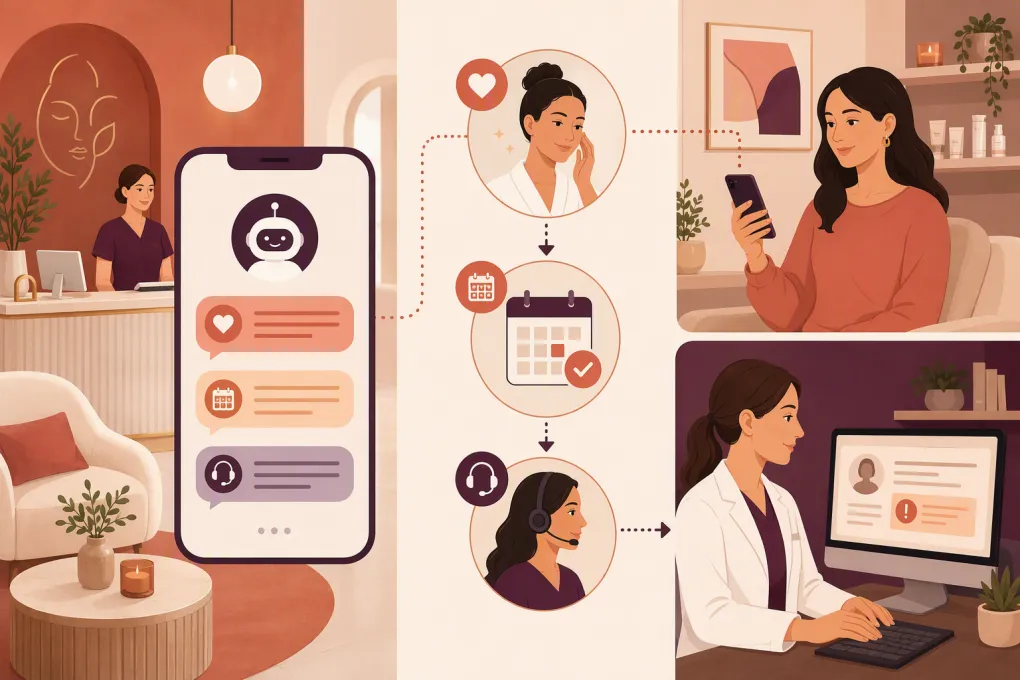 Watch · 20s
A treatment may end when the client leaves your med spa, but the operational work does not. Someone still needs to deliver aftercare reminders, check for concerns, answer routine questions, schedule the next visit, and alert the clinical team when a response needs human judgment.
When that process depends on receptionists remembering individual tasks, follow-up becomes inconsistent. Messages go out late. Clients call after hours. Clinical questions get mixed into the front desk inbox. Opportunities to book recommended follow-up visits are missed.
An AI receptionist for med spa treatment follow-up can handle much of this administrative workload. The key is drawing a hard line between communication automation and clinical decision-making. AI can initiate check-ins, collect structured responses, answer approved administrative questions, and route exceptions. It should not diagnose a reaction, improvise medical advice, or decide whether a symptom is safe.
See how Fitty can manage routine med spa follow-up and booking around the clock →
What an AI receptionist should handle after treatment
A useful AI receptionist does more than send a generic thank-you text. It runs a treatment-specific workflow using timing, messaging, and escalation rules approved by your practice.
Scheduled aftercare communication
Your team can configure messages for the intervals appropriate to each service. The exact timing should come from your medical director, licensed providers, and documented protocols—not from the AI vendor.
A workflow might include:
- A confirmation that the client received written aftercare instructions
- A reminder about relevant restrictions or care steps from your approved materials
- A check-in asking whether the client has a question or concern
- A prompt to schedule a provider-recommended follow-up visit
- A later reminder when it is appropriate to discuss maintenance or another service
The AI receptionist triggers the communication and records the response. Your approved clinical content remains the source of truth.
Structured intake of client responses
Free-form messages are difficult to triage at scale. A better workflow combines a simple question with clear response paths.
For example:
We are checking in after your treatment. Are you contacting us about scheduling, aftercare instructions, or a treatment concern?
The system can handle scheduling directly, send the approved instructions already provided by the practice, or route a treatment concern to the designated person. It should also preserve the client’s original message so staff can review the full context.
Appointment booking and rescheduling
Many post-treatment conversations end with an appointment request. An AI receptionist should be able to offer appropriate availability, book the correct appointment type, send confirmation, and handle basic rescheduling rules.
This is especially useful after hours, when a client may be ready to book but no receptionist is available. The workflow should respect provider, room, equipment, location, and appointment-duration constraints rather than placing every request into a generic calendar slot.
Administrative questions
AI can answer questions grounded in information your med spa has approved, such as:
- Business hours and location details
- Parking or arrival instructions
- How to contact the clinical team
- Whether a follow-up appointment is already scheduled
- General booking and cancellation policies
- Where to find the aftercare instructions provided by the practice
Clinical questions need a different path. Even if a client describes something common, the receptionist should avoid interpreting symptoms or assuring the client that a reaction is normal.
Build escalation before automating messages
Automation is only safe and useful when the exception path is clear. Before launching follow-up, document what happens when the AI cannot—or should not—complete the conversation.
Define escalation categories
A practical routing structure includes at least four categories:
- Administrative: Scheduling, directions, receipts, policies, and account questions.
- Routine clinical review: A non-urgent treatment question that needs a licensed team member.
- Urgent concern: Language matching your practice’s approved escalation criteria.
- Emergency: A message that should receive your approved emergency instruction rather than waiting in a staff queue.
The AI should not independently create the medical criteria behind these categories. Your clinical leadership should define the trigger language, response copy, destination, and expected response process.
Assign a real owner
Routing a message to an unmonitored inbox is not escalation. Specify:
- Which role receives each type of alert
- Where the alert appears
- Who provides backup coverage
- What happens outside business hours
- How unresolved items are handed off between shifts
- How staff mark the issue as reviewed or closed
Test this process with realistic scenarios. Include misspellings, vague statements, multiple questions in one message, and clients who stop responding halfway through the exchange.
Use conservative fallback language
If the system is uncertain, it should say so and involve a person. A safe fallback is more valuable than a confident but unsupported response.
The wording should be direct: the automated receptionist cannot assess symptoms, the message is being routed according to practice policy, and the client should follow the practice’s approved urgent or emergency instructions when applicable.
Design treatment-specific workflows
A single sequence for every service creates weak communication and unnecessary risk. Build separate workflows around the operational requirements of each treatment category.
For each workflow, document:
- Treatment or appointment type
- Responsible provider and location
- Approved send times
- Allowed communication channels
- Approved aftercare source material
- Questions the AI may answer
- Questions it must escalate
- Follow-up appointment type and booking rules
- Stop conditions, such as an opt-out or completed appointment
- Recordkeeping requirements
Do not let a marketing sequence continue unchanged after a client reports a concern. A concern should pause promotional messaging until your team reviews the situation and determines the appropriate next step.
Write messages clients can act on
Post-treatment messages should be short, identifiable, and focused on one action. The client should immediately understand who is contacting them and why.
A useful administrative check-in could follow this structure:
- Identify the med spa
- Reference the treatment date or visit without exposing unnecessary information
- State the purpose of the message
- Offer clear response options
- Explain how to reach appropriate help
- Include required opt-out language for the channel
Avoid sending sensitive treatment details to a shared phone or leaving them in voicemail unless your consent process and privacy policies support that use. Also avoid promotional language inside a clinical check-in. Clients should not have to determine whether a message is genuine care coordination or an upsell.
Address consent, privacy, and communications rules
Med spas operate at the intersection of healthcare, consumer messaging, and marketing. Automation does not remove those responsibilities.
Before using an AI receptionist, review:
Consent and channel rules
Document how clients consent to calls, texts, or emails. Separate operational communication from marketing where required, honor opt-outs, and configure appropriate sending hours. Automated calls, prerecorded content, and AI-generated voice interactions may create additional legal requirements.
Have qualified counsel review your workflows under the laws and regulations applicable to your business, including federal and state communication rules. This article is operational guidance, not legal advice.
Protected and sensitive information
Map what information enters the platform, where it is stored, who can access it, and which other systems receive it. If a vendor will create, receive, maintain, or transmit protected health information on your behalf, determine whether a business associate agreement and other safeguards are required.
Ask vendors about access controls, audit history, retention, deletion, incident procedures, subcontractors, and staff permissions. Do not assume that an AI label—or a general claim of secure software—answers those questions.
Minimum necessary access
The receptionist needs enough context to perform the assigned task, but it may not need the client’s complete chart. Limit access by workflow and role. A booking interaction may require treatment category, provider, location, and scheduling status without exposing unrelated clinical history.
Connect follow-up to front desk operations
An AI receptionist fails when it becomes another disconnected inbox. The follow-up workflow should connect with the systems and daily routines your team already uses.
At minimum, decide how the system will handle:
- New and existing client identification
- Appointment status and calendar availability
- Duplicate records
- Multiple med spa locations
- Provider-specific booking restrictions
- No-response and opt-out status
- Conversation summaries and staff notes
- Failed message delivery
- Human takeover and return to automation
Fitty, WTF Go’s AI receptionist, is designed to handle conversations such as lead response, booking, follow-up, and payment collection without limiting those interactions to front desk hours. For a med spa deployment, the important step is configuring those capabilities around your approved treatment protocols and escalation boundaries.
Measure whether the workflow is actually working
Do not evaluate follow-up automation only by the number of messages sent. That rewards activity rather than operational performance.
Track measures such as:
- Successful versus failed message delivery
- Client response volume by workflow
- Follow-up appointments requested and booked
- Conversations escalated by category
- Time from escalation to staff review
- Questions the AI could not answer
- Human takeover frequency
- Opt-outs and communication complaints
- Duplicate, incorrect, or mistimed messages
- Open items that were never resolved
Review transcripts or conversation records regularly, especially after adding a treatment, changing providers, or revising aftercare instructions. The goal is not to eliminate human involvement. It is to reserve staff time for the conversations that require judgment, empathy, or clinical expertise.
A practical rollout plan
Start narrowly instead of automating every treatment at once.
- Choose one commonly performed treatment with a stable, documented follow-up protocol.
- Map the current process from checkout through the final follow-up step.
- Get clinical approval for timing, content, escalation criteria, and emergency language.
- Configure booking rules and staff ownership.
- Test routine, ambiguous, urgent, opted-out, and after-hours scenarios.
- Launch with active transcript and escalation review.
- Correct failure points before expanding to another treatment.
A well-run AI receptionist should make your med spa more responsive without pretending to be a provider. Keep clinical judgment with licensed professionals, give the system precise administrative responsibilities, and make every escalation land with a real owner.
Frequently asked questions
Can an AI receptionist give med spa aftercare advice?
It can deliver aftercare content approved by the practice, but it should not create advice, interpret symptoms, diagnose reactions, or replace a licensed provider.
Can an AI receptionist book post-treatment appointments?
Yes, if it has access to the appropriate appointment types, availability, locations, provider rules, and scheduling restrictions.
How should an AI receptionist handle a treatment concern?
It should collect the client’s message, apply practice-approved routing rules, provide approved urgent or emergency instructions when applicable, and alert the designated staff member.
Does med spa follow-up automation need to support HIPAA requirements?
If the workflow involves protected health information, the med spa should assess the vendor’s role, safeguards, access controls, data handling, and willingness to sign a business associate agreement when required.
Keep reading

Run your gym on autopilot with WTF Go
Fitty — your AI receptionist — answers calls and DMs, fills classes, follows up with every lead, and collects dues while you coach.