AI & Automation
AI Receptionist for Med Spa Rebooking: A Practical Guide
Learn how an AI receptionist for med spa rebooking turns missed follow-ups into booked visits with smarter timing, scripts, handoffs, and clear tracking.
 Watch · 20s
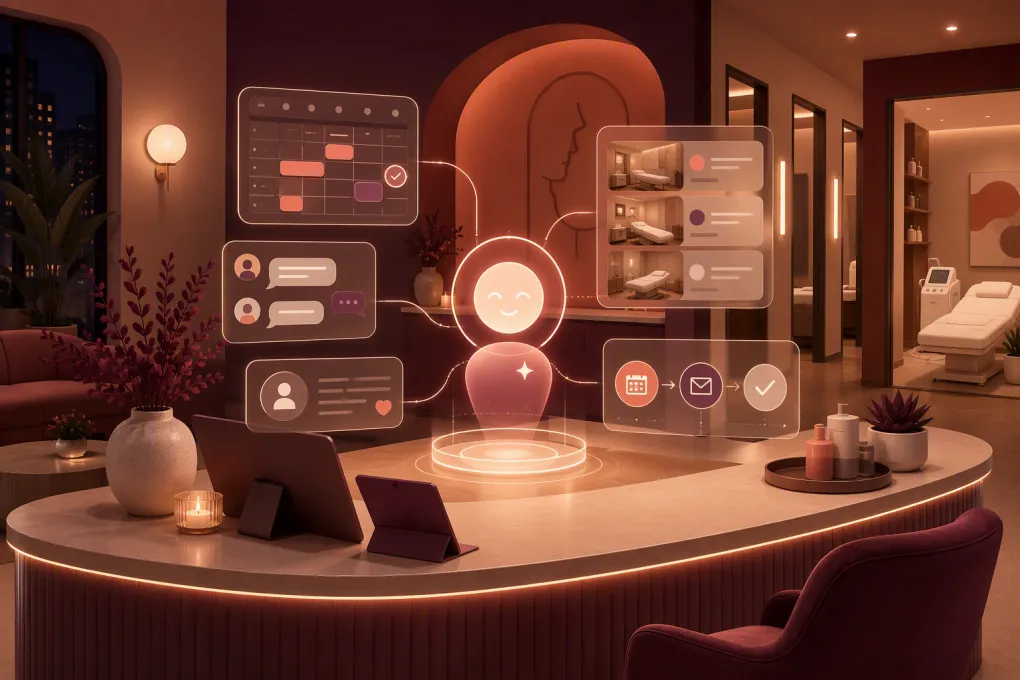
A med spa can deliver an excellent treatment and still lose the next appointment. The client leaves without booking, the front desk gets busy, and the follow-up task sits untouched until the ideal return window has passed. An AI receptionist for med spa rebooking closes that operational gap by contacting eligible clients, answering routine questions, offering available times, and moving conversations toward a confirmed appointment.
The value is not simply sending more reminders. Basic reminder software already does that. The real opportunity is creating a controlled rebooking workflow that knows who should be contacted, when outreach is appropriate, what the AI may say, and when a person must take over.
See how Fitty handles med spa follow-up and booking 24/7 →
Why med spa rebooking breaks down
Most rebooking problems are process problems rather than staff-effort problems. Front-desk teams are expected to answer calls, greet clients, check people out, manage providers, collect payments, and respond to new leads. Follow-up with existing clients competes with everything happening in real time.
Common failure points include:
- The recommended return window is not recorded consistently.
- Follow-up depends on a staff member remembering to run a report.
- Clients receive a booking link but cannot get a simple question answered.
- Messages go out after the most relevant treatment window.
- Nobody owns replies received after hours.
- Staff cannot tell whether the client booked, declined, or needs help.
- Generic campaigns contact clients who are not appropriate candidates for that service.
An AI receptionist can remove repetitive work, but it will not repair poor data or unclear booking rules. Automation should sit on top of a defined process—not replace one.
What an AI receptionist should do
For rebooking, the AI needs to manage more than outbound messages. A practical workflow should cover five jobs.
1. Identify clients who are eligible for outreach
The trigger should come from a reliable operational event, such as a completed appointment, a staff-recorded follow-up date, or an approved service interval. Do not infer clinical eligibility from incomplete notes or purchase history alone.
Useful trigger fields include:
- Completed service
- Treating provider
- Recommended return date or date range
- Services the client may book without another consultation
- Preferred location and provider
- Communication consent and preferred channel
- Existing future appointment
A booked appointment, opt-out, contraindication flag, unresolved complaint, or staff hold should stop automated outreach.
2. Start a two-way conversation
A static reminder says, “Book now.” An AI receptionist should be able to handle routine responses such as:
- “What times are available next week?”
- “Can I see the same provider?”
- “How long is the appointment?”
- “Can I move the visit I already booked?”
- “I’m not ready yet—check back next month.”
The AI should answer from approved business information, not improvise. Service duration, preparation instructions, cancellation policies, location details, and booking rules need a maintained source of truth.
3. Book against real availability
Rebooking only becomes useful when the conversation ends in a confirmed appointment. The workflow should recognize provider schedules, service duration, room or equipment constraints, location, buffer time, and any consultation requirements supported by the spa’s booking setup.
If the AI cannot safely complete the booking, it should collect the client’s preferences and route the conversation to staff. A clean handoff is better than a confident but incorrect appointment.
4. Follow up without creating message fatigue
More outreach is not automatically better. Build the cadence around the return window for each service rather than applying one schedule to every client.
A workable structure is:
- At checkout: Ask whether the client wants to reserve the next visit now.
- After the completed appointment: Send only necessary care or service communications approved by the business.
- Before the recorded return window: Offer suitable appointment options.
- During the return window: Send a concise follow-up if there has been no response.
- After the window: Move the client into a lower-frequency reactivation workflow or assign a staff task.
Stop messages immediately when the client books, declines, opts out, requests a later follow-up, or needs human assistance.
5. Escalate clinical and sensitive questions
An AI receptionist is an operational agent, not a licensed medical professional. It should not diagnose a reaction, determine treatment suitability, change post-treatment instructions, or make promises about outcomes.
Define escalation categories before launch:
- Possible adverse reactions or urgent symptoms
- Pregnancy, medication, allergy, or contraindication questions
- Treatment-result complaints
- Refunds, disputes, or chargebacks
- Requests outside approved booking rules
- Repeated confusion or negative sentiment
Give each category an owner and response path. For potentially urgent concerns, use language reviewed by the spa’s clinical leadership and direct the client to the appropriate human or emergency resource.
Build the workflow before writing messages
The strongest rebooking automation starts with a service matrix. Create one row for every service category and document:
- Whether automatic rebooking outreach is allowed
- The event that starts the workflow
- The approved return date or staff-entered interval
- Whether a consultation is required
- Which providers, rooms, or resources can support it
- Questions the AI may answer
- Questions that require staff or clinical review
- The maximum follow-up cadence
- Conditions that suppress outreach
This exercise often exposes operational inconsistencies. One provider may record a return date while another leaves it blank. A service may be bookable online even though staff believe it requires approval. Resolve those conflicts before enabling automation.
See how WTF Go and Fitty can turn approved follow-up rules into a 24/7 booking workflow →
Use scripts that create a decision
Messages should be specific enough to be useful but not reveal sensitive treatment information unnecessarily. They should also make the next step easy.
Return-window message
Hi [First Name], this is the reception team at [Spa]. It may be time to plan your next visit with [Provider, if appropriate]. Would you like available times, or would you prefer that we check back later?
Availability follow-up
I can help with that. Do you prefer mornings, afternoons, or evenings? I can also look for a specific day or provider.
Existing-appointment response
You already have an appointment scheduled for [Date and Time]. Would you like to keep it or look at other options?
Human handoff
I want to make sure the right team member handles this. I’ll pass your message to [team or role] for follow-up.
Avoid claiming that a provider recommended a treatment unless that recommendation is actually documented. Do not use urgency such as “you are overdue” when the timing is only a marketing estimate.
Protect consent, privacy, and client trust
Med spas operate at the intersection of hospitality, commerce, and healthcare. The applicable privacy and communication requirements depend on the business, the data involved, the communication channel, and federal and state law.
Before launch:
- Confirm how clients consent to calls and texts and how opt-outs are honored.
- Review Telephone Consumer Protection Act requirements and relevant state rules with qualified counsel.
- Determine whether the spa is a HIPAA-covered entity or business associate.
- If a technology vendor handles protected health information, evaluate whether an appropriate business associate agreement is required and available.
- Keep unnecessary treatment details out of SMS previews and voicemail messages.
- Restrict the AI to approved information and preserve an activity log.
- Define retention, access, deletion, and staff-permission policies.
- Disclose that the client is interacting with an automated assistant when required and whenever clarity would improve trust.
Do not assume that using scheduling software makes every connected messaging or AI tool appropriate for medical information. Review the complete data path.
Measure rebooking as an operating system
Track results by location, service category, provider, source workflow, and communication channel. Useful measures include:
- Eligible-client volume: Clients who met the approved outreach criteria
- Contact rate: Eligible clients who successfully received outreach
- Reply rate: Clients who responded to the conversation
- Rebooking rate: Eligible clients who booked an appropriate future visit
- Time to rebook: Time between the trigger and confirmed appointment
- Human-handoff rate: Conversations that required staff intervention
- Booking-error rate: Appointments requiring correction because of workflow or data issues
- Opt-out rate: Clients who asked not to receive future outreach
- Cancellation and no-show patterns: Whether AI-booked visits are holding as expected
Do not judge the system only by message volume. A healthy workflow produces correct bookings, appropriate handoffs, and fewer manual follow-up tasks without damaging client trust.
Review failed conversations every week during rollout. Look for unanswered questions, incorrect service rules, missing provider availability, excessive handoffs, and messages sent to the wrong segment. Update the knowledge base and booking logic before expanding the program.
A practical rollout plan
Start with one location, one or two repeatable services, and a narrow group of eligible clients. Choose workflows with clear booking rules and limited clinical ambiguity.
Run the rollout in four stages:
- Audit: Clean service names, provider assignments, consent records, booking rules, and return-date fields.
- Configure: Build triggers, stop conditions, approved answers, escalation paths, and message timing.
- Test: Use internal test profiles to check booking, rescheduling, opt-out, existing appointments, unavailable providers, and after-hours replies.
- Monitor: Review conversations and appointment outcomes before adding more services or locations.
Assign one operational owner and one clinical reviewer. The operational owner maintains scheduling logic and message performance. The clinical reviewer approves boundaries, safety language, and escalation rules.
Fitty is designed to keep these conversations moving when the desk is busy or closed: answering leads, following up, booking, and supporting payment collection within WTF Go’s broader operating system. That gives operators one place to connect rebooking activity with the rest of the client journey instead of treating follow-up as an isolated campaign.
Explore Fitty for after-hours med spa rebooking and follow-up →
The goal is not to remove people from the client experience. It is to reserve staff attention for clinical questions, complex scheduling, complaints, and high-value conversations while the AI handles consistent operational follow-through.
Frequently asked questions
Can an AI receptionist book med spa appointments automatically?
Yes, when the service, provider, resource, and eligibility rules are clearly defined in the connected booking workflow. Clinical exceptions and ambiguous requests should be routed to staff.
Is an AI receptionist for a med spa HIPAA compliant?
Compliance depends on the spa’s status, the data being handled, the vendor’s safeguards, and whether a business associate agreement is required. Review the complete workflow with qualified privacy and legal advisors.
When should a med spa send a rebooking message?
Base timing on a documented return date or approved service-specific window. Avoid applying one generic cadence across treatments with different clinical and scheduling requirements.
Should the AI answer treatment or side-effect questions?
It may provide approved administrative information, but it should not diagnose symptoms, determine suitability, or change clinical instructions. Those conversations need an immediate human escalation path.
How should a med spa measure AI rebooking performance?
Track eligible clients, replies, confirmed rebookings, time to book, handoffs, booking errors, opt-outs, cancellations, and no-shows. Review outcomes by service, provider, location, and workflow.
Keep reading

Run your gym on autopilot with WTF Go
Fitty — your AI receptionist — answers calls and DMs, fills classes, follows up with every lead, and collects dues while you coach.