AI & Automation
AI Receptionist for Med Spa New Patient Intake: A Guide
Learn how an AI receptionist for med spa new patient intake can capture leads, collect details, book consultations, and protect sensitive information at scale.
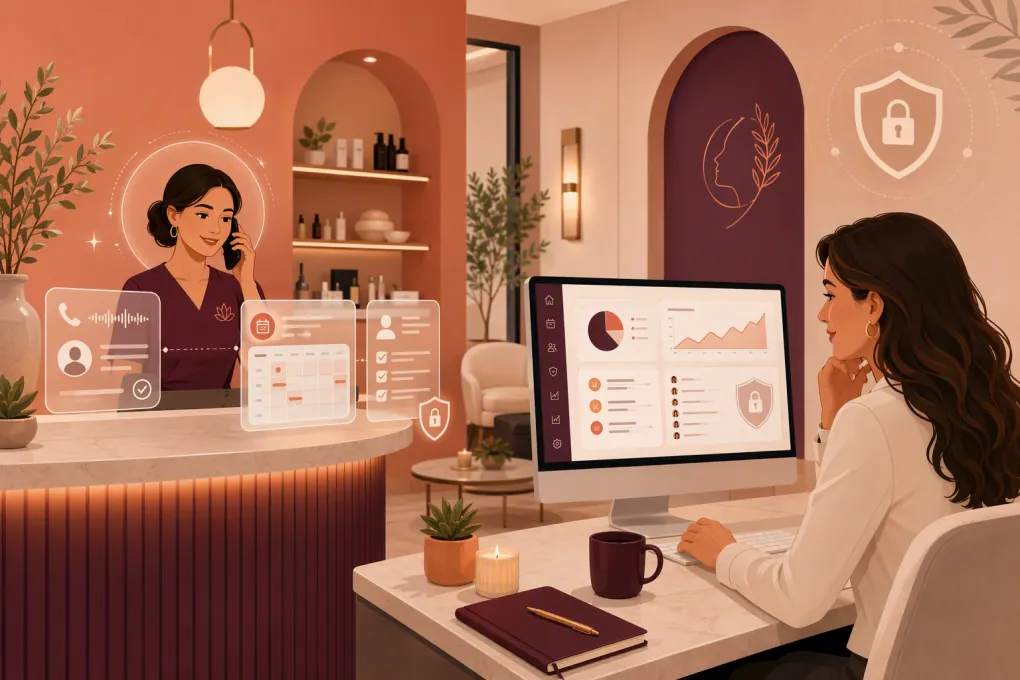 Watch · 20s
A prospective patient sees your med spa on Instagram at 9:40 p.m. They have questions about treatment options, availability and pricing. They are interested now—but your front desk will not see the inquiry until tomorrow.
That delay creates an opening for another provider to respond first. It also illustrates why med spa intake is not simply a form-filling task. It is a connected workflow spanning the first question, lead qualification, consultation booking, reminders, secure information collection and staff handoff.
An AI receptionist can manage much of that administrative work around the clock. The key is building it as an intake coordinator, not an unlicensed clinical decision-maker.
See how Fitty can respond to med spa inquiries and move leads toward a consultation →
What an AI receptionist should handle during intake
A useful AI receptionist does more than display a chatbot bubble. It should move the prospective patient to the correct next step while keeping your team in control.
For most med spas, that means handling five core jobs.
1. Capture the lead immediately
The AI receptionist should collect basic contact and scheduling information while interest is active:
- Name
- Preferred contact method
- Phone number or email address
- General service of interest
- Preferred location
- Preferred days or times
- Whether the person is a new or returning patient
- How they heard about the practice
Keep this first interaction short. Asking for a complete medical history before the patient understands the next step can create friction and unnecessary privacy exposure.
2. Answer approved nonclinical questions
Many initial inquiries are operational rather than medical. An AI receptionist can answer questions about:
- Business hours and locations
- Services offered
- Consultation requirements
- General price ranges approved for publication
- Membership or package policies
- Accepted payment methods
- Parking and arrival instructions
- Cancellation and deposit policies
- Typical appointment length, when approved by the practice
Answers should come from a controlled knowledge base. The system should not improvise treatment claims or pull answers from unreviewed public sources.
3. Route the patient to the right appointment
Different services may require different booking paths. A first-time injectable patient may need a consultation, while an established patient might qualify for direct booking under your practice rules.
Your routing logic should account for:
- New versus existing patients
- Consultation versus treatment appointments
- Provider credentials and service eligibility
- Location-specific availability
- Appointment duration
- Required deposits
- Minimum age or guardian requirements
- Services that must be scheduled by staff
The AI should only offer appointment types and times that match your configured rules. If it cannot determine the correct path, it should create a clear staff task instead of guessing.
4. Follow up with leads who do not book
Some patients ask a question, receive an answer and disappear. That does not always mean they lost interest. They may have been interrupted, needed to check a calendar or wanted to compare options.
A structured follow-up sequence can bring those leads back without forcing your front desk to maintain a manual callback list. Depending on the patient’s consent and channel preferences, the sequence might include:
- A prompt to finish booking shortly after the initial conversation.
- A follow-up answering a common concern related to the requested service.
- A final invitation to book or speak with a staff member.
Every message should identify the practice, respect opt-out requests and follow applicable calling and messaging rules. Avoid including sensitive treatment details in ordinary text messages unless your compliance process explicitly permits it.
5. Hand off a clean record to staff
Your team should not have to read a long transcript to understand what happened. The handoff should show:
- Contact information
- Service requested
- Questions asked
- Answers provided
- Appointment status
- Follow-up status
- Any unresolved issue
- Whether human review is required
The goal is operational continuity. A staff member should be able to open the record and act without asking the patient to repeat everything.
Separate lead qualification from clinical screening
This is the most important boundary in AI-assisted med spa intake.
Lead qualification answers administrative questions: What service interests the person? Which location works? Are they trying to book a consultation? Clinical screening evaluates health history, contraindications, treatment suitability and informed consent. That work belongs inside a clinician-approved process and may require review by a licensed professional.
An AI receptionist should not:
- Diagnose a condition
- Recommend a prescription treatment
- Decide whether a patient is medically eligible
- Interpret symptoms or medical history
- Promise a specific clinical result
- Minimize reported complications
- Handle urgent symptoms as a routine sales conversation
Configure explicit escalation language for mentions of severe pain, breathing problems, vision changes, allergic reactions or other potentially urgent concerns. The system should direct the person to appropriate emergency resources based on your approved protocol and alert staff where appropriate. It should not attempt to triage beyond its authorized role.
Design a safer intake data flow
Medical spa operators need to think carefully about where patient information is collected and stored. Whether HIPAA applies depends on the practice’s structure and activities, but other federal and state privacy requirements may still govern health-related data. Get qualified legal and compliance guidance for your specific operation.
Use a data-minimization approach:
In the initial conversation
Collect only what is needed to answer general questions, identify the lead and select the next administrative step.
In the secure intake form
Collect health history, medications, allergies, pregnancy status or other clinician-required details through an approved system. Do not ask patients to send sensitive medical information through an ordinary chat or text channel merely because it is convenient.
In the clinical system
Store clinical documentation, consent records and provider notes in the systems your practice has approved for those purposes.
Before connecting any AI tool to patient workflows, review:
- What data the vendor receives
- Where data is stored
- Who can access it
- Retention and deletion controls
- Whether conversations are used to train models
- Audit logs and staff permissions
- Encryption and incident-response practices
- Available contractual protections, including a business associate agreement when required
- How data moves into your CRM, booking platform or clinical record system
Do not assume that an AI product is appropriate for protected health information because it is marketed to healthcare businesses. Verify the configuration, contracts and actual data path.
Build the workflow before writing the script
A polished greeting cannot repair a broken process. Map the intake workflow first.
Start with one high-volume service category and document:
- Which questions the receptionist may answer.
- Which claims or topics are prohibited.
- Whether a consultation is required.
- Which appointment types can be booked automatically.
- When a deposit is collected.
- Which intake form is sent after booking.
- Which responses require staff or clinician review.
- What happens when no appointment is available.
- How cancellations and rescheduling are handled.
- When follow-up stops.
Then build the AI conversation around those rules. This approach is easier to test than attempting to automate every treatment and exception at once.
Explore how Fitty can answer, follow up and book consultations using your operating rules →
Make consultation booking easy without losing control
A strong booking flow gives the patient a small number of valid choices rather than asking an open-ended question such as, “When are you free?”
The receptionist can confirm the location, service category and preferred time window, then offer eligible slots from the connected schedule. Before finalizing, it should present the applicable deposit, cancellation and rescheduling terms.
If your med spa collects consultation deposits, make sure the payment flow is handled through an approved processor and recorded against the correct patient and appointment. Do not ask for card details in free-form chat.
Useful fallback paths include:
- Add the lead to a waitlist
- Offer another qualified provider
- Offer another location
- Request a callback from staff
- Capture preferred dates for manual scheduling
This is where Fitty can reduce front-desk workload: it is designed to answer leads, book appointments, follow up and collect payments or dues around the clock. Your team still defines the services, availability, payment rules and escalation boundaries.
Test the AI like a difficult prospective patient
Do not launch after testing only the ideal conversation. Build a test sheet with normal questions, vague requests and edge cases.
Test scenarios should include:
- “How much are lip fillers?”
- “Which treatment do I need?”
- “Can I book today?”
- “I had a reaction after my appointment.”
- “Can I get this treatment while pregnant?”
- “I want to speak to a person.”
- “Do you have an appointment at another location?”
- “I need to cancel, but I already paid a deposit.”
- “Stop texting me.”
Check whether the system stays within its approved knowledge, respects opt-outs, escalates correctly and writes a usable record. Retest whenever you change services, providers, pricing, policies or schedules.
Measure intake performance with operational metrics
Track the workflow from inquiry to attended consultation. Useful measures include:
- Response time by channel
- Percentage of inquiries that provide valid contact information
- Consultation booking rate
- Time from inquiry to booking
- Follow-up completion and response rate
- Deposit completion rate
- Appointment cancellation and no-show rate
- Number and type of human escalations
- Incorrect-answer or routing incidents
- Consultations that progress to treatment
Review transcripts and outcomes together. A high booking rate is not useful if patients are entering the wrong appointment type or arriving with inaccurate expectations.
Assign an owner to the system. Someone should review failed conversations, update approved answers and coordinate changes with front-desk and clinical leaders.
What good AI intake looks like
The best AI receptionist for med spa new patient intake is not the one that talks the most. It is the one that responds promptly, gathers the minimum necessary information, answers within clear boundaries and creates a reliable path to a booked consultation or human handoff.
Start with one workflow, establish privacy and clinical guardrails, and measure real appointment outcomes. Once that path works consistently, expand to other services, locations and follow-up sequences.
See how WTF Go and Fitty can support a more responsive med spa intake workflow →
Frequently asked questions
Can an AI receptionist complete the entire med spa intake process?
It can handle lead capture, approved FAQs, scheduling, reminders and administrative follow-up. Clinical screening, treatment suitability, consent and medical advice should remain within a clinician-approved process.
Is an AI receptionist for a med spa automatically HIPAA compliant?
No. Compliance depends on the practice, vendor contracts, configuration, data collected and connected systems. Verify the complete data flow and obtain qualified compliance guidance before sharing protected health information.
What information should an AI receptionist collect first?
Start with name, contact details, general service interest, preferred location and scheduling preferences. Send sensitive medical questions through an approved secure intake process.
Can an AI receptionist book consultations and collect deposits?
Yes, when it is connected to the appropriate scheduling and payment workflows. The practice should define eligible appointment types, deposit policies, cancellation rules and cases requiring staff review.
Keep reading


Run your gym on autopilot with WTF Go
Fitty — your AI receptionist — answers calls and DMs, fills classes, follows up with every lead, and collects dues while you coach.