AI & Automation
AI Receptionist for Med Spa Lead Qualification: Playbook
Learn how an AI receptionist for med spa lead qualification can screen inquiries, route clinical questions, book consults, and protect patient trust.
 Watch · 20s
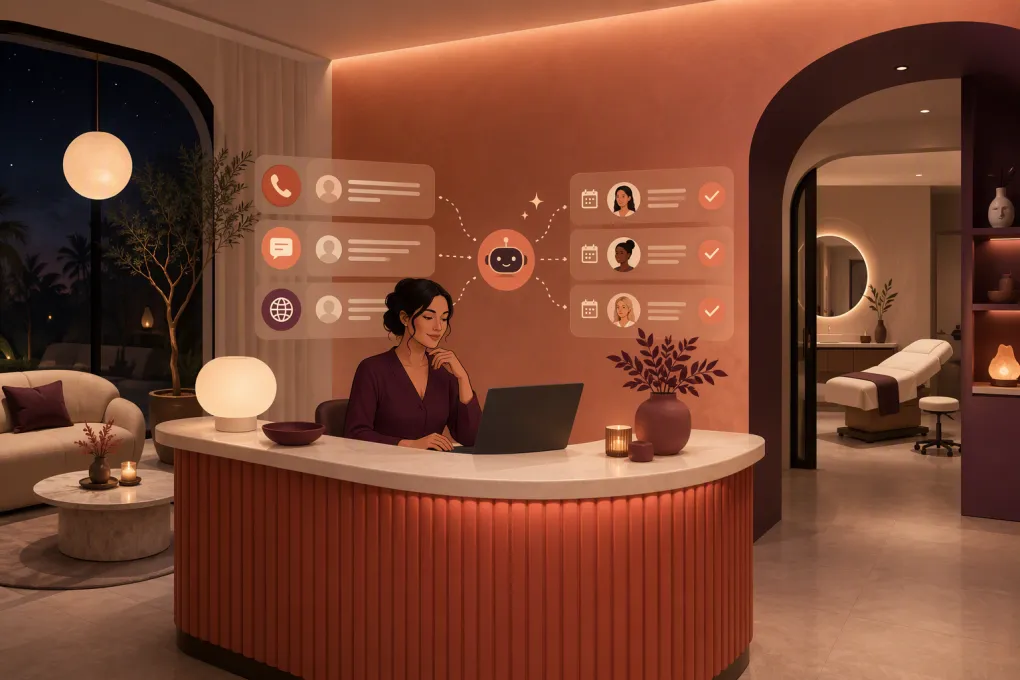
A med spa lead rarely arrives with a tidy, complete request. One person asks about pricing through Instagram. Another calls after closing with questions about injectables. A third submits a website form, then contacts two competitors while waiting for a reply.
The front desk has to identify what each person wants, answer appropriate nonclinical questions, collect enough information to route the inquiry, and secure the next step. That work competes with checking in patients, managing schedules, collecting payments, and supporting providers.
An AI receptionist for med spa lead qualification can take over the repetitive first-response work. The goal is not to let software make clinical decisions. It is to respond immediately, organize demand, and move qualified prospects toward a consultation while escalating anything that requires human or licensed clinical judgment.
See how Fitty can qualify and book med spa leads around the clock →
What lead qualification should mean in a med spa
For a med spa, qualification is the process of determining the correct operational next step. It should answer questions such as:
- Which service or outcome is the person interested in?
- Is this a new or returning patient?
- Which location do they prefer?
- What days and times generally work?
- Are they ready to schedule a consultation?
- Does the inquiry require a provider, manager, or emergency response?
- Has the person agreed to receive the relevant follow-up communications?
Qualification is not diagnosis, prescribing, assessment of medical eligibility, or a guarantee that a treatment is suitable. Final candidacy belongs with an appropriately licensed professional following the med spa’s protocols and applicable rules.
That boundary should shape every AI conversation. A useful receptionist can explain the consultation process, share approved service information, and book the correct appointment type. It should not tell someone that a procedure is safe for them based on a few chat responses.
Where med spa leads are commonly lost
Most leakage happens between the initial inquiry and a confirmed appointment. Common failure points include:
Calls that arrive while staff are occupied
A caller may reach voicemail because the receptionist is checking out a patient or assisting a provider. If that caller is comparing local options, leaving a message does not mean they will wait for a callback.
Inconsistent answers across channels
Pricing language, consultation requirements, cancellation policies, and treatment descriptions can vary depending on who answers. Inconsistency creates confusion and exposes the business to avoidable risk.
Forms that collect information but do not advance the lead
A generic contact form may capture a name and email address without identifying the desired service, location, or availability. Staff still have to begin a manual back-and-forth before an appointment can be booked.
Follow-up without a defined sequence
Interested prospects are often placed in a vague callback queue. Without an owner, next action, and stopping rule, leads receive either too little follow-up or disconnected messages from multiple employees.
Clinical questions reaching nonclinical staff
Prospects may ask about contraindications, side effects, medication interactions, pregnancy, complications, or whether they are a candidate. Reception workflows need a clear handoff rather than encouraging staff—or an AI—to improvise.
What an AI receptionist should collect
The shortest effective qualification flow is usually better than a long questionnaire. Ask only for information needed to route or schedule the inquiry.
A practical sequence can include:
- Intent: Identify whether the person wants to book, reschedule, ask about a service, discuss financing, or reach the clinical team.
- Service category: Capture the treatment or concern in the prospect’s own words, then map it to an approved appointment type.
- Patient status: Determine whether the person is new, returning, or currently in treatment.
- Location: Route multi-location inquiries using preferred location, availability, and services offered.
- Scheduling preferences: Offer actual openings rather than asking staff to call back with options.
- Contact details and communication permission: Collect only what the workflow requires and record relevant consent or opt-out signals.
- Routing flags: Escalate clinical, urgent, dissatisfied-patient, refund, or privacy-related messages according to policy.
Avoid using a consumer-facing chatbot as an open-ended medical intake tool. If medical history is needed before treatment, collect it through the med spa’s approved intake process with appropriate safeguards—not an improvised marketing conversation.
Design the conversation around the next best action
Lead qualification is valuable only when it produces a clear outcome. Every conversation should finish in one of a few defined states:
- Consultation booked
- Approved treatment appointment booked
- Human callback requested and assigned
- Clinical question escalated
- Existing-patient issue routed
- Lead declined further communication
- Inquiry closed as irrelevant or spam
This makes the pipeline usable. Staff can see what requires attention instead of rereading every transcript.
Keep booking rules specific
Document which services require a consultation, which providers can perform them, whether new and returning patients use different appointment types, and how much time each visit needs. Include location-specific rules rather than assuming every med spa in the group operates identically.
The AI should also understand deposits, cancellation terms, age requirements, and current promotions—but only from approved business information. When a rule changes, there should be one source of truth to update.
Give the AI a safe response for uncertainty
An AI receptionist should not guess. If it cannot confidently map a request, it can say that the team needs to review the question, collect the minimum contact details, and create a task with the conversation attached.
Explore how Fitty can turn qualified inquiries into booked med spa consultations →
Build clear clinical and urgent-message guardrails
Before launch, define categories the AI must never handle as ordinary sales conversations. These may include reports of severe symptoms, possible complications, medication questions, treatment reactions, or requests for individualized medical advice.
The escalation workflow should specify:
- What language the AI uses to avoid diagnosing or minimizing the concern
- Whether the person should call emergency services for potentially urgent situations
- Which staff role receives the alert
- Which channel is used for escalation
- What happens if the first contact does not respond
- How the interaction is documented
Have clinical leadership and appropriate legal or compliance advisers review these workflows for your services, jurisdiction, communication channels, and technology stack. Do not assume that labeling a tool “AI receptionist” removes healthcare privacy, advertising, telemarketing, or recordkeeping obligations.
Make follow-up useful rather than relentless
Automated follow-up should help a lead complete a stated goal. It should not keep sending generic “just checking in” messages indefinitely.
Build sequences around context:
- Unfinished booking: Return the prospect to available consultation times.
- Requested callback: Confirm who will call and provide an expected window.
- Pricing inquiry: Share approved pricing or explain what must be determined during a consultation.
- No-show or cancellation: Offer a controlled rescheduling path under the med spa’s policy.
- Not ready: Ask whether the person wants information later, then respect the answer.
Set stopping conditions. Follow-up should stop when the person books, opts out, states they are not interested, or reaches the sequence limit established by the business. Communication permissions and channel-specific rules should be built into the workflow rather than left to staff memory.
Measure the workflow, not just lead volume
More inquiries do not automatically mean a healthier pipeline. Review whether the system is producing timely, appropriate next steps.
Useful operating measures include:
- Time from inquiry to first response
- Share of inquiries ending in a booked consultation
- Percentage requiring human or clinical escalation
- Appointments booked by source, service, and location
- Unfinished booking conversations
- Opt-outs and complaints
- No-shows and cancellations from AI-booked appointments
- Common questions the AI could not answer
Audit transcripts regularly. Look for incorrect routing, awkward repetition, unsupported claims, oversharing, and moments where the AI should have handed off sooner. Update approved answers and rules based on actual conversations.
A practical implementation checklist
Before putting an AI receptionist in front of med spa leads, complete these steps:
- List every channel where inquiries arrive.
- Define approved service, pricing, promotion, and policy language.
- Map each common intent to an appointment type or staff owner.
- Separate administrative qualification from clinical screening.
- Establish urgent, clinical, privacy, and complaint escalations.
- Connect live scheduling with provider, room, service, and location rules.
- Configure communication consent, opt-out handling, and follow-up limits.
- Test routine requests, unusual wording, interruptions, and hostile or distressed messages.
- Review early conversations daily, then maintain a regular audit cadence.
- Assign one operator to own changes after launch.
The strongest setup is not the one with the longest script. It is the one that responds quickly, stays inside clear boundaries, and reliably moves each inquiry to the right next action.
Fitty, WTF Go’s AI receptionist, is built to answer leads, qualify their needs, book appointments, follow up, and support payment collection without forcing the front desk to manage every repetitive exchange. For med spas, the important part is configuring those capabilities around approved language and disciplined escalation rules.
See how WTF Go and Fitty can support your med spa’s lead workflow →
Frequently asked questions
Can an AI receptionist determine whether someone is eligible for a med spa treatment?
It should not make clinical eligibility decisions. It can collect administrative details and book a consultation, while a licensed professional evaluates treatment suitability.
Can an AI receptionist answer med spa pricing questions?
Yes, when it uses current, approved pricing language. If price depends on dosage, treatment area, or clinical assessment, it should explain that clearly and guide the lead to a consultation.
What happens when a lead asks a medical question?
The AI should avoid individualized medical advice and route the question according to the med spa's clinical escalation policy. Potentially urgent concerns need a separate, clearly documented response path.
Does an AI receptionist replace the med spa front desk?
It is best used to handle repetitive first responses, qualification, scheduling, and follow-up. Human staff remain essential for clinical issues, exceptions, complaints, and high-context patient service.
How quickly can a med spa launch AI lead qualification?
Timing depends on scheduling complexity, locations, service rules, integrations, and compliance review. Do not launch until approved answers, booking logic, consent handling, and escalation paths have been tested.
Keep reading

Run your gym on autopilot with WTF Go
Fitty — your AI receptionist — answers calls and DMs, fills classes, follows up with every lead, and collects dues while you coach.