AI & Automation
AI Receptionist for Med Spa Laser Hair Removal Bookings
Learn how an AI receptionist for med spa laser hair removal bookings can answer leads, screen inquiries, book consults, and reduce missed lead follow-up.
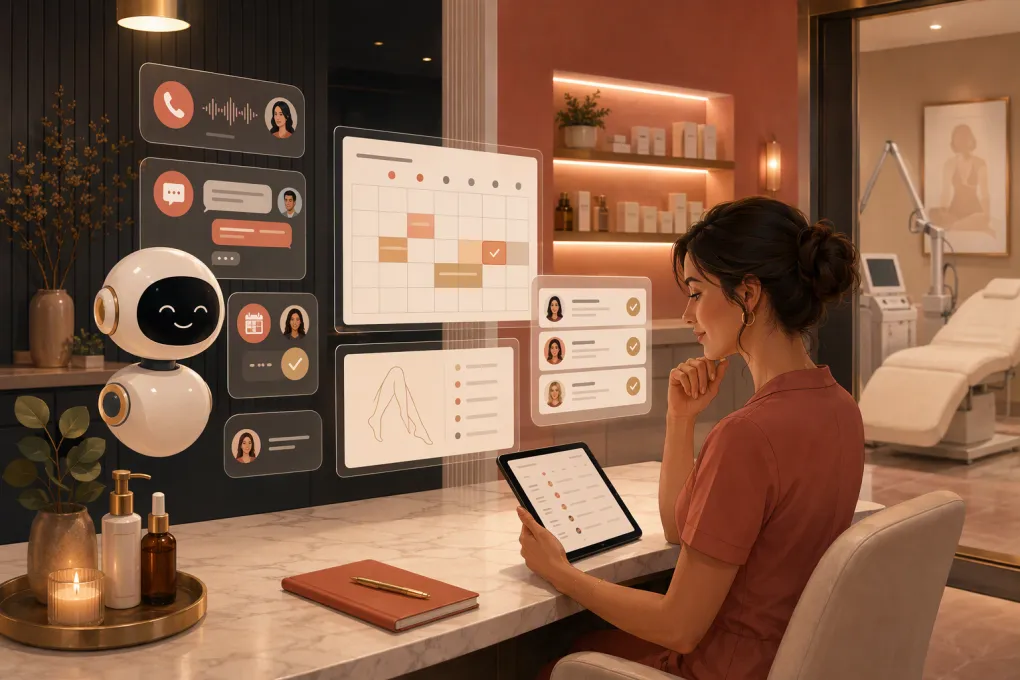 Watch · 20s
A laser hair removal lead does not always contact your med spa while the front desk is free. They call during treatments, send a text after dinner, or submit a form while comparing several nearby providers. If the response comes the next morning, the lead may already have booked elsewhere.
An AI receptionist gives med spas a practical way to cover those gaps. It can answer common questions, collect the information needed for the next step, schedule an appropriate consultation, and follow up when a prospect stops responding. The goal is not to replace clinical judgment. It is to remove avoidable friction between initial interest and a properly booked appointment.
See how Fitty handles laser hair removal leads when your team is busy or offline →
What an AI receptionist should do for laser hair removal leads
A useful AI receptionist is more than a website chatbot that repeats office hours. It should move the conversation forward while staying inside boundaries set by your clinical and management teams.
For laser hair removal bookings, that usually means handling five connected workflows.
Answer calls, texts, and online inquiries quickly
Prospects often ask the same operational questions:
- Which body areas do you treat?
- Do I need a consultation first?
- How should I prepare?
- How long does an appointment take?
- Do you offer packages or payment plans?
- Can you treat my skin tone or hair type?
- What appointments are available this week?
The AI should answer approved nonclinical questions directly. When a question requires an assessment, it should explain that a qualified provider must evaluate the prospect and offer to book a consultation.
That distinction matters. A receptionist can explain your process; it should not promise candidacy, results, treatment safety, or a specific number of sessions.
Capture useful lead information
A name and phone number are not enough to route every laser inquiry correctly. Configure the conversation to collect only the information your staff actually uses, such as:
- Preferred treatment area
- New or returning client status
- Preferred location
- General scheduling preferences
- Whether the person wants a consultation or an existing treatment appointment
- Preferred contact channel
- Referral source, if your team tracks it
Avoid turning the interaction into an automated medical intake. Detailed health history, medication review, contraindication screening, skin assessment, and informed consent belong in the clinical workflow defined by your medical leadership.
Book the correct appointment type
The receptionist should not place every inquiry into the first open laser slot. Your booking rules need to reflect how the med spa operates.
For example, a new prospect may need an initial consultation, while an established client may be eligible to book the next session in an existing plan. Different treatment areas may require different appointment lengths. Certain providers, rooms, devices, or locations may also have to be available.
Map these rules before enabling automated booking:
- Identify every laser-related appointment type.
- Define who may book each type.
- Assign the correct duration, provider, room, and equipment requirements.
- Set minimum notice and cancellation rules.
- Decide when the AI must transfer the conversation to staff.
If the scheduling system cannot enforce those constraints, the AI should collect the request rather than create a booking your team has to repair later.
Build a booking flow that converts without overstepping
The strongest workflow feels simple to the prospect because the complexity has been handled behind the scenes.
A practical laser hair removal flow can follow this sequence:
- Acknowledge the request. Confirm that the person is asking about laser hair removal and identify the desired location if you operate multiple sites.
- Answer the immediate question. Use information approved by the business, including hours, general preparation guidance, consultation requirements, and current published offers.
- Set an appropriate expectation. Explain that treatment suitability and recommendations are determined by a qualified provider.
- Collect routing information. Ask for the treatment area, client status, scheduling preference, and contact details.
- Offer valid appointment times. Show only slots that meet your provider, room, equipment, and appointment-type rules.
- Apply the booking policy. Collect a deposit through a secure payment process if your med spa requires one.
- Confirm and remind. Send the date, time, location, preparation instructions, and rescheduling policy.
- Escalate exceptions. Route clinical, complaint, refund, adverse-event, and complex pricing questions to a person.
Fitty, WTF Go’s AI receptionist, is designed to keep these conversations moving around the clock: answering leads, booking appointments, following up, and collecting amounts due based on the workflows your business establishes.
Explore how Fitty can turn after-hours laser inquiries into correctly routed bookings →
Where med spas lose laser hair removal bookings
Installing an AI tool will not fix a weak operating process by itself. Review these common failure points before launch.
Slow response after form submissions
A generic confirmation email does not resolve the prospect’s question or secure an appointment. Trigger an immediate conversational response that references the requested service and offers a clear next step.
Giving a price without enough context
Laser pricing may depend on the treatment area, package structure, location, promotion, or consultation. Decide exactly what the receptionist may quote. If pricing varies, it should explain the variables and book the appropriate next step rather than improvise.
Keep the AI’s pricing source current. Expired promotions and mismatched package details quickly create front-desk disputes.
Booking treatment when a consultation is required
Automated scheduling must follow your clinical and state-specific operating requirements. If your policy requires a consultation or provider clearance, do not let the system bypass it for the sake of conversion.
Treating every unanswered lead the same
Follow-up should reflect what happened. Someone who asked for Saturday availability needs a different message from someone who abandoned the conversation after seeing a deposit requirement.
Useful follow-up branches include:
- No response after an initial inquiry
- Consultation offered but not booked
- Booking started but not completed
- Deposit link sent but not paid
- Consultation completed with no treatment scheduled
- Existing client due for the next session
Every sequence should have a stopping rule. Stop sales messages when the person declines, opts out, books, or needs staff intervention.
Failing to hand off context
When a staff member takes over, they should see the conversation, contact details, requested service, offered times, and unresolved question. Asking a prospect to repeat everything makes the automation feel like another obstacle.
Safety, privacy, and compliance boundaries
Laser hair removal sits closer to clinical care than a standard salon booking. The AI receptionist needs explicit limits.
Have appropriate legal, privacy, and clinical professionals review your setup based on your services, state, systems, and business relationships. Key controls include:
- No diagnosis or candidacy decisions. The AI should not determine whether treatment is safe for an individual.
- Approved preparation language. Use instructions reviewed by your clinical leadership rather than AI-generated medical advice.
- Urgent issue escalation. Reports of burns, blistering, severe pain, or other possible adverse events should be routed according to your urgent-response protocol, not placed into a sales follow-up sequence.
- Data minimization. Collect only what is necessary at each stage and avoid requesting sensitive health information through an unsuitable channel.
- Access controls. Limit who can view conversations and client information.
- Consent and messaging rules. Maintain appropriate consent and opt-out handling for automated texts and marketing follow-up.
- Secure payments. Use a payment provider and workflow designed for card processing rather than collecting card details in free-form chat.
HIPAA applicability depends on the business, transaction, data, and vendor relationships involved. Do not assume that calling a tool secure makes a workflow compliant. Confirm how information is stored, transmitted, accessed, retained, and deleted, and determine whether required agreements are available.
How to evaluate an AI receptionist for your med spa
Ask vendors to demonstrate your actual booking process, not a generic restaurant or dental demo. Provide a realistic test scenario involving a new laser prospect, a returning client, an after-hours caller, and a question that requires clinical escalation.
Evaluate the system on these criteria:
- Can it handle voice and text conversations naturally?
- Does it work with your real appointment types and availability?
- Can it follow location-specific rules for a multi-site med spa?
- How does it distinguish consultations from treatment sessions?
- Can staff take over without losing context?
- Can you control approved answers, promotions, and pricing language?
- How are deposits, balances, cancellations, and rescheduling handled?
- What happens when scheduling or payment systems are unavailable?
- Can you review conversations and identify where prospects drop off?
- How are consent, access, retention, and deletion managed?
Also test what the AI refuses to do. A trustworthy system should escalate when it lacks approved information or encounters a clinical decision.
Launch with a controlled operating plan
Start with one service line or location rather than automating every med spa interaction at once. Laser hair removal is a strong candidate because inquiries are repetitive but still require clear clinical boundaries.
Build an approved knowledge base covering services, areas treated, locations, hours, consultation policy, preparation instructions, promotions, deposits, cancellations, and handoff rules. Then review test conversations with reception, management, and clinical leadership.
During the first weeks, audit conversations regularly. Look for inaccurate answers, incorrect appointment types, dead-end handoffs, and questions your knowledge base does not address. Update the workflow instead of expecting the AI to infer policy.
Track operational outcomes your team can verify: response coverage, consultations booked, incomplete bookings, staff escalations, no-shows, opt-outs, and reasons leads do not schedule. The objective is not simply more conversations. It is more appropriate bookings with less manual chasing and no erosion of the client experience.
See how WTF Go and Fitty can automate your med spa’s inquiry-to-booking workflow →
Frequently asked questions
Can an AI receptionist book laser hair removal treatments directly?
Yes, if the client is eligible under your established booking rules. New prospects who require consultation or clinical clearance should be booked into that step instead of a treatment session.
Can an AI receptionist answer questions about laser hair removal safety?
It can provide approved general information and preparation guidance, but it should not assess candidacy, diagnose conditions, or give individualized medical advice. Those questions need a qualified provider.
Can the AI collect a consultation deposit?
It can direct the prospect through a secure payment workflow when supported by the med spa's systems. Card details should not be collected in an unsecured free-form conversation.
Will an AI receptionist replace med spa front-desk staff?
It is better used to cover repetitive inquiries, after-hours responses, booking, and follow-up. Staff remain essential for clinical escalation, exceptions, complaints, and higher-touch client situations.
What should a med spa automate first?
Start with common laser hair removal questions, consultation booking, confirmations, and follow-up for incomplete bookings. Add more workflows after reviewing real conversations and correcting gaps.
Keep reading

Run your gym on autopilot with WTF Go
Fitty — your AI receptionist — answers calls and DMs, fills classes, follows up with every lead, and collects dues while you coach.