AI & Automation
AI Receptionist for Med Spa Appointment Deposits: Guide
Learn how an AI receptionist for med spa appointment deposits can book leads, collect payments, reduce no-shows, and protect staff time around the clock.
 Watch · 20s
A lead who asks about a med spa appointment at 8:30 p.m. is not planning around your front desk schedule. They want to know whether the treatment is available, find a workable time, understand the deposit policy, and book. If that process stalls until morning, the lead may keep shopping.
An AI receptionist can cover that gap, but answering messages is only part of the job. The useful version must move a qualified inquiry through scheduling and deposit payment without confusing the client, exposing payment data, or creating more cleanup for staff.
For med spa operators, the goal is not simply faster replies. It is a reliable path from inquiry to confirmed, deposit-backed appointment.
See how Fitty can answer med spa leads and move them toward a booked appointment →
What an AI receptionist should handle
An AI receptionist for med spa appointment deposits should coordinate several connected tasks:
- Respond to calls, texts, website inquiries, or other supported channels
- Identify the requested service and preferred location
- Answer approved questions about pricing, timing, preparation, and policies
- Check appointment availability
- Explain the deposit and cancellation terms before requesting payment
- Send the client to a secure payment step
- Confirm the appointment only after the required payment status is received
- Send reminders and approved preparation instructions
- Escalate clinical, financial, or unusual requests to a person
The distinction between answering and completing matters. A chatbot that says, “Someone will contact you tomorrow,” may reduce inbox clutter, but it does not solve booking leakage. A capable AI agent keeps the conversation moving until the client books, declines, or reaches an issue that requires staff judgment.
Build the deposit policy before automating it
Automation magnifies the quality of the process behind it. If each employee explains deposits differently, an AI receptionist will not fix the underlying ambiguity.
Document one policy that covers the following points.
Which services require a deposit?
You do not necessarily need the same rule for every appointment. Consider the amount of provider time reserved, room or device capacity, consumables prepared in advance, and your history of late cancellations for each service category.
Your booking rules might distinguish among:
- Consultations
- Short recurring services
- Longer device-based appointments
- Appointments involving a specific provider
- Packages or multi-session plans
- Group events or appointments reserving several time slots
Keep the number of rule variations manageable. A policy that requires staff to interpret several exceptions during every booking is difficult to automate and difficult for clients to understand.
Is it a deposit or a card on file?
These are not interchangeable.
A deposit is a payment collected before the appointment and generally applied according to your disclosed terms. A card-on-file policy stores a payment method through a payment provider for later authorized charges. A preauthorization or temporary hold is another distinct payment event.
Your client-facing language, receipts, booking system, and internal accounting should all describe the transaction consistently. Have your payment provider and qualified legal or accounting advisers review the setup where appropriate.
What happens after a cancellation?
Define:
- The cancellation window
- Whether the deposit is refundable, transferable, or credited
- How rescheduling affects the deposit
- What happens when the med spa cancels
- How repeated reschedules are handled
- Who can approve an exception
The AI should present the relevant terms before checkout and record the client’s acknowledgment. It should not improvise exceptions or promise a refund outside the approved policy.
Design the booking and payment sequence carefully
The order of operations prevents duplicate bookings and “orphaned” payments that cannot be matched to an appointment.
A practical workflow looks like this:
| Stage | AI receptionist action | Operational control |
|---|---|---|
| Qualification | Identifies service, location, client status, and preferred time | Avoid collecting unnecessary medical details |
| Availability | Offers valid appointment options | Use live availability rather than a static schedule |
| Policy disclosure | States the deposit, cancellation, and rescheduling terms | Require clear acknowledgment |
| Temporary hold | Holds the selected time when supported | Set an expiration so inventory is not blocked indefinitely |
| Checkout | Directs the client to a secure payment flow | Do not collect full card details in chat or free-text notes |
| Confirmation | Confirms after successful payment status | Send receipt and appointment details |
| Failure recovery | Handles an expired link or failed payment | Offer a retry or human handoff without duplicating the booking |
| Reconciliation | Matches payment, client, service, and appointment | Flag unmatched transactions for staff review |
The system also needs an explicit rule for the moment between selecting a time and completing payment. If the appointment is not held, another client could take it during checkout. If it is held forever, unpaid bookings can consume valuable capacity.
Use a time-limited hold where your scheduling platform supports it. If it does not, clearly tell the client that availability is not guaranteed until payment and confirmation are complete.
Explore how Fitty can support booking, follow-up, and payment collection for your med spa →
Give the AI approved language, not unlimited freedom
Med spa conversations can shift quickly from scheduling into clinical territory. An AI receptionist should not diagnose, determine candidacy, promise results, or replace informed consent with a chat exchange.
Create an approved answer library for common operational questions, including:
- Service duration
- Starting prices or approved price ranges
- Provider and location availability
- Deposit and cancellation terms
- General preparation instructions approved by your clinical team
- Financing or membership options you actually offer
- Consultation requirements
- When a client must speak with a licensed professional
Then define mandatory handoffs. Examples include questions about contraindications, medication interactions, complications, pregnancy, adverse reactions, treatment suitability, emergency symptoms, disputed charges, and policy exceptions.
A strong handoff captures the client’s name, contact information, requested service, question, and urgency without making the client repeat the entire conversation. It should also route the task to the right team instead of dropping it into a general inbox.
Protect payment and client information
Convenience does not remove your responsibility to handle information carefully.
Keep card data out of conversations
The AI should direct clients to a payment flow handled by an appropriate payment provider. It should never ask someone to text, dictate, or paste a complete card number into a general conversation, CRM note, or voicemail transcript.
Confirm what your payment provider stores, what your software can access, and how refunds or disputes are managed. PCI DSS obligations depend on the payment setup, so review the actual data flow rather than assuming the software handles everything automatically.
Minimize health information
Collect only what is needed to route and schedule the inquiry. Detailed medical intake usually belongs in a controlled intake process, not an open-ended sales conversation.
If a vendor may create, receive, maintain, or transmit protected health information on your behalf, determine whether HIPAA requirements and a business associate agreement apply. This is a fact-specific compliance question, not a box to check based solely on a product’s marketing page.
Separate transactional and marketing consent
Appointment confirmations, payment links, reminders, and promotional campaigns do not always operate under identical consent rules. Document how the client agreed to receive messages, honor opt-outs, and have counsel review your calling and texting practices when needed.
Plan for the cases that break clean automations
Most workflow failures happen at the edges. Test the system against scenarios such as:
- The client pays, but the appointment confirmation fails
- The selected time disappears during checkout
- The payment link expires
- The client wants to use a gift card or package credit
- An existing client has an account under another phone number
- A parent or partner is paying for someone else
- The client wants multiple services in one visit
- The requested provider works at multiple locations
- The client disputes the cancellation policy
- The client asks for a same-day appointment close to cutoff time
For each case, define whether the AI should retry, offer another option, or create a staff task. Include a response-time expectation and an owner for every handoff queue.
Measure completed bookings, not conversation volume
A busy AI inbox does not prove business value. Review the full funnel from first inquiry through appointment completion.
Useful operating measures include:
- Lead response time by channel and hour
- Percentage of qualified inquiries reaching the scheduling step
- Deposit checkout starts and successful completions
- Abandonment point in the booking flow
- Bookings completed without staff intervention
- Human handoff reasons and resolution time
- Unmatched or duplicate payments
- Cancellations, reschedules, no-shows, refunds, and disputes
- Appointment revenue associated with AI-assisted bookings
Read conversation samples alongside the dashboard. A conversion drop may come from unclear pricing, weak availability, a broken payment link, an overly rigid policy, or answers that do not address the client’s actual concern.
How to roll out an AI receptionist without disrupting the desk
Start with a controlled scope rather than automating every treatment and exception at once.
- Choose a defined booking category. Begin with services that have clear durations, pricing rules, and deposit requirements.
- Map the current process. Write down what happens from inquiry to payment, confirmation, reminder, arrival, and cancellation.
- Standardize the policy. Remove conflicting scripts and undocumented employee exceptions.
- Connect live systems where supported. Availability and payment status should come from current records, not copied lists.
- Test real scenarios. Include failed payments, reschedules, existing clients, after-hours leads, and clinical questions.
- Run a monitored launch. Review transcripts, handoffs, payment reconciliation, and staff feedback regularly.
- Expand only after the workflow is stable. Add services, locations, and channels in deliberate stages.
WTF Go is built as an operating system for gyms, studios, spas, and wellness businesses. Fitty, its AI receptionist, can answer leads, book, follow up, and support payment collection around the clock. For a med spa, that means the conversation does not have to stop when the front desk closes—and the handoff from interest to a committed appointment can become a managed workflow rather than a string of disconnected messages.
See how WTF Go and Fitty can strengthen your med spa’s deposit-backed booking process →
Frequently asked questions
Can an AI receptionist collect a med spa appointment deposit?
Yes, when it is connected to an appropriate booking and payment workflow. The AI should direct the client to secure checkout, verify payment status, and confirm the appointment without storing full card details in the conversation.
Should every med spa service require the same deposit?
Not necessarily. Operators can set rules based on provider time, treatment duration, capacity, consumables, and cancellation risk, but the policy should remain simple enough for clients and staff to understand.
Is an AI receptionist HIPAA compliant?
Compliance depends on the full configuration, data collected, vendors involved, contracts, access controls, and operating practices. Minimize health information in booking conversations and determine whether business associate agreements are required.
What happens if a client pays but the appointment is not booked?
The workflow should flag the unmatched payment immediately, prevent an automatic duplicate charge, and create a staff task for reconciliation. Test this failure case before launch.
Can an AI receptionist answer questions about treatment suitability?
It can provide approved general information, but it should not diagnose, determine candidacy, or promise clinical outcomes. Questions involving contraindications, medications, complications, or individual suitability should go to a qualified professional.
Keep reading

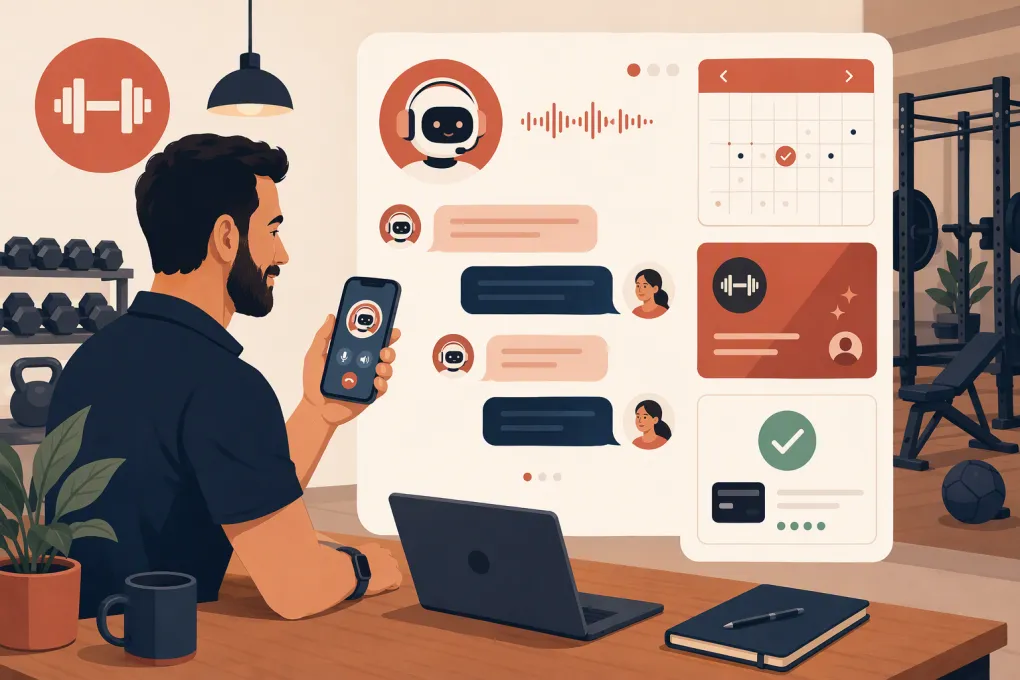

Run your gym on autopilot with WTF Go
Fitty — your AI receptionist — answers calls and DMs, fills classes, follows up with every lead, and collects dues while you coach.