AI & Automation
AI Receptionist for Massage Therapy Clinics: Buyer’s Guide
Compare an AI receptionist for massage therapy clinics by pricing, booking controls, integrations, privacy, contracts, testing, and implementation needs.
 Watch · 20s
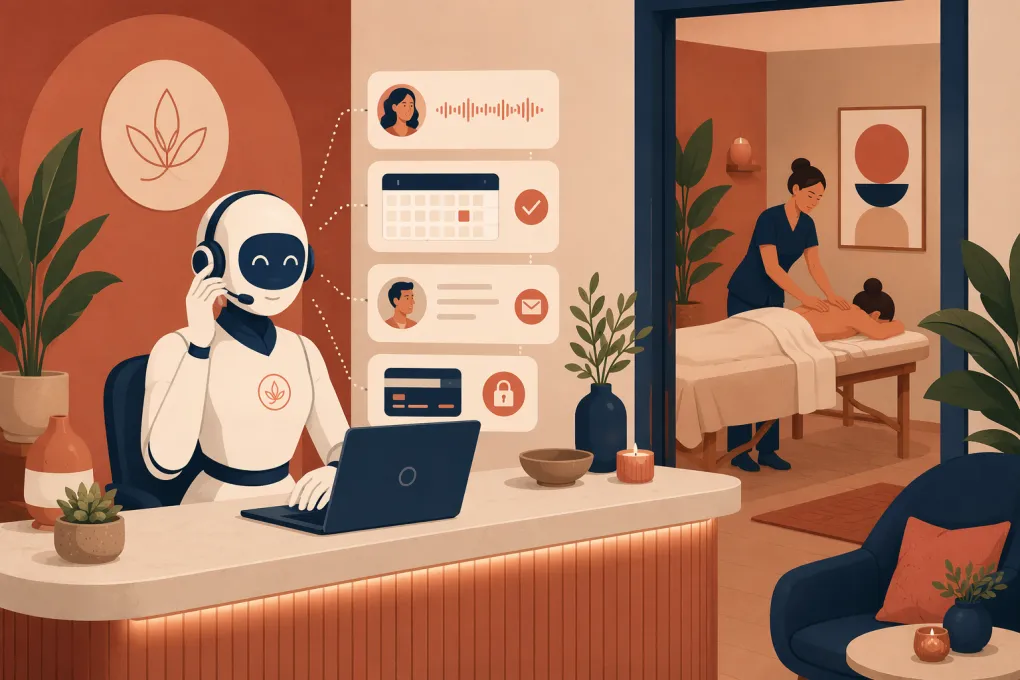
A massage therapist cannot answer the phone during a session without disrupting the client on the table. Yet many prospective clients call because they want an immediate answer about availability, price, therapist preference or a same-day appointment.
An AI receptionist can close that coverage gap, but only if it works with the clinic’s actual booking rules. A pleasant voice is not enough. The system must distinguish a 60-minute massage from a couples service, respect therapist and room availability, apply cancellation policies and hand clinical questions to a qualified person.
This guide takes an operator’s approach: test the complete workflow, verify every vendor claim and calculate the full operating cost before signing a contract.
See how Fitty is designed to handle inquiries and follow-up around the clock →
What an AI receptionist should do in a massage clinic
The safest starting point is repetitive, rules-based front-desk work.
Answer approved questions
The agent should answer from clinic-controlled information covering:
- Services, durations and public prices
- Hours, locations, parking and accessibility
- Therapist availability and stated specialties
- New-client arrival instructions
- Gift cards, packages and memberships
- Cancellation, late-arrival and no-show policies
- Accepted payment methods
Ask how the vendor prevents unsupported answers. A reliable system should escalate when the approved knowledge base does not contain an answer rather than guessing.
Route and book suitable appointments
Massage scheduling involves more than finding an empty hour. The booking workflow may need to account for:
- Therapist schedules and service eligibility
- Treatment-room capacity
- Couples-room availability
- Setup, cleanup and recovery buffers
- Service duration and enhancements
- Location-specific offerings
- New-client restrictions
- Package or membership eligibility
- Same-day booking cutoffs
Test whether these rules are enforced before the appointment reaches the calendar. Calendar access by itself does not prove the agent understands resource constraints.
Follow up without losing context
A prospective client may call after hours, ask for an unavailable therapist or stop midway through booking. The system should preserve the requested service, preferred time, contact information and conversation history so either the AI or a staff member can continue.
Text follow-up also requires proper consent and opt-out handling. The Federal Communications Commission publishes guidance on unwanted calls and texts, but a clinic should obtain legal advice for its specific outreach practices rather than treating software settings as compliance advice.
Escalate clinical and sensitive issues
An AI receptionist should not decide whether massage is appropriate after surgery, interpret symptoms or make claims about treatment outcomes. Escalation is appropriate when a client mentions:
- Recent surgery, injury or an adverse reaction
- Pregnancy-related concerns outside clinic policy
- A possible contraindication
- Harassment, therapist conduct or safety
- A request for diagnosis or clinical advice
- An emergency or serious distress
The staff handoff should include the caller’s details, question and prior conversation. Clients should not have to start over.
Compare the available service models
“AI receptionist” can refer to several different products. Compare the operating model before comparing voices or demos.
| Service model | Core strength | Common limitation | Integration requirement | Best fit |
|---|---|---|---|---|
| All-in-one operations platform with an AI agent | Keeps lead records, communication, booking and payment workflows in one environment | May require process changes or migration from current tools | Confirm how existing contacts, schedules and payment records move | Clinics wanting to consolidate disconnected systems |
| AI receptionist connected to existing scheduling software | Lets the clinic retain its current booking platform | Quality depends on the depth and reliability of the connection | Verify live availability, write-back, rescheduling and cancellation—not just calendar viewing | Clinics committed to their current software |
| Human answering service | Human judgment can help with unusual or emotional calls | Agents may not have live booking access or detailed clinic knowledge; coverage and usage can affect cost | Usually needs scripts, transfer rules and possibly scheduling access | Clinics with complex calls that need human handling |
| Basic voicemail, forms and scheduler automation | Simple and relatively easy to control | Clients must navigate separate steps; no conversational qualification | Usually native to the scheduler or website | Low-volume clinics with straightforward booking rules |
If a vendor says it integrates with scheduling software, ask what that means. Examples of systems a massage clinic might already use include MassageBook, Jane, Vagaro, Mindbody, Square Appointments or another practice-management platform. These are examples to investigate, not a claim that every AI receptionist—or Fitty specifically—supports them.
The vendor should demonstrate the exact connection with your system and plan. An integration may support creating appointments but not moving them, checking package balances or enforcing room resources.
Pricing: calculate the full cost, not the headline fee
AI receptionist pricing may be structured by location, phone number, user, conversation, call minute, message volume or a bundled monthly allowance. Some providers use custom quotes. Do not compare proposals until they include the same expected workload.
Ask for every potential cost:
- Platform and location fees
- AI voice minutes or completed calls
- SMS or messaging usage
- Phone-number provisioning or porting
- Setup and workflow configuration
- Scheduling or CRM integrations
- Data migration and cleanup
- Payment-processing fees
- Staff seats and administrator access
- Premium support or onboarding
- Usage overages
- Contract termination or export fees
Then compare cost against the work being replaced or improved. Useful baselines include unanswered calls, time spent returning routine messages, after-hours inquiries, manual follow-up and booking corrections. Avoid assuming every answered call becomes revenue.
Also ask how usage spikes are handled. A seasonal promotion, gift-card campaign or weather-related rescheduling day can produce very different call volume from an ordinary week.
Contract and vendor questions to ask
Put material answers in the contract or order form. A sales call is not an operating guarantee.
Workflow and implementation
- Who builds the knowledge base and booking rules?
- How long does implementation usually take for a clinic with our locations and services?
- What work is required from our staff?
- Is there a sandbox, pilot or test number?
- Who updates policies, services and hours after launch?
- What happens when the scheduling system is unavailable?
Data, privacy and security
- What client information is stored, where and for how long?
- Can we delete or export conversations and contact records?
- Which employees and subcontractors can access data?
- Is data encrypted in transit and at rest?
- Is clinic data used to train shared models?
- How are incidents reported?
Massage intake may include health-related information. The U.S. Department of Health and Human Services explains that HIPAA applies to covered entities and business associates, not automatically to every business handling health information. Determine your clinic’s status with qualified counsel. If HIPAA applies, ask whether the vendor will sign an appropriate business associate agreement and whether the proposed workflow is covered.
Commercial terms
- Is the agreement monthly or annual?
- Does it renew automatically?
- Can pricing change during the term?
- What service levels apply to outages and support?
- Can we reduce locations or usage commitments?
- What happens to our phone number and data at cancellation?
- Is implementation refundable if the required integration fails?
How to evaluate Fitty without relying on unsupported claims
WTF Go positions Fitty as an AI receptionist and agent for gyms, studios, spas and wellness businesses. Its stated scope includes answering leads, booking, following up and supporting dues collection 24/7.
That product scope is relevant to massage clinics, but it does not prove that every massage-specific workflow or third-party integration is supported. Before buying, ask WTF Go to demonstrate your use case live.
A useful Fitty evaluation should include:
- A caller requesting a specific therapist and duration.
- A couples massage requiring two therapists and the correct room.
- A request outside normal business hours.
- A service that cannot be booked by a new client.
- A cancellation that falls inside the clinic’s penalty window.
- A clinical question that must be escalated.
- A lead who does not book and needs follow-up.
- A payment or balance workflow using a secure method.
During the demonstration, inspect the resulting contact record, appointment, transcript, staff alert and follow-up—not just the conversation itself. Ask for a screen share or supervised test environment if public screenshots and documentation do not show the workflow you need.
Fitty also has practical boundaries. It requires accurate clinic information and defined escalation rules. It should not provide clinical judgment, fix incorrect schedules or make policy exceptions without authorization. Integration support, migration scope, payment handling, implementation timing and usage limits should be confirmed directly for your account.
Ask WTF Go to run Fitty through your real massage-booking scenarios →
A massage-specific implementation plan
1. Map actual inquiry types
Review call logs, voicemails, website forms and front-desk notes. Categorize inquiries by service questions, booking, rescheduling, cancellation, payment, gift cards and clinical escalation.
This creates a defensible scope based on real demand rather than a generic AI template.
2. Normalize the service menu
For every service, document the public name, duration, price, eligible therapists, required room, buffers, enhancements and booking restrictions. Resolve differences between the website, scheduler and staff scripts.
3. Set authority limits
Specify what the agent may book, change, refund or waive. Define when it should transfer a call, request a callback or display emergency guidance.
4. Test edge cases
Include late arrivals, gift cards with unknown balances, unavailable preferred therapists, same-day couples appointments, recent-procedure questions and clients changing duration during a call.
5. Launch in a controlled phase
Start with after-hours inquiries or one location. Review transcripts and booking outcomes frequently, then expand only after the rules and handoffs are reliable.
Final decision checklist
Before approving an AI receptionist for a massage therapy clinic, confirm that:
- It can enforce therapist, room, duration and buffer rules.
- It supports the required actions in your scheduling system.
- It escalates clinical, safety and complaint-related conversations.
- Staff can see complete conversation and follow-up history.
- Clients can request a person or callback.
- Pricing includes setup, usage, integrations and overages.
- Contract terms cover renewal, cancellation and data export.
- Security and privacy terms match the clinic’s obligations.
- The vendor successfully completes your edge-case test script.
- A staff owner is assigned to maintain policies and audit results.
The right system should protect treatment time while giving clients a clear next step. The deciding factor is not whether the AI sounds impressive. It is whether the complete inquiry, booking, handoff and follow-up workflow works under the clinic’s real operating rules.
Frequently asked questions
How much does an AI receptionist for a massage clinic cost?
Pricing varies by provider and may depend on locations, call minutes, messages, integrations or bundled usage. Compare the full cost of setup, overages, phone service, support and data migration—not only the advertised platform fee.
Can an AI receptionist book directly into massage scheduling software?
Some can, but integration depth varies. Require a live test of availability checks, appointment creation, rescheduling, cancellation and resource rules in your exact scheduling system.
Is an AI receptionist HIPAA compliant?
A product label alone does not establish compliance. Determine whether HIPAA applies to your clinic and verify the vendor’s data practices, access controls, subcontractors and willingness to sign an appropriate agreement when required.
Can AI handle questions about injuries or massage contraindications?
It should collect limited information and escalate according to clinic policy, not diagnose or decide whether treatment is medically appropriate. Clinical and safety questions require qualified human review.
What should a massage clinic test before signing a contract?
Test therapist preferences, room constraints, couples services, after-hours calls, cancellation rules, clinical escalation, lead follow-up and secure payment workflows. Inspect the resulting records and staff handoffs as well as the call itself.
Keep reading


Run your gym on autopilot with WTF Go
Fitty — your AI receptionist — answers calls and DMs, fills classes, follows up with every lead, and collects dues while you coach.