AI & Automation
AI Receptionist for Massage Appointment Bookings: Guide
Use an AI receptionist for massage appointment bookings to answer leads, schedule clients, reduce no-shows, and protect therapist focus around the clock.
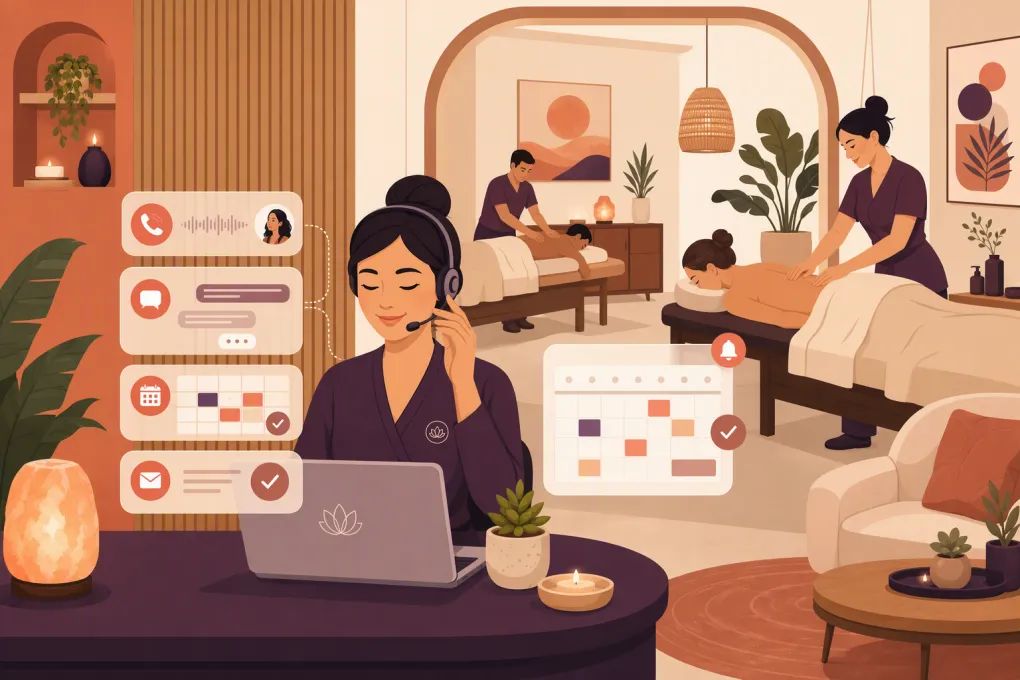 Watch · 20s
A massage appointment is often won or lost while every therapist is occupied. A prospective client calls, gets voicemail, and moves to the next studio. A returning client texts after closing, but nobody replies until morning. Meanwhile, the front desk spends its busiest hours answering routine questions and moving appointments around.
An AI receptionist for massage appointment bookings can close those gaps, but only if it works with your actual scheduling rules. The goal is not a chatbot that sends generic answers. It is a reliable front-desk workflow that identifies what the client needs, presents valid availability, completes the booking, confirms the details, and knows when a human should take over.
Why massage booking is harder than it looks
Massage businesses have more scheduling variables than a simple open-calendar model suggests. Availability can depend on:
- Massage modality and session length
- Therapist qualifications and client preferences
- Treatment-room availability
- Setup, cleanup, and recovery buffers
- Couples massage capacity
- Prenatal, medical, mobility, or age-related policies
- Membership, package, gift card, and deposit rules
- Same-day booking and cancellation windows
- Location-specific services at multi-location businesses
A conventional answering service can take a message, but that still leaves your team with follow-up work. A basic online booking page makes the client do all the navigation. An AI receptionist should handle the conversation while applying the same operational rules your trained receptionist would use.
See how Fitty can handle massage inquiries and follow-up when your team is unavailable →
What an AI massage receptionist should actually do
The useful test is not whether the system can answer a question. It is whether it can move a legitimate inquiry to the correct next step without creating scheduling problems.
Respond across the channels clients use
Prospective clients may call, text, submit a website form, or start a web chat. Your AI receptionist should respond promptly and preserve context when the conversation continues.
It should be able to handle common questions such as:
- Do you have an appointment tonight?
- Which massage should I book?
- Do you offer couples massage?
- Can I request a specific therapist?
- Can I use a gift card or membership credit?
- What is your cancellation policy?
- Where should I park, and when should I arrive?
Answers should come from an approved business knowledge base—not improvised claims about services, policies, or health outcomes.
Collect only the information needed to book
A good flow keeps questions short and purposeful. For a standard massage appointment, the agent may need:
- Preferred location
- Service or general goal
- Session duration
- Preferred date or time range
- Therapist preference, if any
- New or returning client status
- Contact information
The agent should not force clients through a long intake questionnaire before showing availability. Clinical history and sensitive intake information belong in the appropriate secure form after booking, not in a casual text exchange.
Offer valid appointments, not calendar guesses
The AI must reference the scheduling system or another defined source of truth. If it offers times from a separate calendar that is not synchronized, double bookings and invalid appointments are inevitable.
Configure rules for edge cases before going live. For example:
- A 90-minute deep-tissue session should only be offered with qualified therapists who have enough time plus the required buffer.
- Couples massage should require two eligible therapists and the correct room.
- Add-ons should adjust service duration or room requirements when necessary.
- A client using a package should not be promised coverage until eligibility is verified.
- Same-day appointments may require a shorter response window or staff approval.
When the system cannot verify a condition, it should say so and escalate rather than invent an answer.
Build the booking conversation around client intent
Clients rarely describe their request using your exact service-menu labels. Someone may ask for help with shoulder tightness rather than request a named modality. The AI can explain your available services in plain language, but it should avoid diagnosing conditions or making medical promises.
A practical conversation might follow this sequence:
- Clarify the desired outcome and preferred duration.
- Ask whether the client has a therapist or gender preference.
- Search qualified availability at the correct location.
- Present two or three valid options.
- Confirm the selected service, therapist, time, location, and policy.
- Complete the booking or send the approved secure checkout step.
- Trigger confirmation and intake instructions.
For possible medical issues, contraindications, accessibility requirements, complaints, or requests outside policy, route the conversation to a trained employee.
Connect booking with follow-up and payment workflows
Answering the first message is only part of the job. Many inquiries stop midway because the client becomes distracted, cannot decide between times, or is not ready to enter payment details.
A connected follow-up workflow can:
- Remind an interested client to finish booking
- Send confirmation and preparation instructions
- Deliver intake forms through an approved secure channel
- Remind clients of cancellation and arrival policies
- Offer a rescheduling path instead of losing the appointment
- Follow up on declined membership dues or unpaid balances
- Re-engage clients who asked about availability but did not select a time
Set limits on frequency and timing. Every unanswered inquiry does not need an endless sequence of texts. Define when automation stops, when a lead is marked inactive, and when a staff member should intervene.
Fitty is WTF Go’s AI receptionist and agent for lead response, booking workflows, follow-up, and dues collection. It is designed to keep those actions connected instead of leaving staff to copy information between disconnected inboxes and calendars.
Explore how Fitty connects massage booking conversations with automated follow-up →
Decide exactly when a human takes over
AI is most effective when its authority is explicit. Create a handoff matrix covering the situations it may not resolve alone.
Common escalation triggers include:
- The requested service is not mapped in the system
- A client reports an injury, severe symptoms, or a possible contraindication
- The client disputes a charge or cancellation fee
- A therapist or room conflict appears
- A VIP, corporate, group, or event request needs custom handling
- A client asks for an exception to a policy
- The agent detects frustration or repeated misunderstanding
- A minor’s appointment requires consent review
The handoff should include the conversation summary, requested service, preferred times, and any steps already completed. Making the client repeat everything defeats much of the value of automation.
Protect client information and communication consent
Massage businesses should treat privacy as an implementation requirement, not a later add-on. Depending on the business, the information involved, and relationships with healthcare organizations, health privacy obligations may vary. State privacy rules, payment security requirements, and messaging consent requirements may also apply.
Before adopting an AI receptionist, ask the provider:
- What client information is stored, and for how long?
- Who can access conversation records?
- Is data encrypted in transit and at rest?
- Can retention and deletion settings be configured?
- How are payment details collected securely?
- Can the provider support your required agreements, if applicable?
- How are SMS consent and opt-out requests handled?
- Is client data used to train external models?
Do not ask clients to send full card details or extensive health histories through ordinary chat. Use secure payment and intake tools built for those purposes.
How to implement an AI receptionist without disrupting the desk
Start with a controlled scope rather than automating every scenario at once.
1. Document the current process
List the questions your staff asks before booking each service. Record therapist qualifications, room constraints, buffers, deposits, cancellation windows, and escalation rules.
2. Clean up the service menu
Remove duplicate service names and clarify duration, eligibility, price-display rules, and add-on behavior. Automation will expose inconsistent setup quickly.
3. Build the approved knowledge base
Include hours, locations, parking, arrival instructions, accessibility information, services, gift cards, memberships, therapist requests, and cancellation policies. Assign an owner responsible for updates.
4. Test realistic edge cases
Do not test only the ideal new-client booking. Try couples sessions, package users, unavailable therapists, same-day requests, cancellations, late arrivals, minors, and clients who change requirements midway through the conversation.
5. Review early conversations
Look for incorrect answers, unnecessary questions, confusing service descriptions, missed handoffs, and invalid appointment offers. Adjust the rules before expanding the agent’s authority.
Measure operational outcomes, not novelty
An AI receptionist should improve a measurable front-desk process. Track a baseline before launch and monitor:
- Calls and messages answered versus missed
- Time to first response by channel
- Inquiry-to-booking conversion
- Booking completion and abandonment
- Appointment changes completed without staff intervention
- Handoff volume and reasons
- No-shows and late cancellations
- Scheduling errors or manual corrections
- Unpaid balances and recovered dues
Review conversation samples alongside the numbers. A higher booking count is not useful if employees are constantly correcting service assignments or calming confused clients.
The buying checklist for massage operators
Before choosing a system, confirm that it can demonstrate your workflow using your services—not a generic salon example. Ask to see how it handles live availability, therapist preferences, multiple locations, buffers, deposits, packages, cancellations, and human escalation.
Also evaluate who maintains the system. Your service menu and policies will change. Someone must own knowledge-base accuracy, permission settings, conversation review, and staff training.
The right setup gives clients a clear path to book while protecting therapists from interruptions and keeping the front desk focused on the situations that need judgment. That is the practical value of an AI receptionist: fewer dead-end inquiries, more consistent follow-through, and less administrative work between the first question and the completed appointment.
See whether WTF Go and Fitty fit your massage studio’s booking workflow →
Frequently asked questions
Can an AI receptionist book massage appointments directly?
Yes, if it is connected to the business's scheduling workflow and configured with valid service, therapist, room, buffer, and policy rules. Otherwise, it may only collect information or send a booking link.
Can an AI receptionist handle phone calls as well as texts?
Some AI receptionists support voice, SMS, web chat, and lead-form follow-up, but channel support varies. Confirm which channels share context and connect to your booking system.
How should an AI handle sensitive health information?
It should collect only what is necessary for scheduling and direct detailed health intake to an appropriate secure form. Operators should verify privacy, retention, security, and contractual requirements with the provider.
Will an AI receptionist replace massage studio staff?
It is better used to handle repetitive inquiries, routine booking, reminders, and follow-up. Staff should retain control of medical concerns, disputes, exceptions, complex scheduling, and sensitive client situations.
What should a massage studio test before going live?
Test therapist qualifications, room conflicts, couples massage, buffers, packages, deposits, same-day requests, cancellations, minors, and escalation. Every offered appointment should be valid in the real scheduling system.
Keep reading

Run your gym on autopilot with WTF Go
Fitty — your AI receptionist — answers calls and DMs, fills classes, follows up with every lead, and collects dues while you coach.