AI & Automation
AI Receptionist for Lash Studios: Booking Guide for Owners
Learn how an AI receptionist for lash studios handles inquiries, books appointments, follows up, and collects payments without adding front-desk payroll.
 Watch · 20s
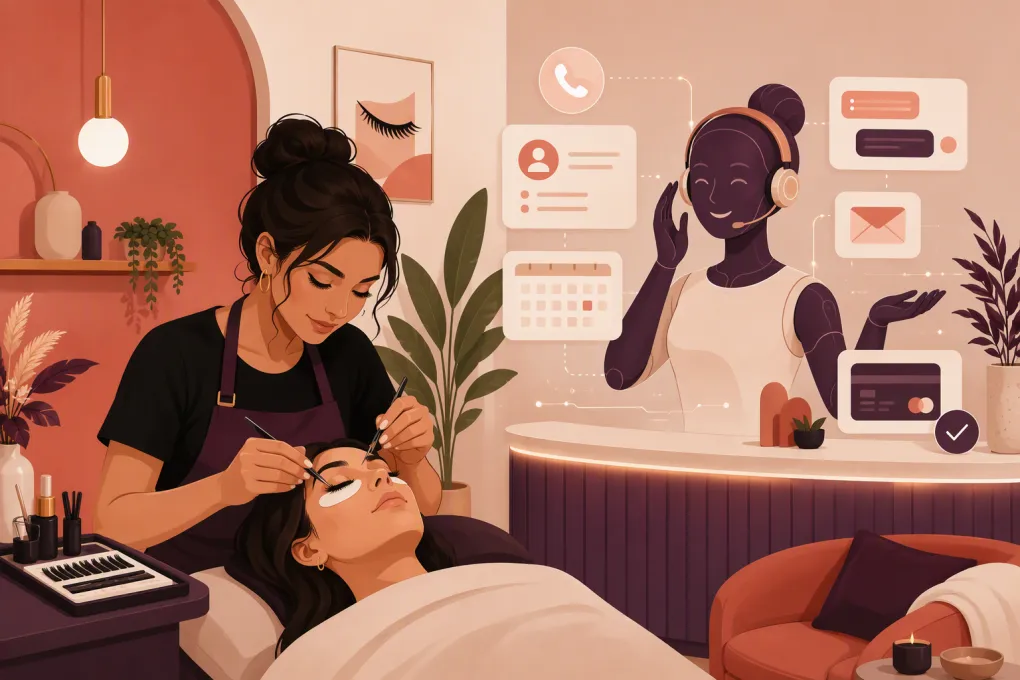
A lash artist cannot answer the phone while isolating lashes, handling adhesive or working inches from a client’s eyes. That creates an operating problem: the moments when your team is busiest producing revenue are often the moments when new inquiries go unanswered.
An AI receptionist for lash studios fills that gap. It can respond to common questions, qualify prospective clients, guide them toward the right service, book eligible appointments and follow up when someone does not complete the process. The value is not simply answering faster. It is protecting the artist’s focus while giving clients a clear path from inquiry to confirmed appointment.
The catch is that lash bookings are not generic calendar slots. A useful system must understand fills versus full sets, artist eligibility, service duration, studio policies and situations that require a human decision.
See how Fitty handles lash-studio inquiries while your artists stay with clients →
What an AI receptionist should handle for a lash studio
The best use of AI is not to make every decision. It is to consistently handle repetitive, rules-based conversations and escalate the exceptions.
Answer routine questions immediately
Most studios receive the same questions repeatedly:
- What does a full set cost?
- How long does an appointment take?
- Do you offer classic, hybrid or volume sets?
- Can I book a fill if another artist did my lashes?
- How late can I arrive?
- How should I prepare for my appointment?
- What is your cancellation policy?
- Do you have availability tonight or this weekend?
An AI receptionist should answer from information approved by the studio. It should not guess when a policy, price or appointment requirement is missing.
Build a knowledge base that includes your current service menu, durations, price ranges or fixed prices, preparation instructions, parking information, cancellation rules and accepted payment methods. Assign someone to update it whenever the studio changes a policy or service.
Qualify the client before showing availability
Offering an open time too early can create a booking that your staff later has to repair. The receptionist should collect enough information to identify the correct appointment type.
For a new lash inquiry, that may include:
- Is this a new full set, fill, removal or consultation?
- What style does the client want?
- When was the current set applied?
- Was the existing set applied by your studio?
- Is a removal likely to be needed?
- Does the client have a preferred artist, date or time?
- Is the client new or returning?
Your studio decides which answers change the booking. For example, you may not accept foreign fills, or you may require an assessment before confirming one. Some services may only be available with artists trained for that technique.
Book the correct service with the correct artist
A lash-studio booking workflow should account for more than calendar availability. It needs rules for:
- Service length and cleanup time
- Artist skills and permitted services
- New-client versus returning-client appointments
- Full-set and fill eligibility
- Removal add-ons
- Deposits or card-on-file requirements
- Location selection for multi-location studios
- Minimum notice or same-day booking rules
The AI should summarize the service, artist, location, date, time and payment requirement before final confirmation. That final recap catches misunderstandings before they become front-desk work.
Explore how WTF Go and Fitty can support lead response, booking and follow-up in one workflow →
Where AI fits compared with other reception options
AI does not automatically replace every front-desk function. The right setup depends on your volume, service complexity and how often clients need judgment rather than information.
| Reception option | Main strength | Main limitation | Best fit |
|---|---|---|---|
| Voicemail and callbacks | Simple and inexpensive to maintain | Delays answers and requires staff to chase every inquiry | Very low inquiry volume with reliable callback coverage |
| Online booking link | Lets clients self-book at any hour | Clients must identify the correct service without help | Straightforward menus with few eligibility rules |
| Human receptionist | Handles nuance, emotion and unusual requests well | Coverage is limited to staffed hours unless shifts are expanded | Busy studios with substantial in-person and phone traffic |
| Answering service | Provides broader call coverage | Agents may lack detailed knowledge of lash services and studio rules | Studios that mainly need message taking and basic scheduling |
| AI receptionist | Responds consistently, handles repetitive questions and can continue booking workflows | Requires careful setup, approved information and human escalation paths | Studios with recurring inquiries, missed calls and rule-based bookings |
Many operators will use a hybrid model. AI handles the first response and routine workflow, while a manager receives escalations involving complaints, medical concerns, unusual service requests or policy exceptions.
Build the workflow around real lash-studio rules
An AI receptionist is only as dependable as the operating rules behind it. Do not start by uploading a price list and turning on automation. Map the full client journey first.
Create a service decision map
For each service, document:
- What the client calls it in everyday language
- The service name in your booking system
- Duration and price
- Eligible artists and locations
- Required questions
- Add-ons that change the appointment length
- Deposit or prepayment requirements
- Conditions that prevent automatic booking
- When a manager must review the request
Include common phrases. A prospective client may ask for a natural set without knowing that your studio categorizes it as classic. The receptionist should clarify the desired result rather than forcing the client to know your menu terminology.
Define hard stops and escalations
Some conversations should always go to a person. Set explicit escalation rules for:
- Eye irritation, allergic reactions or other health concerns
- Requests for medical advice
- Complaints or refund demands
- Charge disputes
- Minors and studio-specific consent requirements
- A service that cannot be confidently identified
- Exceptions to cancellation, lateness or deposit policies
- Aggressive, threatening or inappropriate messages
The system can acknowledge the message, avoid making promises and route the details to the right team member. It should never diagnose a condition or improvise safety guidance.
Protect payment and messaging compliance
Deposits can reduce uncommitted bookings, but payment details should be handled through an appropriate payment processor rather than placed in ordinary chat notes. Confirm how your receptionist, booking platform and processor exchange payment status before launch.
For automated follow-up, maintain consent records where required, identify your business and honor opt-out requests. Federal and state rules can vary by channel and message type, so have qualified counsel review your process if you are uncertain.
Use follow-up to finish incomplete bookings
Many inquiries do not end with an immediate yes or no. A prospect may ask about price, check a work schedule and disappear. Without a follow-up process, that conversation stays buried in an inbox.
Useful follow-up triggers include:
- The client received availability but did not choose a time
- A booking was started but the deposit was not completed
- The client requested a human callback
- A waitlist opening matches the client’s stated preferences
- An outstanding balance remains after an approved payment request
Keep the message connected to the conversation. A useful follow-up might say that the requested afternoon opening is still available and provide the next booking step. A vague message asking whether the person is still interested creates more work and less clarity.
Fitty is designed to answer leads, continue follow-up and support payment collection workflows around the clock. That gives the operator one process to supervise instead of separate tools and disconnected inboxes.
See how Fitty follows up with unfinished inquiries and outstanding payments →
Example conversation logic
A strong conversation is brief, but it gathers enough information to protect the calendar.
New full-set inquiry
- Confirm whether the client currently has extensions.
- Ask what look they want and whether they have an artist preference.
- Match the request to eligible services and artists.
- Present appropriate openings.
- Explain the deposit and cancellation terms before payment.
- Confirm all appointment details and send preparation instructions.
Fill from another studio
- Ask when and where the set was applied.
- Explain your foreign-fill policy exactly as written.
- If assessment is required, avoid guaranteeing that a fill can be performed.
- Offer the approved assessment, removal or full-set path.
- Escalate when the condition of the existing work must be reviewed by an artist.
Late-arrival question
- State the official grace-period policy.
- Collect the appointment details and estimated arrival time.
- Avoid promising that the full service can still be completed.
- Notify the studio if a same-day operational decision is needed.
These flows make the receptionist useful without giving it authority it should not have.
Measure whether the system is helping
Do not judge the receptionist by how many messages it sends. Review operational outcomes.
Track:
- Inquiries received by channel and time of day
- Calls or messages answered versus missed
- Qualified inquiries that reach the booking step
- Completed bookings and incomplete booking attempts
- Deposits successfully completed
- Escalations and their reasons
- Incorrectly categorized services
- Cancellations, late arrivals and no-shows by booking source
- Staff time spent correcting automated bookings
Review transcripts during the first weeks and after every service-menu change. Repeated confusion usually points to a missing rule, unclear service name or weak escalation condition. Fix the underlying workflow rather than editing one isolated response.
Choosing an AI receptionist for your lash studio
Before committing to a platform, ask for a live demonstration using your own scenarios. Test a new full set, foreign fill, removal request, late arrival, deposit failure and health-related question.
Confirm that the system can:
- Use your approved service and policy information
- Recognize natural language rather than relying only on menu buttons
- Respect artist, service, location and duration rules
- Escalate with the full conversation attached
- Work with your booking and payment setup
- Show conversation history and outcomes
- Support changes without requiring a technical project
- Provide clear control over follow-up timing and content
The goal is not an AI that sounds impressive in a demo. It is a receptionist that follows your rules on a busy Tuesday evening, when every artist is occupied and a prospective client is ready to book.
Frequently asked questions
Can an AI receptionist book lash appointments automatically?
Yes, if it has access to the correct availability and is configured with service duration, artist eligibility, location and deposit rules. Requests involving unclear services or policy exceptions should be escalated.
Can AI tell whether a client needs a fill or full set?
It can ask qualifying questions and apply your written booking rules, but it should not evaluate the physical condition of a client's lashes. When an artist must inspect the existing set, the AI should arrange an assessment or escalate the request.
Will an AI receptionist replace my front-desk staff?
Not necessarily. Many studios use AI for immediate responses, routine booking and follow-up while staff handle complaints, exceptions, in-person service and sensitive conversations.
What information is needed to set up an AI receptionist?
Prepare your service menu, prices, durations, artist eligibility, locations, booking restrictions, deposit terms, cancellation policy, preparation instructions and escalation rules.
Can an AI receptionist follow up on missed calls and unpaid deposits?
A properly configured system can continue eligible follow-up workflows and direct clients back to booking or payment steps. Confirm channel consent, payment security and integration requirements with the provider.
Keep reading
Run your gym on autopilot with WTF Go
Fitty — your AI receptionist — answers calls and DMs, fills classes, follows up with every lead, and collects dues while you coach.