AI & Automation
AI Receptionist for Ketamine Therapy Clinics: Operator Guide
Learn how an AI receptionist for ketamine therapy clinics can handle inquiries, screen leads, book consults, follow up, and protect patient trust at scale.
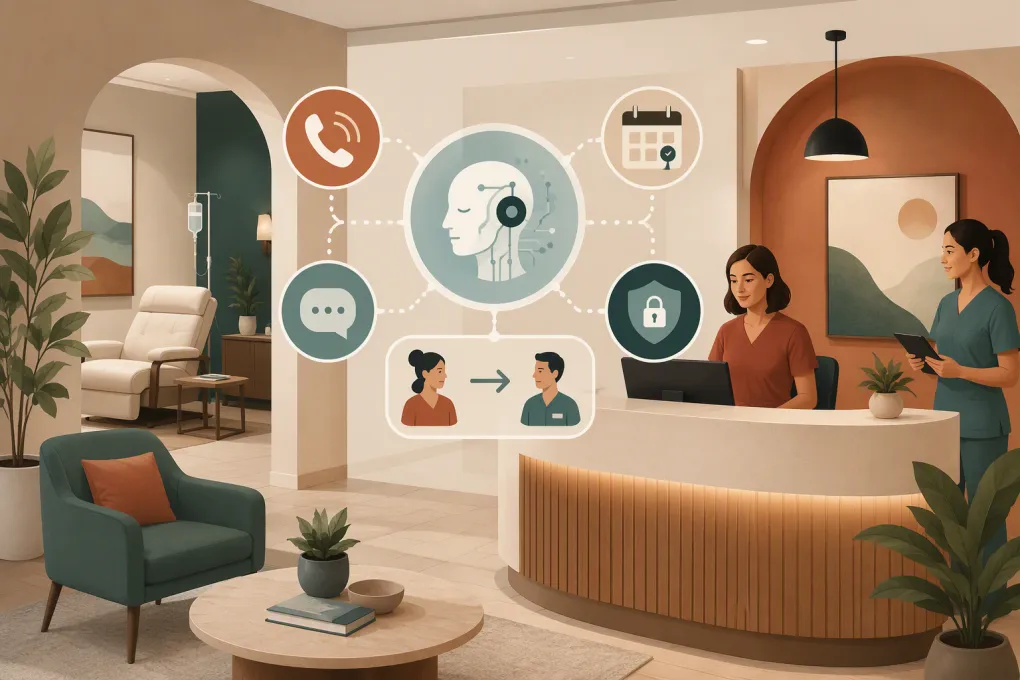 Watch · 20s
A prospective patient rarely contacts a ketamine clinic casually. They may have questions about eligibility, treatment formats, cost, transportation, preparation, or what happens after a session. If the clinic misses that call—or replies with an impersonal form email—the patient may never book a consultation.
An AI receptionist can close that communication gap, but this is not ordinary appointment automation. Ketamine clinics handle sensitive health information, clinically complex services, and patients who may be in distress. The system must be designed around privacy, precise boundaries, and fast human escalation—not simply around answering every question automatically.
Used correctly, an AI receptionist for ketamine therapy clinics can respond around the clock, collect limited intake information, route prospects, schedule appropriate consultations, send approved follow-ups, and keep front-desk work from becoming a bottleneck. It should never diagnose, determine clinical eligibility, provide emergency counseling, or replace licensed staff.
See how Fitty can answer ketamine clinic inquiries and move qualified leads toward a consultation →
What an AI receptionist should actually do
The best use cases are repetitive, rules-based conversations that currently consume staff time or sit unanswered after hours.
Answer common nonclinical questions
A clinic can build an approved knowledge base covering topics such as:
- Clinic location, parking, hours, and accessibility
- Services offered, such as infusions or consultation pathways
- Whether a referral is required
- General consultation and treatment processes
- Accepted payment methods and whether the clinic handles insurance
- Transportation requirements after treatment
- How to request records or contact the clinical team
Answers should come from clinic-approved content. The receptionist should not generate novel explanations about dosing, side effects, medication interactions, treatment suitability, or expected outcomes.
A useful rule is simple: the AI may explain the clinic’s process, but not make a clinical judgment about the patient.
Capture leads without conducting a clinical evaluation
The receptionist can collect basic contact and routing information, including:
- Name
- Preferred contact method
- General service of interest
- New or returning patient status
- Preferred consultation time
- Referral source
- Whether the request requires a staff callback
Avoid turning the first conversation into an uncontrolled medical intake. Detailed diagnoses, medication lists, treatment histories, and symptom narratives should only be collected through an approved, secure workflow when necessary.
Schedule the right type of visit
Ketamine scheduling is not interchangeable with booking a haircut or fitness class. A new patient may need a consultation, records review, medical clearance, or other clinic-defined steps before treatment can be scheduled.
Build separate booking paths for:
- New-patient consultations
- Returning-patient follow-ups
- Treatment appointments approved by staff
- Psychotherapy or integration appointments, where offered
- Billing or records calls
- Urgent staff callbacks
The AI should only expose appointment types the person is eligible to book. It must also enforce operational rules such as clinician availability, room capacity, treatment duration, buffer time, and location.
Keep clinical decisions with clinicians
An AI receptionist needs explicit limits. Without them, a seemingly helpful answer can drift into medical advice.
| Request | Appropriate AI action | Human owner |
|---|---|---|
| What services does the clinic offer? | Provide approved service information | Clinic leadership approves content |
| Am I a good candidate? | Offer to schedule an evaluation | Licensed clinician |
| Can I take my medication before treatment? | Do not advise; escalate to the clinical team | Prescriber or clinical staff |
| Can I drive home afterward? | Provide the clinic’s approved transportation policy | Staff handles exceptions |
| I have new symptoms after treatment | Trigger the clinic’s post-treatment escalation workflow | Clinical staff or emergency services |
| I want to reschedule | Apply approved scheduling and cancellation rules | Staff handles exceptions |
| Will insurance cover this? | Explain the clinic’s general billing process without guaranteeing coverage | Billing staff or payer |
The receptionist should not interpret symptoms, assess contraindications, recommend treatment, promise results, or tell someone to start, stop, or change medication.
Build a safety escalation path
Ketamine clinics may receive messages involving severe symptoms, suicidal thoughts, medication reactions, or immediate danger. The AI cannot be the final destination for these conversations.
Create escalation rules that specify:
- Which words, phrases, or user selections trigger an urgent response
- What approved message the system sends immediately
- Whether the conversation transfers to an on-call person
- How staff are alerted and how receipt is confirmed
- What happens when no staff member responds
For imminent danger, the approved response should direct the person to emergency services. In the United States, people experiencing suicidal or mental health crises can call or text 988. The script should also state that the AI channel is not monitored as an emergency or clinical service.
Do not imply that keyword detection is a complete risk assessment. It is only a routing safeguard.
Privacy and compliance questions to resolve first
An AI receptionist may handle protected health information depending on how the clinic operates and what data the system receives. Before activation, involve the clinic’s privacy, security, legal, and clinical decision-makers as appropriate.
Review these areas:
Business associate agreements
If the clinic is a HIPAA-covered entity and a vendor creates, receives, maintains, or transmits protected health information on its behalf, determine whether a business associate agreement is required. Review downstream vendors and subprocessors as well.
A vendor claiming to support HIPAA-aligned workflows is not enough by itself. The contract, product configuration, staff procedures, and actual data flow all matter.
Data collection and retention
Document what the AI collects, where it is stored, who can access it, and how long it is retained. Apply the minimum-necessary principle rather than capturing information simply because the system can.
Confirm that the clinic can:
- Restrict access by role
- Review conversation history and activity logs
- Correct or remove data under its policies
- Export information when needed
- Manage former employee access
- Respond to a security incident
Calls, texts, and consent
Automated calls and text messages may be subject to federal and state requirements. Call recording and transcription laws also vary by jurisdiction. Obtain appropriate legal guidance and document consent where required.
Keep text messages discreet. A scheduling reminder does not need to disclose a diagnosis, medication, or treatment type on a locked phone screen.
A practical conversation design for ketamine clinics
A strong workflow gives the patient a clear next step without pretending that software can evaluate them clinically.
Step 1: Identify intent
Start with a small set of options:
- Learn about the clinic
- Request a new-patient consultation
- Manage an existing appointment
- Ask a billing question
- Contact the clinical team
- Get urgent help
This is easier to control than an unrestricted chatbot trying to infer every request.
Step 2: Set expectations
Tell users they are interacting with an automated receptionist. Explain that it can help with general information and scheduling but cannot provide medical advice or emergency support.
Step 3: Collect only routing information
Ask for the minimum information needed to book or hand off the conversation. Move detailed intake into the clinic’s secure, approved process.
Step 4: Offer a defined next action
Every conversation should end with one of these outcomes:
- Consultation booked
- Callback requested
- Secure intake link sent
- Existing appointment updated
- Staff handoff initiated
- Emergency guidance displayed
Avoid vague endings such as telling the patient someone will respond soon unless the clinic has a defined response window and ownership queue.
Step 5: Confirm and follow up
Send confirmation through the patient’s approved channel. Include only necessary details, clear cancellation instructions, and a way to reach a person.
Fitty can support the operational side of this flow by answering new inquiries, following up with leads, and routing people into approved scheduling paths around the clock. The clinic still controls its scripts, clinical boundaries, escalation rules, and privacy requirements.
Measure outcomes, not conversation volume
A busy AI receptionist is not automatically an effective one. Track whether it produces safe, useful outcomes.
Useful operating metrics include:
- Median time to first response
- Consultation booking rate by lead source
- Percentage of booked consultations that attend
- Number and type of human escalations
- Conversations that end without a clear disposition
- Scheduling errors or inappropriate booking attempts
- Staff response time after a handoff
- Message opt-outs and complaints
- Questions the knowledge base could not answer
Review transcripts or structured conversation records regularly, subject to the clinic’s access and privacy policies. Look for incorrect answers, confusing language, missed escalation signals, and repeated questions that indicate gaps in clinic communication.
Do not optimize solely for fewer human handoffs. In a healthcare environment, the correct handoff is a success.
How to roll out an AI receptionist safely
Start with a narrow workflow rather than automating the entire patient journey at once.
- Map current inquiries. Categorize calls, texts, forms, and missed-call voicemails.
- Choose one controlled use case. New-patient consultation requests are often easier to define than clinical follow-up.
- Approve the knowledge base. Assign an owner to every clinical, billing, and operational answer.
- Define prohibited topics. Include diagnosis, medication advice, dosing, side effects, eligibility decisions, and emergencies.
- Configure scheduling rules. Test appointment types, buffers, locations, staff calendars, and cancellation policies.
- Test adverse scenarios. Include urgent symptoms, crisis language, angry callers, minors, existing patients, and requests to stop messages.
- Train staff on handoffs. Every alert needs an owner, expected action, and backup.
- Launch with monitoring. Review early conversations frequently and tighten the workflow before expanding it.
The right AI receptionist does not make a ketamine clinic less human. It removes preventable delays while preserving human attention for clinical questions, sensitive conversations, and patient care. That balance—not maximum automation—is the standard operators should use when evaluating the system.
Frequently asked questions
Can an AI receptionist determine whether someone qualifies for ketamine therapy?
No. It can collect limited routing information and schedule an evaluation, but eligibility and treatment decisions must remain with qualified clinical professionals.
Can a ketamine clinic use an AI receptionist under HIPAA?
Potentially, but compliance depends on the clinic, vendor agreements, configuration, data flows, access controls, and operating procedures. Clinics should determine whether a business associate agreement and other safeguards are required.
What should the AI do if a patient mentions suicidal thoughts or severe symptoms?
It should immediately follow a clinic-approved crisis or emergency escalation script, provide appropriate emergency resources, and alert designated staff. It should not attempt to perform a clinical risk assessment.
Can an AI receptionist book ketamine treatment appointments directly?
It should only book appointment types allowed by the clinic’s rules. New patients will often need a consultation or clinical clearance before treatment appointments become available.
What is the best first workflow to automate?
Start with a narrow, nonclinical workflow such as answering general questions and booking new-patient consultations. Expand only after testing privacy, scheduling, escalation, and staff handoffs.
Keep reading


Run your gym on autopilot with WTF Go
Fitty — your AI receptionist — answers calls and DMs, fills classes, follows up with every lead, and collects dues while you coach.