AI & Automation
AI Receptionist for Karate Schools: Practical Setup Guide
Use an AI receptionist for karate schools to handle inquiries, book trials, follow up, and protect parent and student data with practical privacy safeguards.
 Watch · 20s
A parent calls your karate school while every instructor is on the mat. Their eight-year-old is a beginner, the family can only attend on Tuesdays, and they want to know whether a gi is required for the trial. If the call goes unanswered, that parent may contact another dojo before class ends.
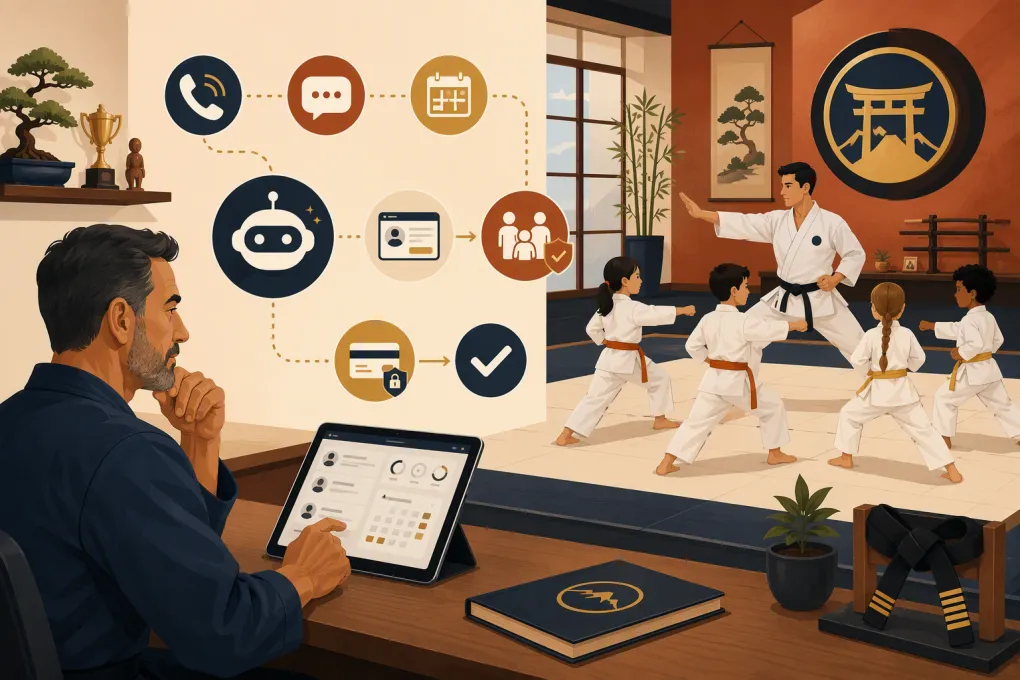
An AI receptionist for karate schools can close this coverage gap—but only if it understands your programs, communicates through the channels your prospects actually use, and connects correctly to your booking and member systems. A generic chatbot with a list of FAQs is not enough.
The goal is a controlled workflow from inquiry to attended trial: answer the parent, identify the appropriate age group, offer an eligible class, collect guardian details, send instructions, and hand the full conversation to staff when judgment is required.
See how WTF Go positions Fitty for lead response, booking, follow-up, and dues workflows →
What an AI receptionist should handle in a dojo
Karate schools have reception requirements that ordinary appointment bots often miss. A useful agent must account for age-based programs, guardian involvement, introductory offers, class capacity, uniforms, rank restrictions, and the difference between a new prospect and an active student.
Typical tasks include:
- Answering approved questions about age groups, schedules, beginner classes, trial lessons, uniforms, parking, and parent observation
- Distinguishing children, teen, adult, and family inquiries
- Offering only classes that accept new or trial students
- Booking an introductory lesson or enrollment consultation
- Sending preparation instructions and reminders
- Following up after an unanswered inquiry, canceled trial, or no-show
- Routing accommodation, safety, cancellation, and billing issues to staff
- Directing members to a secure dues-resolution process
The agent should not estimate how quickly someone will earn a belt, decide whether an injury is safe for training, promise competition-team placement, or negotiate tuition outside your policy.
WTF Go describes Fitty as an AI agent that answers leads, books classes, follows up, and collects dues 24/7. Those are the relevant product-level capabilities operators should evaluate on the WTF Go website. That statement does not establish that every voice, SMS, email, payment, or dojo-management integration is enabled for every account. Confirm the exact channels and connectors required by your school during the product review.
Voice, text, chat, and email are different workflows
The term AI receptionist can imply phone answering, but vendors do not all use it the same way. Some products are chat-first, some automate SMS, and others provide an AI voice agent that answers or places calls.
Ask for a channel-by-channel demonstration rather than accepting a general claim about omnichannel communication.
| Channel | What to verify | Common operational failure |
|---|---|---|
| Phone or voice | Inbound answering, call transfers, voicemail handling, business-hours rules, transcription, recording, and caller disclosure | The agent answers questions but cannot transfer urgent calls or update the lead record |
| SMS | Consent capture, local number support, STOP and HELP handling, quiet-hour controls, and two-way messaging | Follow-up continues after an opt-out or duplicates staff texts |
| Website chat | Identity capture, mobile usability, transcript storage, and conversion to a contact record | The conversation disappears when the visitor closes the browser |
| Shared-inbox access, threading, sender identity, unsubscribe handling, and staff assignment | The AI starts a second thread and staff lose the original context | |
| Social messaging | Supported platforms, platform permissions, response windows, and contact matching | A lead remains isolated from the main CRM record |
If phone coverage is essential, specifically ask whether Fitty currently supports inbound voice for your setup, whether it uses your existing number, and what happens when a caller requests a person. Do the same for texting, email, web chat, and social channels. Channel availability can change, so it should be confirmed in the current product demonstration or agreement.
A dojo-specific workflow to test
Do not evaluate an AI receptionist using only a polished sample question. Give the vendor a realistic acceptance test based on how parents actually inquire.
Consider this scenario—not a customer case study, but a practical test script:
- A parent asks whether two siblings, ages seven and eleven, can try karate on the same Tuesday.
- The younger child fits the beginner youth class. The older child must attend a separate age group thirty minutes later.
- The first class has one remaining trial space; the second is full.
- The parent asks whether both children need a gi and whether they can stay together.
- The parent provides one guardian phone number and asks for a callback after work.
A properly configured system should avoid placing both children into the same class merely for convenience. It should explain the approved trial-clothing policy, offer valid alternatives for the full class, create or update the guardian record without unnecessary duplicate contacts, and preserve the sibling relationship for staff.
Then change the scenario. Mention asthma, a prior injury, a custody-related pickup restriction, or a bullying concern. The agent should stop making routine recommendations and escalate according to your policy.
Ask WTF Go to demonstrate Fitty against your real youth and adult trial-booking rules →
Integrations required for reliable booking
An AI response is only one part of the workflow. Accurate action requires access to authoritative data.
Member management or CRM
The receptionist needs to determine whether the person is a new lead, former member, active student, or guardian associated with multiple students. Verify how records are matched—phone number, email, guardian ID, or another identifier—and how duplicate records are handled.
Class schedule and capacity
The booking connection should read current availability, not a copied schedule. Define which classes accept trials, how many trial students are allowed, age limits, booking cutoffs, location restrictions, and instructor availability.
Messaging and telephony
SMS requires a messaging provider or supported communications layer. Voice requires phone-number routing, call handling, and transfer logic. Email requires authenticated sending and reply tracking. Ask whether these are native capabilities, third-party integrations, or separately billed services.
Payments
Dues follow-up should direct members to a secure, approved payment process. The AI should not collect raw card details in an ordinary chat, text, or transcript. Confirm which system remains the payment source of truth and what the receptionist can see after a payment succeeds or fails.
Integration controls
For every connector, ask:
- Is the connection native, API-based, webhook-based, or a manual export?
- Which system owns the schedule and member record?
- How quickly do updates synchronize?
- What happens when an API request fails?
- Are failed bookings retried or sent to staff?
- Can staff see an audit log of messages and actions?
- What data is written back to the operating system?
- How are records exported if you leave the service?
Ask to see the actual booking record, conversation history, opt-out status, and failed-action queue during the demo. Screenshots can help, but a live test using your own class rules is stronger evidence than a static interface image.
Consent, recording, and minor-data safeguards
Karate schools frequently communicate with parents and store information connected to minors. Treat compliance and data handling as implementation requirements, not cleanup work.
Separate service messages from marketing
A trial confirmation is different from a promotional campaign. Document how consent is collected for each channel and purpose. Preserve the timestamp, source, disclosure language, and phone number or email associated with that consent.
For automated calls and texts, review the federal Telephone Consumer Protection Act requirements and applicable state rules with qualified counsel. The current federal regulatory text is available in 47 C.F.R. § 64.1200. Marketing email should also follow the FTC’s CAN-SPAM compliance guidance.
This is operational guidance, not legal advice. Requirements can depend on the channel, message purpose, technology, recipient, and state.
Make opt-outs immediate and visible
SMS workflows should recognize standard opt-out requests such as STOP, prevent further nonpermitted messages, and synchronize the status across campaigns and staff tools. Email needs a functioning unsubscribe process. Staff should be able to see that a person opted out before manually contacting them for marketing.
Also define messaging windows. An AI agent may operate around the clock, but that does not mean every outbound message should be sent at midnight.
Address call recording and transcription
If calls are recorded or transcribed, determine which state laws apply and whether all-party consent is required. Configure the appropriate disclosure before recording begins, restrict access to recordings, and document when recordings are deleted.
Do not assume that a general website privacy policy is sufficient notice for every call-recording situation.
Minimize information about children
Whenever possible, create the primary contact under the parent or legal guardian. Collect only the child information required to recommend and prepare for a class, such as first name, age range, and program interest.
Avoid asking an AI receptionist to collect detailed medical histories, school information, custody documents, or other sensitive data through ordinary messaging. Route accommodation and safety needs to trained staff using an approved process.
If your online service is directed to children or knowingly collects personal information from children under 13, review the FTC’s COPPA guidance. Many schools can reduce risk by directing registration and communication through the parent, but the correct approach depends on the service and data collected.
Set a retention schedule
Decide how long to retain lead transcripts, call recordings, consent records, abandoned inquiries, and minor-related data. Retention should reflect legal requirements and operational need—not an unlimited default. Your deletion process should cover the AI platform, CRM, messaging provider, recordings, exports, and backups where applicable.
Configure the handoff to instructors and staff
The best automation knows when to stop. Create explicit escalation rules for:
- Injuries, health limitations, or disability accommodations
- Student safety, bullying, or misconduct
- Custody and authorized-pickup concerns
- Refunds, disputes, freezes, and cancellations
- Private lessons and competition-team placement
- Questions about rank transfer from another martial art
- Requests outside approved tuition or trial policies
The handoff should include the conversation, contact details, student age group, requested class, and reason for escalation. Staff should not have to ask the parent to repeat everything.
A controlled rollout plan
Start with after-hours inquiries for one location or program. Load approved answers, connect only eligible trial classes, and review every conversation during the initial rollout.
Next, add confirmations, preparation instructions, rescheduling, and no-show follow-up. Test whether messages stop after booking, enrollment, opt-out, or staff takeover.
Only then add existing-member questions and dues workflows. Billing disputes, hardship requests, and cancellations should remain with authorized staff.
Track outcomes that expose operational quality: unanswered inquiries, valid trial bookings, invalid bookings, staff escalations, no-shows, duplicate contacts, opt-out failures, and actions that could not be written back to the system.
An AI receptionist earns its place when it makes the dojo easier to reach without creating scheduling errors, compliance problems, or impersonal handoffs. Fitty is built around the relevant lead, booking, follow-up, and dues workflows; the next step is verifying its current channels and integrations against your school’s actual operating rules.
Review Fitty with your schedules, communication channels, and escalation requirements →
Frequently asked questions
Can Fitty answer phone calls for a karate school?
Fitty is positioned as an AI agent for answering leads and handling related workflows, but operators should confirm current inbound voice availability, number routing, transfers, recording, and transcription for their specific setup.
What systems must an AI receptionist integrate with?
At minimum, evaluate connections to your member or CRM records, live class schedule, messaging or phone provider, and payment workflow. Confirm which integrations are native and which require an API, third-party service, or manual process.
Can an AI receptionist text parents automatically?
It can if the platform supports SMS, but the school must address consent, message purpose, opt-outs, timing, and applicable federal and state requirements. Opt-out status should synchronize across automated and staff messaging.
What information should the AI collect about a child?
Collect only what is needed for the inquiry, usually through the parent or guardian. Avoid gathering detailed medical, school, custody, or other sensitive information through ordinary chat or text.
How should a karate school test an AI receptionist?
Use real class rules and difficult scenarios involving siblings, age limits, full classes, injuries, billing disputes, and staff escalation. Verify the resulting booking, contact record, transcript, consent status, and audit trail.
Keep reading

Run your gym on autopilot with WTF Go
Fitty — your AI receptionist — answers calls and DMs, fills classes, follows up with every lead, and collects dues while you coach.