AI & Automation
AI Receptionist for Jiu Jitsu Academies: Operator Guide
Learn how an AI receptionist for jiu jitsu academies can answer leads, book trial classes, follow up, collect dues, and support members 24/7, at any hour.
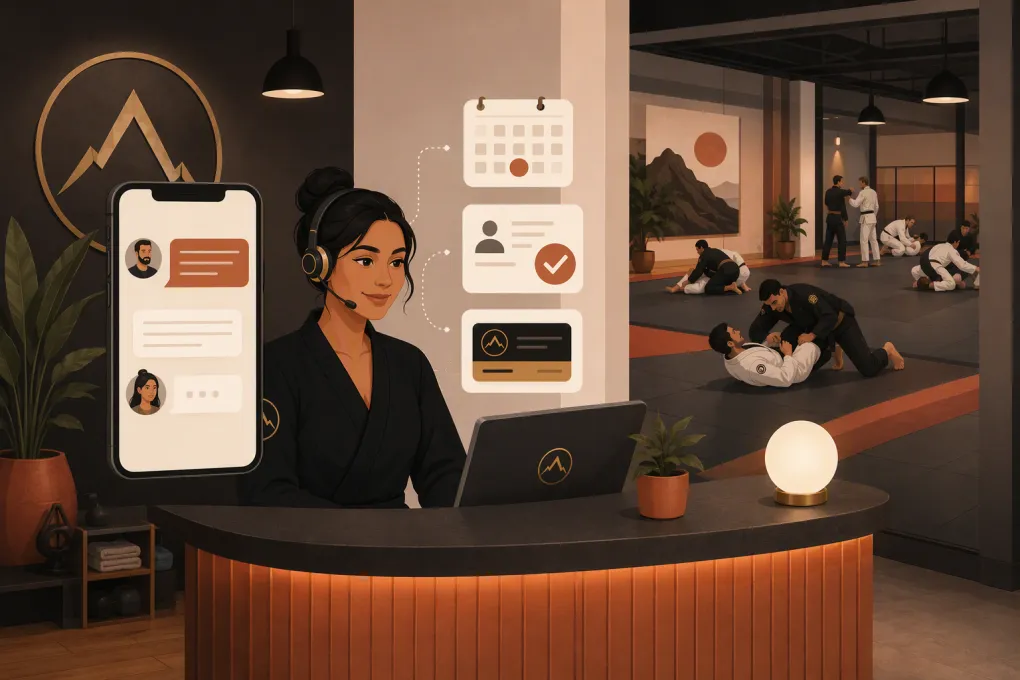 Watch · 20s
A prospective student finds your academy after dinner. They want to know whether beginners are welcome, what to wear, and which class they should try. Nobody answers immediately, so they message the next academy on the list.
That is the front-desk problem for many jiu jitsu operators. Leads arrive while the owner is teaching, coaching a competition class, cleaning mats, or trying to have a life outside the academy. Hiring more front-desk coverage may help, but it does not automatically cover nights, weekends, or every simultaneous inquiry.
An AI receptionist for jiu jitsu academies can handle the repetitive first-contact work: answering common questions, qualifying prospects, booking trial classes, following up, and directing sensitive issues to a person. The goal is not to replace good coaching or human relationships. It is to stop routine administrative work from depending on whether someone happens to be available.
See how Fitty handles jiu jitsu leads and bookings 24/7 →
What an AI receptionist should actually do
A useful AI receptionist is more than a generic website chatbot. It should connect conversations to real academy workflows and move people toward a clear next step.
For a jiu jitsu academy, that normally means:
- Answering questions about beginner, fundamentals, kids, women’s, gi, no-gi, and competition classes
- Explaining what a new student should wear or bring
- Recommending an appropriate trial class based on age, experience, schedule, and goals
- Booking the prospect into an available class or intro appointment
- Collecting the contact information needed for follow-up
- Sending reminders and following up with leads who have not booked or attended
- Answering established-member questions using approved academy policies
- Escalating billing disputes, injuries, cancellations, and unusual requests to staff
- Helping collect overdue dues without forcing coaches to chase members between rounds
The important distinction is action. A bot that only provides information may reduce a few questions. A receptionist that can book, follow up, and support payment workflows can remove actual work from the academy’s daily operation.
High-value workflows for a jiu jitsu academy
1. Turning beginner questions into trial bookings
Most first-time prospects do not know academy terminology. They may ask for “adult beginner training” rather than fundamentals, or ask whether they need to be fit before starting. Your AI should respond in plain language instead of expecting the lead to understand the schedule.
A practical conversation flow should:
- Confirm whether the inquiry is for an adult or child.
- Ask about previous martial arts or grappling experience.
- Identify preferred days or times.
- Recommend the correct beginner-friendly option.
- Answer basic preparation questions.
- Offer specific available times and complete the booking.
- Provide the academy’s arrival instructions.
Do not make the lead navigate a complicated timetable alone. “View our schedule” creates more work for someone who does not yet know which class fits.
2. Following up without sounding robotic
A lead who does not book immediately is not necessarily lost. They may need to check their work schedule, talk with a spouse, or find a suitable kids’ class.
Build follow-up around the prospect’s status rather than sending the same message to everyone:
- Inquired but did not book: Offer help choosing a class.
- Booked but has not attended: Send clear reminders, parking details, and what to bring.
- Missed the trial: Make rescheduling easy without shaming the prospect.
- Attended but did not enroll: Ask whether they have questions about the program or schedule.
- Requested a later start: Follow up near the date they provided.
Every sequence should have a stopping rule. Follow-up must stop when someone enrolls, declines, opts out, or needs human assistance. Review applicable communication and consent requirements with qualified counsel, especially when using automated calls or texts.
3. Handling kids’ program inquiries correctly
Kids’ jiu jitsu leads require different questions from adult leads. Age is often central to class placement, and communication should remain with the parent or legal guardian.
The receptionist should know:
- The age range for each kids’ class
- Whether a trial or orientation is required
- Parent viewing and drop-off policies
- Uniform requirements
- Arrival and pickup procedures
- Whether siblings can attend at overlapping times
- Which questions must be escalated to a coach
Avoid allowing an AI to make promises about behavior, development, competition readiness, or accommodations. It can explain approved program information, but a coach should handle nuanced placement and support decisions.
4. Answering member questions without interrupting class
Current members often ask predictable questions: whether the academy is open on a holiday, how to update a payment method, when open mat starts, or which classes are appropriate for a new belt level.
Create a member knowledge base covering:
- Current schedule and temporary changes
- Holiday and weather closures
- Academy etiquette and uniform policies
- Promotion and attendance policies
- Freeze, cancellation, and notice procedures
- Billing update instructions
- Event, seminar, and open-mat details
Policy answers should quote or accurately summarize the academy’s real terms. The AI should never improvise an exception. Requests involving refunds, contract disagreements, disciplinary matters, or personal circumstances belong with a manager.
5. Following up on overdue dues professionally
Collections are sensitive because the member is also part of the academy community. The process should be consistent, private, and free of unnecessary confrontation.
An AI agent can notify a member that a payment needs attention, direct them to the approved payment process, and follow up according to academy policy. It should not threaten, embarrass, or discuss an account with anyone other than the responsible account holder.
Fitty is designed to answer leads, book classes, follow up, and collect dues around the clock, bringing those workflows into one operating system rather than leaving staff to manage disconnected tasks.
See how Fitty can automate trial follow-up and dues collection →
How to prepare your academy before switching it on
AI quality depends heavily on the information and rules you provide. Do not launch with an old schedule, vague membership language, and no escalation path.
Build one approved source of truth
Collect the operational information currently spread across your website, staff messages, documents, and head coach’s memory. At minimum, document:
- Class names, times, age ranges, and experience requirements
- Trial options and booking rules
- Pricing information the receptionist is allowed to disclose
- What visitors should wear and bring
- Address, parking, entrance, and arrival instructions
- Waiver and guardian requirements
- Membership freeze and cancellation policies
- Academy closures and schedule exceptions
- Staff contacts and escalation responsibilities
Assign one person to own updates. If the schedule changes, the AI’s information should change as part of the same process.
Define hard boundaries
Write down what the AI may answer, what it may do, and what it must escalate.
Immediate human review is appropriate for:
- Injury or medical questions
- Harassment, safety, or disciplinary complaints
- Refunds and disputed charges
- Contract interpretation
- Requests for policy exceptions
- Private information about another student
- Competition eligibility or advanced class placement requiring coach judgment
For emergencies, the system should direct the person to appropriate emergency services rather than attempting to troubleshoot the situation.
Test with real academy language
Before launch, test the questions prospects actually ask, including misspellings and casual phrasing:
- “Can I start if I’ve never trained?”
- “Do I need a gi for my first class?”
- “Is this UFC training?”
- “My daughter is six. Which class is hers?”
- “Can I train no-gi only?”
- “I work shifts. Can I come on different days?”
- “I missed my trial. Can I rebook?”
Check whether the answer is accurate, concise, and connected to a next action. Also test what happens when the AI does not know. A clean escalation is better than a confident guess.
What to measure after launch
Do not judge the system by how many conversations it has. Measure whether it improves the path from inquiry to attendance and membership.
Useful operating metrics include:
- Median first-response time by channel and time of day
- Percentage of qualified inquiries that book a trial
- Trial booking-to-attendance rate
- Missed trials that successfully reschedule
- Trial attendance-to-membership conversion
- Number and type of human escalations
- Common unanswered questions
- Overdue accounts resolved after automated follow-up
- Incorrect answers or bookings requiring staff correction
Review conversation samples regularly. Look for friction such as recommending the wrong age group, offering classes that are not beginner-friendly, or sending follow-up after a person has declined.
Choosing the right AI receptionist
Ask vendors to demonstrate your workflows rather than presenting a generic sales demo. Give them your schedule and several realistic inquiries, then watch how the system responds.
Evaluate whether the platform can:
- Use your live class availability and booking rules
- Maintain context across a prospect’s conversation
- Separate lead, member, parent, and billing workflows
- Trigger follow-up based on actual status
- Stop automation when a person responds or enrolls
- Escalate with the conversation history attached
- Restrict answers to approved policies
- Support multiple locations without mixing schedules or offers
- Show managers what was booked, answered, or escalated
- Keep member and prospect data appropriately protected
Also ask who handles implementation, how academy data is updated, what happens when the system is unavailable, and how you can export your records. AI should make the operation more dependable, not create another isolated inbox.
The standard is a better front-desk operation
A jiu jitsu academy wins trust through coaching quality, culture, cleanliness, safety, and consistent communication. AI cannot manufacture those fundamentals. It can make sure a promising lead receives an answer while class is running, a nervous beginner knows what to expect, and routine follow-up does not disappear under the day’s coaching workload.
The strongest implementation starts narrow: accurate answers, beginner qualification, trial booking, reminders, and clear escalation. Once those workflows are reliable, add member support and dues follow-up with defined policies and regular review.
Explore WTF Go and put Fitty to work at your academy →
Frequently asked questions
Can an AI receptionist book jiu jitsu trial classes?
Yes, if it is connected to the academy’s current schedule, availability, and booking rules. It should recommend an appropriate class before completing the booking.
Will an AI receptionist replace my front-desk staff?
It is better used to cover repetitive and after-hours work while staff handle relationships, exceptions, disputes, and sensitive situations. The right division depends on your academy’s staffing model.
What information does an AI receptionist need from a BJJ academy?
It needs an accurate schedule, age and experience rules, trial procedures, approved pricing information, arrival instructions, membership policies, and defined escalation contacts.
Can AI follow up with leads who miss their trial class?
Yes. It can offer rescheduling and answer remaining questions, but the sequence should stop when the lead books, declines, opts out, or requests human help.
How should an AI handle injury or billing dispute questions?
Those issues should be escalated to a qualified staff member. The AI can collect basic context and route the conversation, but it should not provide medical advice or invent policy exceptions.
Keep reading


Run your gym on autopilot with WTF Go
Fitty — your AI receptionist — answers calls and DMs, fills classes, follows up with every lead, and collects dues while you coach.