AI & Automation
AI Receptionist for Infrared Sauna Studios That Converts
See how an AI receptionist for infrared sauna studios answers questions, books sessions, follows up with leads, and handles routine member requests 24/7.
 Watch · 20s
An infrared sauna studio can lose a booking while the owner is cleaning a room, helping a first-time guest, or sleeping. The prospect usually has practical questions: What should I wear? How long is a session? Can two people use the room? Is there availability tonight? If nobody responds quickly, that prospect can move on to another studio.
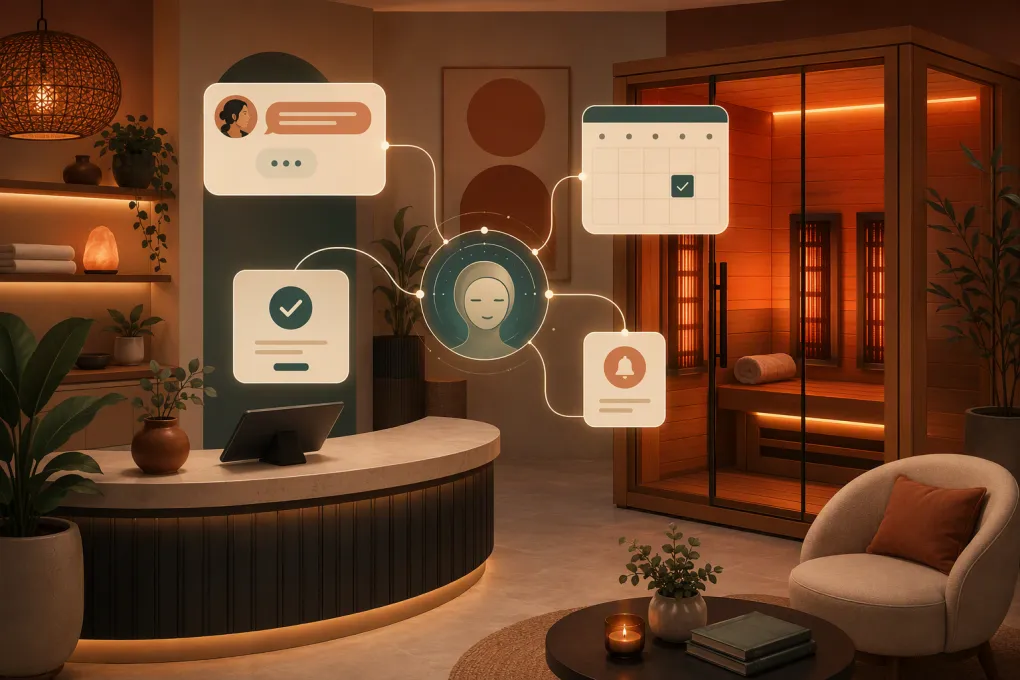
An AI receptionist for infrared sauna studios closes that response gap. It can answer approved questions, guide prospects toward the right session, book against current availability, follow up with leads, and handle routine requests outside staffed hours. The goal is not to replace hospitality. It is to stop repetitive front-desk work from competing with the in-studio experience.
The difference between a useful AI receptionist and a frustrating chatbot is operational design. It needs accurate rules, clear boundaries, and direct paths to booking or human help.
See how Fitty can handle after-hours sauna inquiries and move prospects toward a booking →
What an AI receptionist should handle for a sauna studio
A basic chatbot waits for someone to visit a webpage and choose from a menu. A properly configured AI receptionist supports the actual customer journey, from initial question through booking and follow-up.
For an infrared sauna business, that usually includes:
- Answering questions about session lengths, room capacity, amenities, preparation, and studio policies
- Checking availability and helping the guest book an appropriate session
- Explaining introductory offers, packages, and memberships without inventing discounts
- Following up with leads who asked questions but did not book
- Sending approved preparation and arrival instructions
- Handling common requests such as rescheduling or cancellation within studio policy
- Directing billing questions or overdue balances into an approved payment workflow
- Escalating medical, safety, complaint, or exception-based questions to a person
Every answer should come from studio-approved information. The AI should not guess whether a guest qualifies for a promotion, promise an unavailable time, or improvise health advice.
High-value workflows to automate first
Trying to automate the entire front desk at once creates unnecessary risk. Start with high-volume, rules-based conversations that have a clear next action.
Turn service questions into bookings
Prospects often begin with broad questions such as, “How does infrared sauna work?” or “Which session should I choose?” A weak automation gives a generic explanation and ends the conversation. A stronger workflow answers briefly, asks one or two useful questions, and presents the next available booking options.
A practical conversation might:
- Ask whether the person is a first-time or returning guest.
- Explain the studio’s available session types and durations.
- Ask whether the booking is for one person or multiple guests.
- Show appropriate availability.
- Complete the booking or provide the approved checkout path.
- Send preparation and arrival information.
Keep the qualification short. Someone trying to book a sauna session should not have to complete a lengthy intake interview before seeing availability.
Capture after-hours demand
Interest in wellness services does not stop when the front desk closes. Prospects may call or inquire after work, late at night, or early in the morning. If the only response is “We will get back to you,” the burden shifts to tomorrow’s staff—and the lead may already be gone.
An AI receptionist can immediately answer routine questions and direct the person into booking. If the requested time or service is unavailable, it should offer valid alternatives rather than reaching a dead end.
The handoff matters too. When human attention is required, the team should receive the person’s name, contact information, request, and relevant conversation context. That prevents staff from reopening with, “How can we help?” after the guest has already explained the issue.
Follow up without sounding robotic
Not every inquiry becomes a booking during the first conversation. The prospect may be comparing options, checking a partner’s schedule, or waiting until payday.
Build follow-up around the person’s actual intent. Useful messages include:
- A link to finish booking the session they discussed
- An answer to the unresolved question that stopped the booking
- A reminder that an introductory offer has specific eligibility rules
- Alternative times if the original slot is no longer open
Avoid sending the same generic message repeatedly. Follow-up should stop when the person books, declines, opts out, or needs a human response. For marketing texts or calls, obtain and document the appropriate consent and honor opt-out requests. Have qualified counsel review your workflows for federal and state requirements.
See how Fitty follows up with interested sauna leads instead of leaving them in a spreadsheet →
Reduce no-shows and arrival confusion
Many avoidable front-desk problems begin before the guest arrives. A first-time visitor may not know when to arrive, what to bring, whether towels are provided, or what happens if they are late.
Your automated confirmation sequence should state:
- Studio address and parking or entry instructions
- Recommended arrival time
- What the studio provides and what the guest should bring
- Session duration and room-capacity rules
- Late-arrival, cancellation, and no-show policies
- Waiver or intake requirements
- A simple way to reschedule or contact the studio
Do not bury critical policies in a long block of wellness copy. Put the operational details first and link to longer guidance if needed.
Handle routine payment conversations carefully
Payment follow-up is uncomfortable for staff and easy to postpone. An AI agent can consistently notify members about an outstanding balance and provide an approved way to resolve it.
It should never request full card details in an ordinary chat or text conversation. Use a secure, payment-provider-hosted flow and limit the AI’s role to explaining the balance category, sharing the correct payment path, and escalating disputes. Questions about freezes, refunds, chargebacks, or policy exceptions should go to an authorized staff member.
Fitty is built to answer leads, book, follow up, and help collect dues as part of the broader WTF Go operating system. Explore how WTF Go can connect sauna lead response, booking, and payment follow-up →
Give the AI clear health and safety boundaries
Infrared sauna conversations can quickly move from scheduling into medical territory. A prospect may ask whether sauna use is appropriate during pregnancy, with a medical condition, after a procedure, or while taking medication.
Your AI receptionist should not diagnose, assess individual risk, or claim that sauna use treats a disease. Configure a firm response that:
- States that the studio cannot provide medical advice
- Directs the person to a qualified healthcare professional
- Shares only the studio’s approved safety and eligibility policies
- Escalates concerning symptoms or unusual circumstances
- Tells anyone facing an emergency to contact emergency services
Review all benefit language used by the AI. It should repeat only claims your business has approved and can support. Do not let it turn general wellness language into promises about curing, treating, detoxifying, or preventing specific conditions.
Privacy also requires attention. Collect only the information needed for the workflow, restrict staff access, and define how conversation records are retained. A wellness business is not automatically subject to HIPAA solely because guests discuss health concerns, but other privacy, consumer-protection, recording-consent, and data-security rules may still apply. Get advice based on your business model and location.
How to implement an AI receptionist without creating chaos
The quality of the launch depends more on preparation than on the novelty of the technology.
1. Audit real front-desk conversations
Review recent calls, messages, emails, and staff notes. Group questions by topic: pricing, preparation, availability, safety, memberships, cancellations, and payments. Use the language customers actually use rather than writing an abstract FAQ from scratch.
2. Build one approved source of truth
Document current information for:
- Locations and operating hours
- Session types, lengths, and room capacities
- Pricing, packages, memberships, and offer eligibility
- Booking, cancellation, late-arrival, and refund policies
- Amenities and preparation instructions
- Waiver requirements
- Human escalation contacts
Assign an owner to each section. When a policy changes, update the source used by the AI—not just a paper binder at reception.
3. Define booking rules and exceptions
Specify buffers for room reset and cleaning, how far ahead guests can book, capacity limits, and whether particular sessions require staff review. Decide what happens when a preferred slot is unavailable or a guest requests an exception.
Automation should enforce the same rules your best employee would follow.
4. Test realistic edge cases
Do not test only perfect booking requests. Try misspellings, vague questions, expired promotions, same-day cancellations, multi-person bookings, upset customers, medical questions, and requests outside business policy.
Confirm that the AI knows when to stop and hand off. A safe escalation is better than a confident wrong answer.
5. Launch narrowly, then review conversations
Begin with routine inquiries and booking assistance. Review transcripts or conversation summaries regularly, correct weak answers, and add missing policies. Expand into lead follow-up and payment workflows after the basic experience is reliable.
Measure business outcomes, not conversation volume
A high number of AI conversations does not prove the system is helping. Track outcomes tied to studio operations:
- Inquiries that reach a completed booking
- Bookings created outside staffed hours
- Leads still waiting for a human response
- Reschedules and cancellations completed correctly
- Questions the AI cannot answer
- Human escalations and their reasons
- Payment links completed versus disputed
- Incorrect answers or policy exceptions requiring correction
Review these by location, service, and inquiry source where your systems allow it. The purpose is to identify friction: missing availability, confusing offers, weak follow-up, or policies customers consistently misunderstand.
An AI receptionist works best when it gives guests immediate, accurate help while protecting the moments that require human judgment. For infrared sauna operators, that means fewer dropped inquiries, cleaner booking workflows, and more staff attention available for the guests already in the studio.
Frequently asked questions
Can an AI receptionist book infrared sauna sessions?
Yes, when connected to an approved booking workflow, it can help guests choose a session and book from current availability while following capacity, timing, and eligibility rules.
Should an AI receptionist answer sauna safety questions?
It can share studio-approved safety policies and general preparation information, but it should not provide medical advice or assess whether sauna use is safe for a specific person.
Can AI follow up with sauna leads by text?
Yes, but the studio should obtain appropriate consent, identify the business, honor opt-outs, and have its messaging practices reviewed for applicable federal and state requirements.
Will an AI receptionist replace front-desk staff?
It is better used to cover repetitive inquiries, booking steps, follow-up, and routine payment reminders. Staff should continue handling sensitive concerns, exceptions, disputes, and in-person hospitality.
What information is needed before launching an AI receptionist?
Prepare accurate hours, services, availability rules, prices, offer terms, capacity limits, preparation instructions, cancellation policies, payment procedures, and escalation contacts.
Keep reading

Run your gym on autopilot with WTF Go
Fitty — your AI receptionist — answers calls and DMs, fills classes, follows up with every lead, and collects dues while you coach.