AI & Automation
AI Receptionist for Hair Salons: What Owners Need to Know
Learn how an AI receptionist for hair salons handles calls, books appointments, follows up, and protects revenue after hours without losing the human touch.
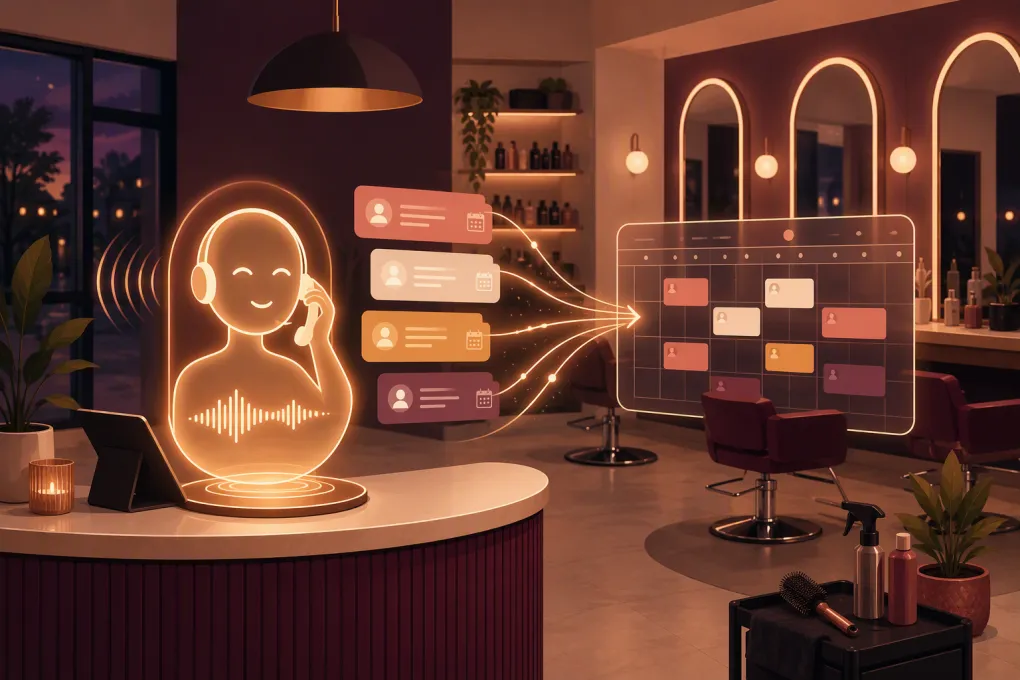 Watch · 20s
A stylist cannot answer the phone while applying color, cutting a bob, or consulting with the client in the chair. The front desk may be helping someone else, and after closing, nobody is available at all. Yet prospective clients often call expecting an immediate answer.
That creates a familiar salon problem: the team is busy delivering the service that generates revenue, while new appointments disappear into voicemail. An AI receptionist for hair salons can close that gap by answering routine questions, qualifying callers, booking appropriate services, and following up when a person is not available.
The goal is not to remove hospitality from the salon. It is to stop making hospitality dependent on whether an employee can reach the phone.
See how Fitty can handle salon inquiries when your team is busy →
What an AI receptionist for hair salons actually does
An AI receptionist is more than a recorded menu. A properly configured system can hold a natural conversation by phone or message, use the salon’s operating information, and complete approved actions.
Common workflows include:
- Answering calls during services, breaks, meetings, and after hours
- Explaining location, hours, parking, policies, and accepted payment methods
- Identifying the service a prospective client wants
- Asking whether the client is new or returning
- Collecting basic information about hair length, current color, or desired result
- Offering available appointment times
- Booking straightforward services according to salon rules
- Sending confirmations, instructions, or booking links
- Following up with leads who did not schedule
- Routing sensitive or complicated requests to a person
The important phrase is according to salon rules. An AI agent should not improvise service duration, promise a color result, or squeeze a complex appointment into the wrong calendar opening. Its usefulness depends on the boundaries and operating logic you give it.
Why standard voicemail underperforms for salons
Voicemail transfers the work to the caller. They must leave a clear message, wait for a response, notice the return call, and restart the scheduling conversation. Each additional step gives them an opportunity to call another salon.
It also creates operational debt for the front desk. A morning callback list may include vague requests such as “I need my hair done Saturday” without enough information to select a service, stylist, duration, or price range.
An AI receptionist can collect those details during the original conversation. Even when it cannot safely book the appointment, it can create a useful handoff containing:
- Caller name and preferred contact method
- Requested service
- New or existing client status
- Preferred dates and times
- Stylist preference, if any
- Relevant service history or starting-point information
- Whether a consultation is required
- The exact question that needs human review
That turns an unstructured voicemail into an actionable lead.
Salon calls an AI receptionist should—and should not—book
Not every salon appointment belongs in the same automation flow. Start by dividing the service menu into three groups.
Services that can usually be booked directly
These are services with predictable timing, clear staff eligibility, and limited consultation requirements. Depending on your salon, examples may include:
- Standard haircuts
- Blowouts
- Shampoo and style appointments
- Simple add-on treatments
- Maintenance appointments for established clients
The AI still needs rules for client type, hair length, staff availability, cleanup time, and any required buffers.
Services that need qualification first
Some appointments can be booked only after the agent collects additional information. Color maintenance, extensions, corrective work, major transformations, and specialty texture services often fall into this category.
A useful qualification flow might ask:
- What result are you trying to achieve?
- Is your hair currently colored or chemically treated?
- How long and dense is your hair?
- Have you visited this salon or stylist before?
- Are you open to a consultation before the full service?
The answers can determine whether the next step is a standard appointment, a consultation, a photo request, or a staff callback.
Requests that should go to a person
Escalate complaints, refunds, medical questions, severe allergic-reaction concerns, wedding-party coordination, and uncertain chemical-service requests. The AI can capture information, but it should not make clinical judgments, resolve heated disputes, or guarantee outcomes.
Good automation knows where to stop.
How to build a reliable salon call flow
A polished voice is less important than accurate operating logic. Before activating an AI receptionist, document how your strongest front-desk employee handles an inquiry.
1. Clean up the service menu
For every service, define:
- Client-facing name and description
- Typical duration used for scheduling
- Which team members can perform it
- New-client restrictions
- Consultation requirements
- Add-ons or processing time
- Preparation instructions
- Cancellation and late-arrival rules
Avoid forcing the agent to interpret overlapping names such as “full color,” “all-over color,” and “single process” unless those distinctions are clearly documented.
2. Create decision rules
Write rules as direct instructions rather than general guidance. For example:
- If a new client requests corrective color, schedule a consultation instead of the full service.
- If the caller is unsure which color service they need, collect details and request staff review.
- Never quote a final price when the amount depends on hair length, product use, or consultation.
- Do not place a haircut into a color-only calendar block.
- If no suitable time is available, collect alternate days and create a follow-up task.
These rules protect both the client experience and the schedule.
3. Define the handoff
Decide who receives escalations, during which hours, and through which channel. A handoff should include the conversation summary and collected details so the client does not have to repeat everything.
WTF Go’s Fitty is designed to answer leads, book services, follow up, and keep conversations moving around the clock. That gives owners one operating layer for the inquiry instead of another disconnected inbox the team has to monitor.
See how Fitty can turn missed salon calls into qualified booking conversations →
Protect the client experience
Hair services are personal, and callers may explain insecurities, previous bad experiences, or concerns about their appearance. The agent’s tone should be calm and direct without pretending to be a stylist.
A few practical safeguards matter:
- Identify the automated assistant clearly rather than misleading callers.
- Use the same service terminology your team uses in the salon.
- Do not let the agent diagnose scalp conditions or provide medical advice.
- Avoid guarantees about color, texture, timing, or final price.
- Give callers an easy way to request a person.
- Review transcripts or summaries for recurring confusion.
- Limit access to the customer and payment information needed for the workflow.
If the system sends marketing texts or makes outbound calls, review applicable consent, opt-out, and communication rules with qualified counsel. Appointment confirmations and promotional campaigns are not automatically treated the same way.
What to look for before choosing a salon AI receptionist
A generic answering bot may sound capable in a demo but fail when it reaches a real salon calendar. Evaluate the operating details, not just the voice.
Ask each vendor:
- Can it recognize different services, durations, and staff qualifications?
- Can it distinguish new-client rules from returning-client rules?
- How does it access availability and prevent double-booking?
- Can it route complex services to consultations?
- What happens when the caller changes topics mid-conversation?
- Can staff inspect conversation history and correct outcomes?
- Does it support phone, text, or both?
- Can it follow up when a lead does not book?
- How are recordings, transcripts, and customer data stored?
- What happens if the system or calendar connection is unavailable?
- How long does setup take, and who maintains the service rules?
Also determine whether the product is a standalone answering layer or part of a broader operating system. A standalone tool may be appropriate if your current systems already work well together. An all-in-one platform can be more practical when calls, booking, follow-up, and customer records are fragmented.
How to launch without disrupting the front desk
Do not begin by routing every call through an untested system. Use a controlled rollout.
Phase 1: After-hours coverage
Start when the salon is closed. This addresses a clear gap without changing the daytime front-desk workflow. Review every interaction for incorrect answers and missing policies.
Phase 2: Overflow calls
Let the AI answer when employees cannot pick up. Test common interruptions, accents, background noise, vague service requests, and callers who ask several questions at once.
Phase 3: Direct booking and follow-up
Enable booking only for services with tested rules. Then add follow-up for callers who expressed interest but did not select a time.
Phase 4: Broader automation
Expand to additional services after reviewing results with stylists and reception staff. The people who work with the schedule every day will spot edge cases that owners and software vendors may miss.
Fitty can become the always-available first response while your team keeps control of exceptions, service quality, and in-salon hospitality.
Explore an AI receptionist workflow built around real booking operations →
Metrics worth reviewing
Do not judge the system only by how human it sounds. Track whether it improves the operation.
Useful measures include:
- Calls answered versus calls abandoned or sent to voicemail
- Qualified inquiries created
- Appointments booked from calls and messages
- Consultations scheduled for complex services
- Leads requiring human follow-up
- Incorrect bookings or staff corrections
- Cancellations and no-shows by booking source
- Average time to first response
- Common unanswered questions
- Requests that repeatedly trigger escalation
Review the actual conversations behind the numbers. A high booking count is not useful if the appointments have the wrong duration or land with an unqualified stylist.
The right role for AI at the salon front desk
An AI receptionist works best as an operational layer between demand and the team—not as a replacement for judgment, artistry, or personal service. It should handle repetitive inquiries immediately, protect focused service time, and send nuanced situations to an informed employee.
For salon owners, the practical test is simple: can the system turn an unanswered call into the correct next step without creating cleanup work later? If the service menu, booking rules, and escalation paths are configured properly, the answer can be yes.
Frequently asked questions
Can an AI receptionist book hair salon appointments?
Yes, if it can access accurate availability and follow rules for service duration, stylist eligibility, buffers, and new-client requirements. Complex services should usually be qualified or routed to a consultation first.
Can an AI receptionist handle color-service inquiries?
It can collect information about the desired result, current color, hair history, and availability. It should not guarantee outcomes or book corrective and transformation services without the salon's required consultation process.
Will clients know they are speaking with AI?
The assistant should identify itself clearly and provide a simple way to request a person. Transparency helps set expectations and avoids misleading callers.
How should a salon test an AI receptionist?
Start with after-hours or overflow calls, review conversations, correct service rules, and then enable direct booking for predictable services. Expand only after the team confirms that appointments are being placed correctly.
Keep reading
Run your gym on autopilot with WTF Go
Fitty — your AI receptionist — answers calls and DMs, fills classes, follows up with every lead, and collects dues while you coach.