AI & Automation
AI Receptionist for Gym Free Trial Bookings That Convert
Learn how an AI receptionist for gym free trial bookings captures leads, answers questions, schedules visits, follows up, and reduces no-shows day and night.
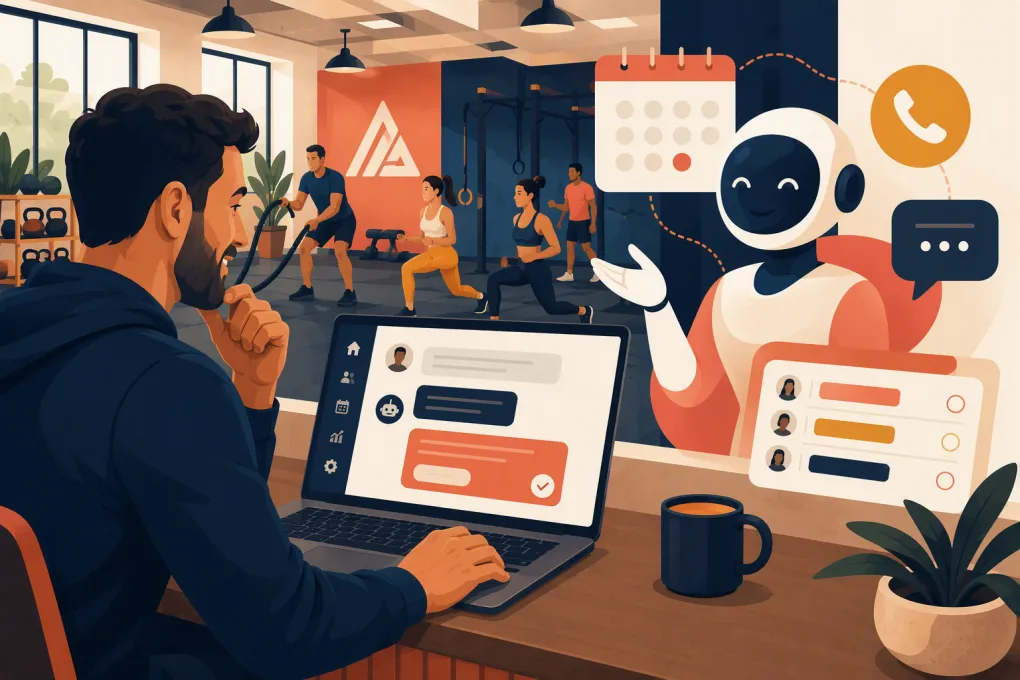 Watch · 20s
A free-trial lead rarely waits until your front desk is quiet. They inquire during a class, after closing, between appointments or while your staff is helping someone else. If the response comes hours later, the prospect may already have booked with another gym.
An AI receptionist for gym free trial bookings closes that response gap. It can answer routine questions, offer eligible times, make the booking and continue following up without forcing a coach or manager to monitor every channel.
The technology is only useful, however, when it follows real operating rules. A bot that gives vague answers or books the wrong class creates more work than it removes. Here is how to build a workflow that produces qualified, confirmed trial appointments.
What an AI receptionist should handle
A basic website chatbot answers questions. An effective AI receptionist owns the conversation through the next meaningful action.
For free-trial leads, that usually includes:
- Responding to website forms, chat inquiries, calls or text conversations
- Identifying the prospect’s goal and preferred location
- Answering approved questions about classes, amenities and trial eligibility
- Showing actual booking options rather than telling the lead to call back
- Collecting the information required to reserve a visit
- Sending confirmations, reminders and arrival instructions
- Following up when someone stops replying or misses the appointment
- Escalating sensitive, complex or high-value conversations to a person
Speed matters, but completion matters more. An instant response that says someone will contact the lead tomorrow has not solved the booking problem.
See how Fitty handles gym trial inquiries and books leads 24/7 →
Build the booking workflow around the prospect
The strongest workflow feels like a capable front-desk conversation, not an interrogation. Each step should remove uncertainty and move the lead toward a suitable visit.
1. Recognize the request
The AI should distinguish between a free-trial inquiry and other common intents, such as membership pricing, an existing-member question, personal training or cancellation.
A prospect may never use the phrase “free trial.” They might ask:
- “Can I try a class before joining?”
- “Do you have anything for beginners?”
- “Can I come in tonight?”
- “How does your intro offer work?”
Train the receptionist around these natural variations rather than one exact keyword.
2. Answer the questions blocking a booking
Most leads do not need a full sales presentation. They need enough confidence to choose a time.
Your approved knowledge base should cover:
- What the trial includes
- Who is eligible
- Class formats and experience levels
- What to bring and when to arrive
- Parking, entrance and check-in details
- Age or guardian requirements
- Accessibility considerations
- Any waiver or identification requirements
- What happens after the trial
Do not make the AI improvise policies. If the business has not approved an answer, the receptionist should say that a team member will confirm it.
3. Ask only useful qualification questions
Every question creates friction, so each one should affect the recommendation, booking or follow-up.
Useful questions may include:
- Which location works best?
- What type of training are you interested in?
- Are you new to this class format?
- What days or times generally work?
- Are there injuries or limitations an instructor should know about?
Medical details require care. The receptionist should not diagnose conditions or declare that a workout is safe. It can collect an operational note and route the conversation to a qualified staff member when needed.
4. Offer specific available times
“Check our schedule” transfers the work back to the lead. Instead, offer a small set of appropriate options based on location, class capacity, trial rules and experience level.
For example:
We have a beginner-friendly strength class Tuesday at 6:00 p.m. or Saturday at 9:00 a.m. at the Downtown location. Which works better?
Specific choices make the next step obvious. If neither works, the AI can ask for another day or time range rather than dumping the entire schedule into the conversation.
5. Complete the reservation
Before confirming, collect only what the business genuinely needs. This often means the prospect’s name, mobile number, email address and required waiver information.
The confirmation should restate:
- Location
- Date and start time
- Class or appointment type
- Recommended arrival time
- What to bring
- Rescheduling instructions
That final summary gives the prospect a chance to catch an error before it becomes a front-desk problem.
Use follow-up to reduce abandoned inquiries
Many trial leads start a conversation and disappear. They get distracted, need to check a calendar or are not ready to choose immediately. A single response is not a follow-up system.
Create different sequences for different statuses:
Inquired but did not select a time
Send a short continuation that references the original interest and offers a clear next step. Avoid restarting the conversation with a generic sales message.
Example: “You asked about trying our beginner boxing class. Would a weekday evening or Saturday morning be easier?”
Selected a time but did not finish booking
Remind the prospect what remains incomplete. If a waiver or contact field is required, link directly to that step rather than the homepage.
Booked but not yet attended
Use reminders to reinforce the date, location and arrival instructions. Give the lead an easy way to reschedule. A rescheduled trial is usually more useful than an unexplained no-show.
Missed the trial
Keep the tone neutral. Ask whether they would like another time, then offer relevant openings. Do not shame the prospect or mark the lead dead after one missed visit.
Explore how Fitty automates trial booking, reminders and lead follow-up →
Give the AI clear booking rules
An AI receptionist needs the same operating boundaries you would give a new employee. Before launch, document the following.
Trial eligibility
Define whether the offer is limited to local residents, first-time visitors, specific classes or certain locations. Include the policy for former members, repeat trial requests and guests.
Schedule restrictions
Identify which sessions accept trials. A class can appear available while still being unsuitable for a first visit because of skill level, staffing, equipment or onboarding requirements.
Capacity and cutoff rules
Specify when online booking closes, whether waitlists are allowed and what happens if the last spot disappears during the conversation.
Location-specific details
Multi-location operators should maintain separate instructions, hours, offers and escalation contacts for each site. Do not assume one location’s parking or trial policy applies everywhere.
Human escalation
Define when the AI should stop and hand off. Common triggers include billing disputes, injury concerns, complaints, requests for exceptions, accessibility questions that require confirmation and prospects asking to speak with a manager.
The handoff should include the conversation history, lead details and requested action. Making the prospect repeat everything undermines the experience.
Protect consent and trust
Automation does not remove your responsibility for responsible communication. Collect appropriate consent for promotional text messages and calls, honor opt-out requests and keep transactional booking messages distinct from broader marketing where required.
Also make it clear when a prospect is interacting with an automated assistant. The AI should not invent availability, policies or staff statements. If information is uncertain, a transparent handoff is better than a confident wrong answer.
Access should follow staff permissions, and customer information should be limited to what the workflow requires. Review how your systems store conversation records, contact details and waiver information.
Measure the full funnel, not message volume
Conversation count is not the business outcome. Track the stages from initial inquiry through membership decision.
Useful operating metrics include:
- Median time from inquiry to first meaningful response
- Percentage of trial inquiries that reach a booking
- Percentage of bookings that attend
- Reschedule and cancellation volume
- Leads requiring human intervention
- Common unanswered questions
- Trial attendees who receive timely post-visit follow-up
- Trial attendees who become paying members
Break results down by lead source, location, class type and time of inquiry. This helps reveal whether the issue is the receptionist workflow, the offer, class availability or the in-person sales process.
Review conversation transcripts as well. A dashboard can show where leads stop, but transcripts show why. Look for unnecessary questions, inaccurate answers, poor time suggestions and handoffs that remain unresolved.
How Fitty supports the workflow
Fitty is WTF Go’s AI receptionist and agent for gyms, studios, spas and wellness businesses. It answers leads, books classes, follows up and can help collect dues around the clock.
For trial bookings, the practical advantage is continuity. The inquiry, scheduling step and follow-up do not need to live as disconnected tasks assigned to whoever notices them first. Fitty can keep the conversation moving while your team focuses on coaching, appointments and members already in the building.
It should still be configured around your offer, schedule and escalation rules. AI does not replace good operations; it executes them more consistently.
See how WTF Go and Fitty can run your free-trial booking workflow →
Roll out without disrupting the front desk
Start with one clearly defined offer, such as a first class or introductory appointment. Document the eligible sessions, required fields, approved answers and escalation triggers.
Then test the workflow using real scenarios:
- A complete beginner asking what to expect
- A lead requesting a full class
- A returning visitor who may not qualify
- A prospect with an injury question
- A lead choosing the wrong location
- A booking started after business hours
- A prospect who misses the appointment
Run each scenario from first message through confirmation and follow-up. Verify that the booking appears correctly, the instructions match the location and staff can see when intervention is required.
After launch, review exceptions frequently. Update the knowledge base when staff repeatedly answer the same question or correct the same misunderstanding.
The standard is a completed, prepared visit
The purpose of an AI receptionist for gym free trial bookings is not to create more chat activity. It is to turn interest into a correctly scheduled visit, prepare the prospect to attend and give your team enough context to deliver a strong first experience.
When the booking rules, follow-up and human handoffs are designed together, automation becomes part of the operation rather than another inbox to manage.
Frequently asked questions
Can an AI receptionist book directly into a gym schedule?
Yes, when it is connected to the business's booking workflow and configured with accurate availability, capacity and trial-eligibility rules.
Will an AI receptionist replace front-desk staff?
It is better used to handle repetitive inquiries, scheduling and follow-up. Staff should remain available for exceptions, sensitive issues and higher-value sales conversations.
How should an AI handle a free-trial lead with an injury?
It can collect a limited operational note, but it should not provide medical advice or guarantee that an activity is safe. Route the prospect to a qualified staff member when judgment is required.
Can an AI receptionist follow up after a missed gym trial?
Yes. It can acknowledge the missed visit, offer suitable new times and complete the rescheduling without requiring the lead to call the gym.
What information does the gym need before setting up Fitty?
Prepare your trial offer, eligible sessions, booking rules, location details, approved answers, required lead fields and clear triggers for human escalation.
Keep reading

Run your gym on autopilot with WTF Go
Fitty — your AI receptionist — answers calls and DMs, fills classes, follows up with every lead, and collects dues while you coach.