AI & Automation
AI Receptionist for Gym Drop-In Class Bookings: Buyer's Guide
Learn how an ai receptionist for gym drop-in class bookings captures leads, checks availability, takes payment, and reduces front-desk work every day.
 Watch · 20s
A potential customer finds your gym at 9:40 p.m. They want to try tomorrow morning’s class, but they have three questions: Is it beginner-friendly? What should they bring? Can they pay for one class without joining?
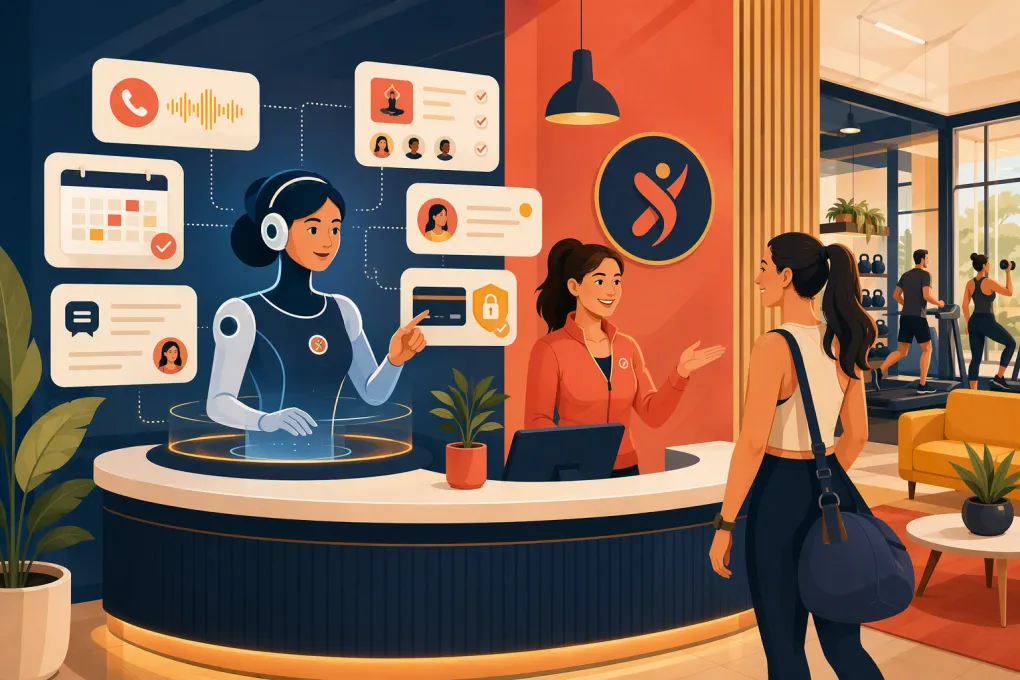
If the only option is a voicemail box or a web form, that high-intent prospect may keep searching. An AI receptionist for gym drop-in class bookings can answer the questions, check the schedule, collect the information or payment you require, and confirm the reservation while the prospect is still ready to act.
That does not mean handing your business to an unmonitored chatbot. The right setup follows your booking rules, works with your operating system, and knows when a human needs to take over.
See how Fitty handles gym inquiries and drop-in bookings 24/7 →
What an AI receptionist should do for drop-in bookings
A useful AI receptionist does more than send prospects to a scheduling link. It carries the conversation from initial interest to a confirmed next step.
For a drop-in class, that normally includes:
- Identifying the class, date, location, and preferred time.
- Answering common questions about format, difficulty, duration, equipment, parking, and arrival time.
- Checking whether the class is available.
- Capturing the guest’s name, contact details, and any required acknowledgments.
- Applying your rules for first visits, age limits, prerequisites, and capacity.
- Collecting the drop-in fee or directing the guest through an approved payment flow.
- Confirming the reservation with clear arrival instructions.
- Following up if the prospect stops before completing the booking.
- Escalating unusual, sensitive, or high-risk questions to staff.
The distinction matters. A basic autoresponder acknowledges the message. An AI receptionist should help complete the transaction.
Why drop-in inquiries are harder than they look
Drop-in booking sounds simple because the guest is buying one visit. Operationally, it can involve more exceptions than a standard member reservation.
Prospects need confidence before they book
First-time visitors often do not understand your class names. A schedule containing labels such as Foundations, Power, Flow, Open Gym, or Level 2 may be obvious to members but unclear to a new lead.
The receptionist needs approved answers to questions such as:
- Is this suitable for a beginner?
- Do I need prior experience?
- Is equipment included?
- What should I wear or bring?
- Can I arrive late?
- Is there parking?
- Are showers or lockers available?
- Can I bring a friend?
Fast, specific answers remove uncertainty. Generic answers create more work or, worse, put the wrong person into the wrong class.
Availability can change during the conversation
Class capacity, waitlists, instructor changes, and location-specific schedules can all affect what the guest can book. An AI agent should use current booking information rather than relying on a static list copied into a prompt.
If real-time availability is not accessible, the agent should say so and offer a safe next step. It should not promise a spot based on stale data.
Your policies still apply
A drop-in guest may need to sign a waiver, meet an age requirement, complete an intro session, or avoid an advanced class without prior experience. Some services may also require consultation or screening before an appointment can be confirmed.
Automation should enforce those rules consistently. It should never improvise an exception simply because the prospect asks confidently.
The ideal drop-in booking workflow
Start by documenting the exact path you want the AI receptionist to follow. Do not begin with every possible customer-service scenario. Begin with one high-intent workflow and make it reliable.
Step 1: Understand the request
The agent should establish:
- Which location the guest wants
- Which class or service they are considering
- Their preferred date and time
- Whether they have visited before
- Whether they meet any published prerequisites
For multi-location operators, location should be confirmed early. This prevents the guest from receiving correct information for the wrong facility.
Step 2: Resolve booking blockers
Give the agent a maintained knowledge base with concise, operator-approved answers. Separate information by location and service where needed.
Useful knowledge categories include:
- Class descriptions and intended experience level
- What to bring
- Check-in and late-arrival policies
- Parking and entrance instructions
- Drop-in eligibility
- Cancellation and refund rules
- Waiver requirements
- Accessibility information
- Childcare availability, if offered
Avoid loading the system with old staff documents and expecting it to identify the current policy. One owner or manager should be responsible for approving the source material.
Step 3: Check availability and apply rules
The agent should verify the requested session against the active schedule. It then needs to apply your business rules before confirming anything.
A practical rule set might specify:
- Whether drop-ins can book every class type
- How close to class time online booking closes
- What happens when a class is full
- Whether a waitlist is available
- Which classes require an introduction
- Whether unpaid reservations are held
- When staff approval is mandatory
Write these rules in plain language. If the front desk cannot interpret a rule consistently, the AI will not solve the underlying policy problem.
Step 4: Secure the booking
Once eligibility and availability are confirmed, the guest should be moved directly into your approved booking and payment process. Do not create unnecessary steps between the conversation and checkout.
The confirmation should include:
- Class name, date, time, and location
- Payment or reservation status
- Required arrival time
- What to bring
- Waiver or check-in instructions
- A way to cancel or ask for help
Fitty is built to handle this operational chain: answering the lead, booking the class, following up, and collecting money when required. Because it sits inside WTF Go’s all-in-one system, the conversation is tied to the customer workflow rather than treated as an isolated chat.
See how WTF Go connects the conversation, booking, and follow-up →
Step 5: Recover incomplete bookings
A prospect may ask several questions and then disappear before paying. That is not automatically a lost lead.
Your follow-up should reflect what happened:
- If they selected a class but did not finish checkout, send the relevant booking path.
- If their preferred class was full, offer appropriate alternatives.
- If they asked about difficulty, recommend a suitable beginner option based on approved guidance.
- If they need staff input, create a clear handoff with the conversation history.
Follow-up should be useful, not repetitive. Repeatedly asking whether someone is still interested adds noise without solving the reason they stopped.
Guardrails every gym should require
AI reception should expand coverage without inventing policies or creating unsafe commitments. Before launch, define what the agent may and may not do.
It should not provide medical advice
The agent can explain the published format of a class, but it should not decide whether exercise is medically appropriate for a person. Questions involving injury, pregnancy, medication, symptoms, or medical restrictions should follow a carefully written escalation policy.
It should not make unauthorized exceptions
Do not allow the agent to waive fees, ignore prerequisites, override capacity, promise refunds, or change membership terms unless the system has an explicit approved workflow for that action.
It should identify when a human is needed
Escalation triggers can include:
- Billing disputes or chargebacks
- Injury or incident reports
- Harassment or safety concerns
- Complex accessibility requests
- Requests for policy exceptions
- Technical failures blocking payment or booking
- Questions outside the approved knowledge base
The handoff should include the customer’s contact information, request, conversation history, and desired class. Making the customer repeat everything defeats much of the benefit.
How to implement it without disrupting the front desk
A controlled rollout is better than turning on every channel and workflow at once.
Build a narrow first version
Start with drop-in requests for a defined group of classes. Choose services with clear eligibility rules, stable schedules, and straightforward pricing. Add edge cases after the core flow works.
Test real conversations
Use questions your staff actually receives, including vague and messy phrasing:
- I’m in town tomorrow. Can I take the morning class?
- Never done this before. Which session should I choose?
- Can my 15-year-old join me?
- I’m running ten minutes late. Can I still come?
- The class says full. Is there any way in?
Test completed bookings, full classes, payment failures, existing customers, duplicate contacts, and requests sent after the booking cutoff.
Review operational outcomes
Track events your team can verify instead of focusing only on chat volume:
- Inquiry received
- Qualified booking request
- Availability checked
- Checkout started
- Booking completed
- Follow-up sent
- Human escalation created
- Guest attended or missed the class
Review failed and escalated conversations regularly. They show where your policies, knowledge base, or integrations need attention.
Assign an owner
Someone must maintain schedules, policies, class descriptions, and escalation contacts. AI reduces repetitive work, but it does not eliminate operational ownership.
Explore Fitty for after-hours inquiries, bookings, follow-up, and dues →
What to look for when choosing an AI receptionist
Evaluate the complete workflow, not the quality of a demonstration conversation.
Ask each vendor:
- Can the agent access current class availability?
- Can it create or update the customer record without duplicate entry?
- Can it complete a booking rather than only share a link?
- How does it handle payment and incomplete checkout?
- Can rules vary by class and location?
- What happens when the requested class is full?
- Can staff review the conversation and take over?
- How are sensitive or medical questions handled?
- Where are policies maintained, and who can update them?
- Can it follow up based on the actual booking status?
Also consider system sprawl. If reception, CRM, booking, payment, and follow-up live in separate tools, your team may spend its time repairing handoffs between them. An all-in-one operating system such as WTF Go gives Fitty access to the workflow it is expected to complete.
The practical standard: a confirmed next step
The goal is not to make an AI sound impressively human. The goal is to help a real prospect take the correct next step without creating cleanup for your staff.
For drop-in class bookings, that means accurate answers, current availability, consistent policies, a completed reservation or payment, and a clean escalation when the request falls outside the rules.
Set up well, an AI receptionist becomes part of the operating system: it catches demand when staff are coaching or off the clock, converts straightforward inquiries, and gives employees the context needed for everything else.
Frequently asked questions
Can an AI receptionist book a gym class directly?
Yes, if it is connected to the gym’s live scheduling and customer system. Confirm that it can check availability and create the reservation, not merely send a generic booking link.
Can an AI receptionist collect a drop-in class payment?
It can guide the customer through an approved payment flow and confirm the resulting booking status. Payment handling should use secure systems and follow the gym’s refund, cancellation, and unpaid-reservation rules.
What happens if a drop-in class is full?
The agent should follow your configured policy by offering a waitlist, suggesting eligible alternatives, or escalating the request. It should never override capacity without authorization.
Will an AI receptionist replace gym front-desk staff?
It is better used to cover repetitive inquiries, after-hours demand, booking, and follow-up. Staff should remain responsible for exceptions, sensitive issues, relationship-building, and situations requiring judgment.
How should a gym test an AI receptionist before launch?
Test real booking questions, full classes, prerequisites, payment failures, late-arrival requests, medical questions, and human handoffs. Verify the final records in the scheduling and CRM systems, not just the chat responses.
Keep reading


Run your gym on autopilot with WTF Go
Fitty — your AI receptionist — answers calls and DMs, fills classes, follows up with every lead, and collects dues while you coach.