AI & Automation
AI Receptionist for Gym Class Schedule Inquiries: Guide
Learn how an AI receptionist for gym class schedule inquiries answers questions, books members, handles changes, and cuts front-desk workload day and night.
 Watch · 20s
Class schedule questions sound simple until your front desk has to answer them all day: “What time is beginner boxing?” “Is tonight’s class full?” “Can I bring a guest?” “Which location has childcare?” “Can you move me from the 5:30 to the 6:30?”
Every question interrupts a check-in, sales conversation, facility task, or member issue. When the desk is closed, the same inquiries sit unanswered. Prospects may move on, while existing members become frustrated because they cannot complete a basic task.
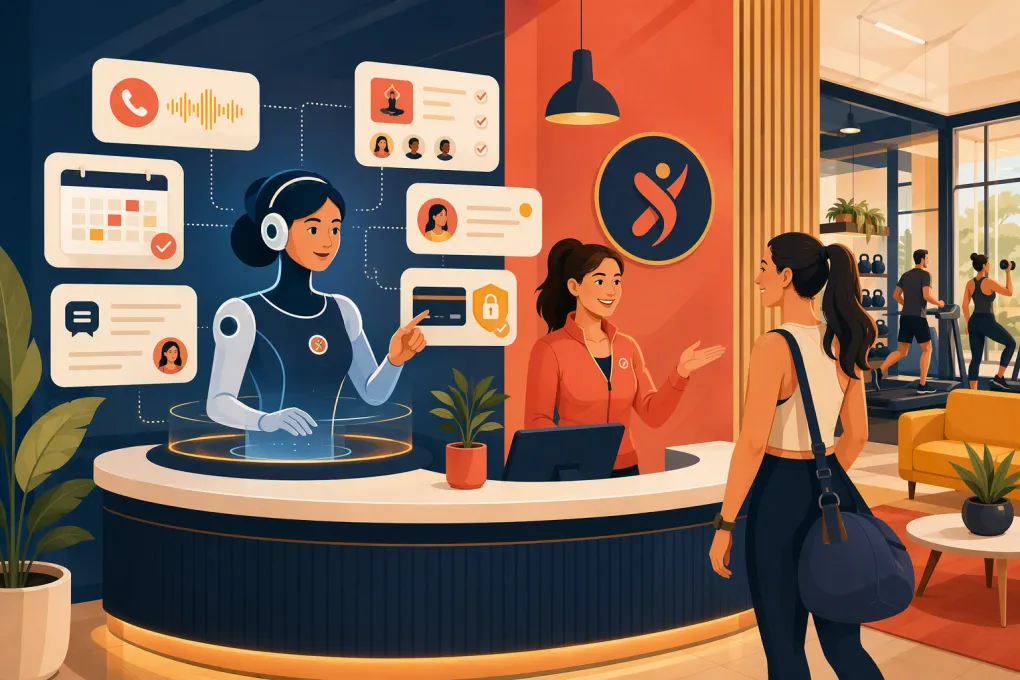
An AI receptionist for gym class schedule inquiries can take over much of this repetitive work. The useful version does more than recite opening hours. It identifies the right class, checks current availability, answers relevant policy questions, completes the booking, and escalates exceptions to a person.
See how Fitty handles class questions and booking requests after hours →
Why schedule inquiries create so much front-desk work
A gym schedule is structured data, but member questions rarely arrive in a structured format. People ask conversationally and leave out important details.
“Do you have yoga tomorrow?” could require the receptionist to clarify:
- Which location the person wants
- What “tomorrow” means in the gym’s local time zone
- Whether the person wants heated, restorative, beginner, or another type of yoga
- Whether the class has space
- Whether the person is eligible to book it
- Whether a drop-in, membership, or intro offer applies
The answer can also change quickly. A coach may be substituted, a class may reach capacity, or a holiday schedule may replace normal hours. Static website FAQs and generic chatbots cannot reliably resolve these situations when they are disconnected from the live schedule.
That distinction matters: schedule automation is not just question answering. It is a real-time operational workflow.
What an AI gym receptionist should actually do
A capable receptionist should move the conversation toward a completed action rather than sending the person elsewhere to finish.
Understand the member’s intent
The system should recognize different ways people ask for the same thing. “Any spin after work?”, “What cycling classes are open tonight?”, and “Can I ride at 6?” may all refer to a class search.
It should then collect only the missing details needed to narrow the options, such as location, preferred day, experience level, or time window.
Read from the current schedule
The AI needs a dependable source of truth for:
- Class names and descriptions
- Dates, start times, and durations
- Location and room
- Instructor assignments
- Capacity and availability
- Waitlist status
- Booking eligibility
- Cancellations or substitutions
If it cannot access current information, it should say so and transfer the inquiry rather than guessing.
Complete the booking
The best outcome is not “Here is a link to our schedule.” It is “You’re booked for Strength Foundations at 6:00 p.m. Tuesday.”
Depending on the request and the customer’s status, the workflow may need to identify the person, confirm membership or package eligibility, present an appropriate purchase path, capture consent, create the reservation, and send confirmation.
Handle changes after the initial booking
Schedule conversations continue after registration. Members may want to cancel, switch classes, join a waitlist, confirm their spot, or ask what happens if they arrive late.
An AI receptionist should apply the gym’s actual rules. It should not promise fee waivers, override booking windows, or invent exceptions that require manager approval.
Build the conversation around the questions people ask
Start by reviewing recent calls, emails, contact forms, and front-desk notes. Create a list of the schedule questions your team repeatedly answers, then map each one to the data and action required.
| Member question | Information required | Desired action |
|---|---|---|
| “What classes are available tonight?” | Location, date, class type, availability | Present relevant open classes |
| “Is this suitable for beginners?” | Class description, prerequisites, coach guidance | Recommend or escalate |
| “Can I bring a friend?” | Guest policy, pass eligibility, class capacity | Register guest or provide next step |
| “The class is full. What can I do?” | Waitlist rules, alternative times, nearby locations | Join waitlist or book an alternative |
| “Can I move my booking?” | Existing reservation, cancellation policy, replacement availability | Cancel and rebook correctly |
| “Which membership covers this?” | Customer status, product eligibility, class restrictions | Book, offer purchase path, or escalate |
This exercise exposes gaps in your operating procedures. If two employees give different answers about late arrivals or waitlists, AI will not fix the underlying inconsistency. Standardize the rule first.
A practical inquiry-to-booking workflow
A clean automated workflow usually follows six stages.
1. Identify the person and request
The AI determines whether it is speaking with an existing member, former member, lead, or guest. It also identifies the requested class, date, location, and preferred time.
Do not force account verification before answering harmless general questions. Require stronger verification before changing an existing reservation, discussing an account, or collecting payment.
2. Search the live schedule
The receptionist searches only the relevant location and time range. If the request is broad, it can offer a short list instead of dumping the full weekly calendar into the conversation.
Each option should include enough detail to support a decision: class name, start time, duration, location, instructor when relevant, and current availability.
3. Check eligibility and constraints
Before booking, the workflow checks membership access, available credits, age restrictions, prerequisites, booking windows, and any other applicable rules.
This is where simplistic bots often fail. A visible opening does not necessarily mean every customer can reserve it.
4. Offer the most useful next action
If the preferred class is open, book it. If it is full, offer the waitlist and suitable alternatives. If the person is not eligible, explain the available pass, membership, or intro option without burying them in every product the gym sells.
5. Confirm the transaction
The confirmation should state exactly what happened. Include the class, date, time, location, and any arrival instructions. If the person only joined a waitlist, do not describe that as a confirmed booking.
6. Follow up when the conversation stalls
A lead may ask for the schedule and then disappear before choosing a class. The receptionist should preserve the context and follow up with a useful prompt, such as whether the person wants the morning or evening option.
Fitty is designed to answer leads, book classes, follow up, and collect dues within the broader WTF Go operating system. That keeps the interaction focused on completion instead of leaving another conversation for the front desk to recover.
See how Fitty turns class schedule questions into completed bookings →
Configure the rules before going live
AI performance depends on operational clarity. Before launch, document the rules it is allowed to apply.
Schedule and booking rules
Define:
- How far in advance each customer type can book
- When registration closes
- Whether customers can join late
- How waitlists are ordered and promoted
- When a cancellation fee or lost credit applies
- Whether class transfers are allowed
- Which classes require prerequisites
- How guest and intro bookings work
Location-specific details
Multi-location operators should specify the time zone, address, parking instructions, entry process, room, amenities, and policies for each site. The AI should never assume policies are identical across locations.
Language and recommendation boundaries
Give the system approved class descriptions and questions it can use to guide customers. For example, it can ask about experience level, scheduling preference, and desired training style.
It should not make medical judgments or guarantee that a class is safe for an injury, pregnancy, or health condition. Those questions need an appropriate human or healthcare professional.
Escalation ownership
Every handoff needs a destination. Decide who owns:
- Billing and disputed charges
- Membership freezes or cancellations
- Medical or accessibility questions
- Complaints about staff or other members
- Requests for policy exceptions
- Technical booking failures
- Private event or large-group requests
Include the conversation history in the handoff so the customer does not have to start over.
Test the receptionist with messy requests
Do not test only clean questions such as “What time is Pilates?” Real customers use typos, relative dates, incomplete class names, and follow-up messages.
Build a test set that includes:
- “Anything low impact after 6?”
- “Book me into the same class I took last Thursday”
- “Can my 15-year-old come with me?”
- “I’m at your downtown location. Is the coach still teaching tonight?”
- “Move me to tomorrow instead”
- “I need something beginner friendly, but I have a knee issue”
- “Why did I lose a credit when I canceled?”
Check whether the AI clarifies ambiguity, uses the correct location, distinguishes waitlisting from booking, and escalates sensitive questions. Re-run these tests whenever policies, products, or schedule systems change.
Measure outcomes that matter to the operation
Avoid judging the tool only by how many conversations it handles. A high conversation count is not useful if customers still call the desk to finish the task.
Track operational outcomes such as:
- Schedule inquiries resolved without staff intervention
- Bookings completed from AI-assisted conversations
- Waitlists joined and alternatives accepted
- Conversations abandoned before booking
- Incorrect answers or failed transactions
- Escalations by reason
- After-hours inquiries converted into a clear next step
- Repeat questions that indicate missing information
Review failed and escalated conversations regularly. They show where the AI needs better access, where instructions are unclear, and where the underlying gym policy needs attention.
Choosing the right AI receptionist
When evaluating a system, ask vendors to demonstrate your real workflow using your actual policies. A polished generic demo does not prove that the system can manage booking constraints.
Confirm that the solution can:
- Work from current schedule and availability data
- Recognize existing customers and new leads appropriately
- Book, cancel, reschedule, and waitlist within defined permissions
- Apply location-specific policies
- Preserve context across follow-ups
- Escalate with a transcript and clear reason
- Protect account and payment information
- Produce an audit trail of actions taken
- Report completed outcomes, not merely message volume
Also determine who maintains class descriptions, policy instructions, and escalation routes. The tool needs an owner even when it runs around the clock.
An AI receptionist for gym class schedule inquiries should remove repetitive work without removing accountability. When schedule data, booking actions, follow-up, and account context live in one operating system, there are fewer gaps for staff to patch manually.
Explore WTF Go and put Fitty on your gym’s schedule inquiries →
Frequently asked questions
Can an AI receptionist book gym classes, not just answer questions?
Yes, if it has access to current availability, customer eligibility, and booking actions. Confirm that it can create a real reservation and clearly distinguish confirmed bookings from waitlist entries.
What happens when a class is full?
The receptionist should explain the class status, offer the waitlist when available, and suggest relevant alternatives by time, class type, or location.
Can an AI receptionist handle multiple gym locations?
It can when location-specific schedules, time zones, policies, amenities, and booking rules are configured correctly. It should clarify the desired location instead of assuming one.
Should AI answer questions about injuries or medical conditions?
It can provide approved general class information, but it should not diagnose conditions or guarantee that a class is medically appropriate. Those inquiries should be escalated.
How should a gym test an AI receptionist before launch?
Test real and deliberately ambiguous requests involving full classes, schedule changes, eligibility, multiple locations, cancellations, and policy exceptions. Verify both the answer and the resulting booking action.
Keep reading


Run your gym on autopilot with WTF Go
Fitty — your AI receptionist — answers calls and DMs, fills classes, follows up with every lead, and collects dues while you coach.