AI & Automation
AI Receptionist for Gym Billing Questions: Operator Guide
See how an AI receptionist for gym billing questions can answer members, collect dues, route disputes, and protect staff time without losing control or trust.
 Watch · 20s
Billing questions rarely arrive at a convenient time. A member notices a charge after dinner, a failed payment blocks class booking before sunrise, or a cancellation request lands while the front desk is coaching a packed session.
The questions may be routine, but the answers carry risk. A vague explanation can create a dispute. An unauthorized account change can cost revenue. A slow response can turn a fixable payment issue into a cancellation.
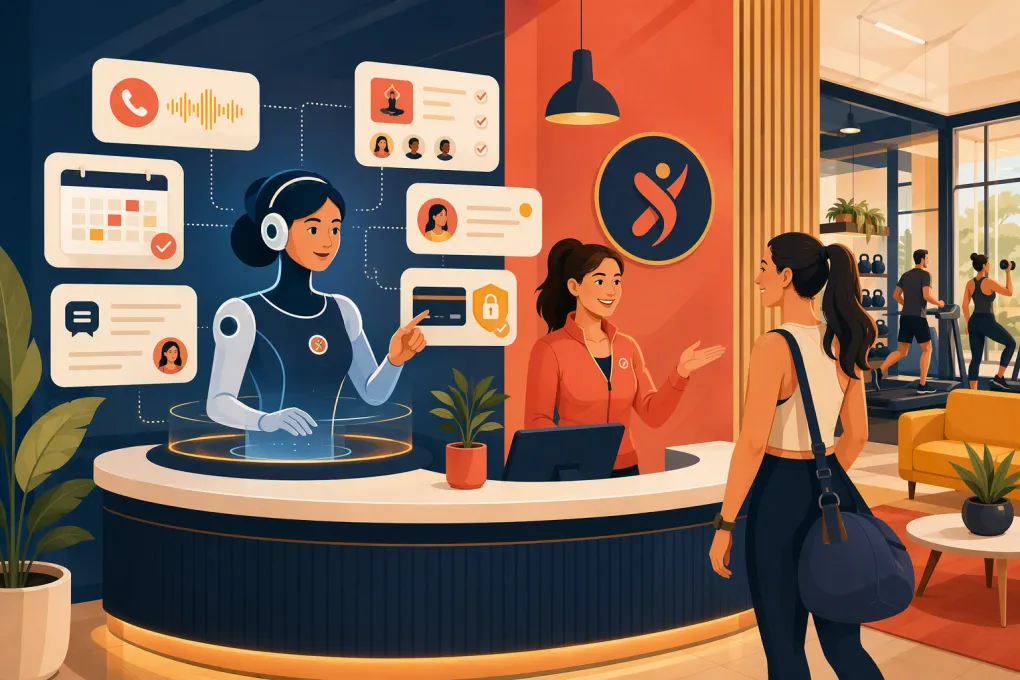
An AI receptionist for gym billing questions can handle much of this workload, provided it has clear access, rules, and escalation boundaries. The objective is not to let a bot make financial policy. It is to give members fast, accurate help while keeping sensitive decisions under operator control.
See how Fitty can handle billing conversations and collect dues around the clock →
What a gym billing AI should actually handle
Billing support includes several different jobs. Treating them as one generic conversation is where automation goes wrong.
A properly configured AI receptionist should be able to:
- Explain recognizable charges using current membership and invoice records
- Confirm payment status, due dates, and outstanding balances
- Send a secure link for updating a card or paying an amount due
- Retry or initiate approved collection workflows
- Explain standard billing policies without improvising
- Capture cancellation, freeze, refund, or dispute requests
- Route exceptions to the correct employee with useful context
- Record the conversation and actions taken
There is an important distinction between explaining an account and changing an account. An AI can explain that a charge matches an active monthly membership. It should not invent a refund, waive a fee, change a contract, or decide whether a medical exception qualifies unless you have explicitly authorized that action through a defined policy.
Start with a reliable source of truth
An AI receptionist is only as accurate as the information it can access. If your membership agreement says one thing, your billing platform says another, and your staff follows an unwritten exception, the AI cannot produce a consistently correct answer.
Before turning on billing automation, document the sources it should trust:
- Member record: Active plan, household members, start date, status, and location.
- Billing ledger: Charges, credits, payments, failed attempts, and open balances.
- Signed agreement: Commitment term, renewal, notice requirements, and cancellation language.
- Current policies: Freezes, late fees, refunds, class credits, charge disputes, and payment methods.
- Approved exceptions: Any account-specific decision already made by management.
Set a hierarchy for conflicting information. For example, the AI might use the billing ledger to report whether a payment succeeded, while routing contract conflicts to management instead of attempting to interpret them.
Policy language should also be versioned. If you changed your freeze terms this year, the AI needs to know which policy applies to memberships sold before and after that change.
Build guardrails before writing scripts
A polished answer is not enough. Gym billing automation needs operating controls behind the conversation.
Verify identity before sharing account details
Decide what information is safe to provide before and after verification. A receptionist might discuss public pricing without verification, but a balance, payment history, or membership status is account-specific.
Use a verification process appropriate to the channel, such as matching contact information already on file or using a one-time verification step. Avoid asking members to send complete card numbers, bank details, passwords, or sensitive documents in ordinary chat or text messages.
Keep payment entry in a secure payment flow
The AI should direct the member to a secure, processor-hosted payment or card-update page rather than collecting raw card information in conversation. Confirm that your payment provider and workflow meet the security obligations applicable to your business.
The conversational layer can explain the amount due and send the link. The payment system should handle the actual credentials and return a success or failure status.
Define actions the AI may never take on its own
Create a short prohibited-actions list. Depending on your policies, it may include:
- Issuing refunds above any preapproved threshold
- Waiving balances or contract obligations
- Changing a membership owner
- Interpreting legal threats or bankruptcy notices
- Responding substantively to a chargeback
- Overriding a documented cancellation date
- Promising that a fee will be reversed
Fitty can answer members, follow up, and collect dues 24/7 while your team retains control of exceptions and policy decisions. See how Fitty fits into a gym billing workflow →
Design workflows around real billing questions
Do not begin with one giant prompt telling the AI to handle billing. Build a workflow for each common intent.
Failed membership payment
A useful workflow should:
- Confirm the member and affected account.
- State that the payment did not complete without guessing why.
- Give the amount and due date when available.
- Send a secure payment or card-update link.
- Confirm the result returned by the payment system.
- Explain any documented access impact.
- Escalate repeated failures or disputed balances.
The wording matters. A decline does not always mean insufficient funds. The safe response is that the payment was unsuccessful and the payment method may need attention.
Unrecognized charge
The AI should match the charge to a real ledger entry, then explain the date, amount, location, and description available in the system. If it cannot find a clear match, it should not speculate.
A practical response pattern is:
- Acknowledge the concern
- Verify the account
- Identify the matching transaction if one exists
- Explain what the charge represents
- Offer escalation if the member still disputes it
The escalation should include the transaction, agreement, previous messages, and the member’s requested outcome so staff do not restart the investigation from zero.
Cancellation, freeze, or refund request
These requests combine billing with contractual and sometimes legal requirements. The AI can capture the request, provide the applicable documented process, and confirm receipt. Whether it can complete the change should depend on your approved rules.
Have qualified counsel review cancellation and renewal language for the states where you operate. Do not ask an AI to infer legal requirements or apply a policy that has not been reviewed.
For any request that is not completed immediately, tell the member:
- What was received
- Whether the account has changed yet
- What happens next
- Who will review it
- When and through which channel the member should expect a response
Past-due balance collection
Collection messages should be direct and service-oriented, not threatening. State the open balance, identify the membership, provide a secure way to pay, and explain documented consequences accurately.
Cadence matters. Set limits for message frequency, stop automated reminders when payment completes, and suppress contacts when an account enters an active dispute or manual review. Honor applicable communication preferences and legal requirements.
Create a simple escalation matrix
Front-desk staff already use judgment calls. Your AI needs the same boundaries in written form.
| Situation | AI action | Human owner |
|---|---|---|
| Member asks for balance or due date | Verify, answer from ledger, offer payment link | No handoff unless records conflict |
| Card update needed | Send secure update flow and confirm status | Billing staff if the update fails repeatedly |
| Charge is not found | Gather date, amount, and payment reference; escalate | Billing manager |
| Refund requested | Explain policy and capture reason | Authorized manager |
| Cancellation terms disputed | Preserve request and conversation; avoid interpretation | General manager or owner |
| Chargeback or legal threat mentioned | Stop routine collection messaging and escalate | Owner, finance lead, or counsel |
| Member is angry or requests a person | Acknowledge and transfer with context | Designated support employee |
Assign every escalation category to a named role, not simply the team. Add expected response windows that your operation can actually meet. An urgent billing dispute should not sit in the same queue as a request for a receipt copy.
Give the AI usable answer patterns
Scripts should guide behavior without forcing robotic repetition. For each billing intent, provide:
- The information required before answering
- The approved explanation
- The action the AI may perform
- Conditions that trigger a handoff
- Statements it must not make
For example, a failed-payment pattern could be:
Acknowledge: I can help you check the membership payment.
Verify: Complete the approved identity check.
Explain: The payment scheduled for the recorded date did not complete. Avoid assigning a reason unless the processor supplies one that may safely be shared.
Resolve: Provide a secure update or payment link.
Close: Confirm whether payment succeeded and explain the account’s current status.
Escalate: Route disputed amounts, duplicate charges, conflicting records, or repeated failures.
Test these patterns with messy wording. Members may say they were double dipped, locked out, charged after quitting, or unable to get into class. Your intent mapping must connect those phrases to the correct billing workflow.
Measure operational outcomes, not chat volume
Conversation count tells you how often the tool was used, not whether it solved the problem. Review metrics that expose service quality and financial control:
- Time to first response
- Billing questions resolved without staff intervention
- Secure payment links completed
- Failed payments recovered
- Handoff rate by billing intent
- Repeat contacts about the same issue
- Incorrect answers or staff corrections
- Refund and dispute reasons
- Escalations that missed their response window
Audit a sample of resolved and escalated conversations regularly. Look for outdated policy explanations, incorrect account matching, unnecessary handoffs, and situations where the AI acted beyond its authority.
Fitty brings AI reception, follow-up, booking, and dues collection into the same operating system, reducing the gaps created when a member conversation and the required action live in separate tools. Explore WTF Go and put Fitty to work on member billing questions →
A practical rollout plan
Start narrow rather than automating every billing scenario at once.
Phase 1: Read-only answers. Allow the AI to verify members, explain charges, report balances, and route exceptions.
Phase 2: Secure self-service. Add payment links, card-update flows, receipts, and confirmation messages.
Phase 3: Approved account actions. Automate only low-risk changes supported by explicit policies and reliable system permissions.
Phase 4: Proactive follow-up. Add past-due reminders and recovery sequences with clear stop conditions.
Before each phase, test normal requests, typos, shared family accounts, duplicate names, outdated contact details, hostile messages, disputed contracts, and unavailable systems. Confirm what happens when the AI cannot access a record. The correct fallback is a transparent handoff, not a confident guess.
The best AI receptionist does not replace financial judgment. It removes repetitive explanation and follow-up, resolves straightforward payment issues immediately, and gives staff a clean escalation when human authority is required.
Frequently asked questions
Can an AI receptionist collect overdue gym payments?
Yes. It can identify an approved balance, send a secure payment link, follow up, and confirm the result. Raw card details should remain inside a compliant payment flow rather than a normal chat.
Should AI approve gym refunds or membership cancellations?
Only when the action is covered by a clear, preapproved policy and reliable system permissions. Disputed contracts, exceptions, and significant refunds should be escalated to an authorized employee.
How does an AI receptionist answer questions about unknown charges?
It verifies the member, matches the charge against the billing ledger, and explains the recorded transaction. If no reliable match exists, it should collect relevant details and escalate instead of guessing.
Can Fitty answer gym billing questions after hours?
Fitty operates 24/7 and can answer members, follow up, and collect dues using configured gym policies and workflows. Exceptions can be routed to the appropriate staff member for review.
Keep reading


Run your gym on autopilot with WTF Go
Fitty — your AI receptionist — answers calls and DMs, fills classes, follows up with every lead, and collects dues while you coach.