AI & Automation
AI Receptionist for Fitness Studios: Setup and ROI Guide
Learn how an AI receptionist for fitness studios handles leads, bookings, follow-up, and dues—with setup steps, testing, controls, and ROI formulas.
 Watch · 20s
A lead asks about tomorrow’s beginner class at 9:18 p.m. Your coach is closing the studio, the owner is reconciling payroll, and nobody sees the message until morning. By then, the lead may have booked elsewhere.
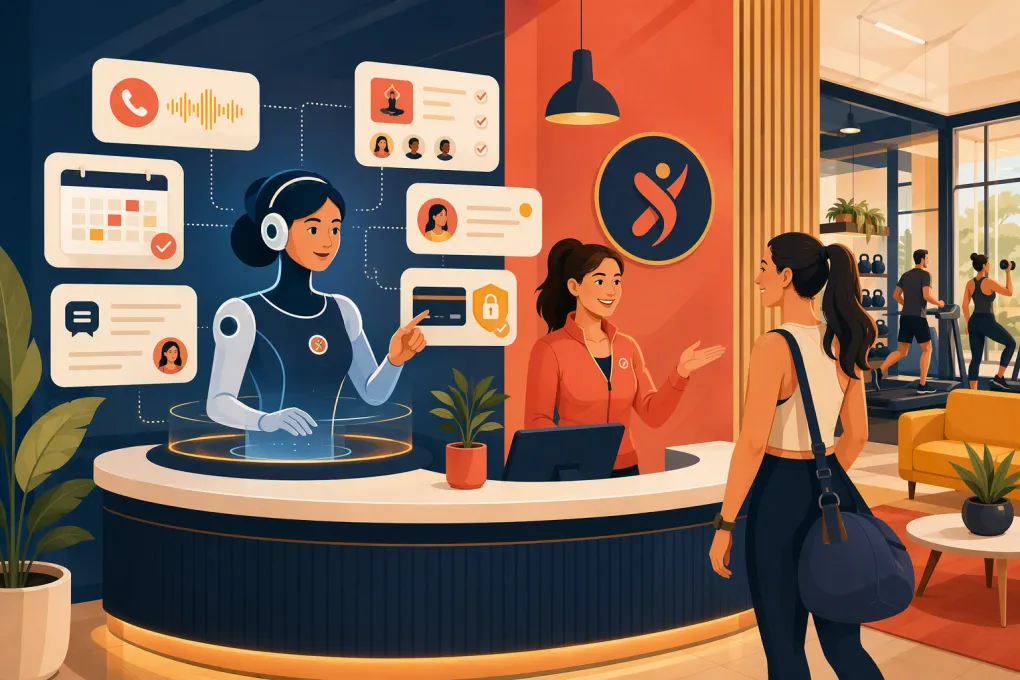
An AI receptionist for fitness studios is designed to close that response gap. It can answer approved questions, qualify leads, guide people toward eligible services, trigger follow-up, and escalate conversations that need a person.
But it is not a plug-and-play substitute for front-desk judgment. Useful automation depends on accurate schedules, clean customer records, working integrations, narrow permissions, and tested failure paths. Without those controls, an AI agent can confidently offer a canceled class, create duplicate leads, or keep messaging someone who opted out.
See how Fitty can support your studio’s after-hours lead workflow →
What an AI receptionist should actually do
A fitness studio AI receptionist should move a conversation toward a controlled operational outcome—not merely produce a friendly answer.
Common workflows include:
- Answering questions about classes, amenities, locations, and policies
- Capturing a prospect’s contact details, goals, experience, and preferred time
- Showing relevant availability and booking an eligible intro or class
- Following up when an inquiry does not become a booking
- Sending approved preparation and arrival instructions
- Answering routine member questions
- Starting an approved outstanding-dues workflow
- Passing sensitive or unusual conversations to staff with context
The boundaries matter. An agent should not invent policies, diagnose injuries, approve exceptions, negotiate disputes, or promise that a payment issue has been resolved before the underlying system confirms it.
Start with specific workflows, not “automate the front desk”
Choose repetitive conversations with clear inputs, actions, and end conditions. The following sample workflows are hypothetical operating patterns—not customer case studies—but they show the level of detail required.
Sample workflow: after-hours intro inquiry
- A prospect asks whether the studio has beginner Pilates classes.
- The agent confirms the preferred location and any published eligibility requirements.
- It retrieves current intro-session availability from the scheduling system.
- The prospect chooses a valid time and completes any required booking or payment step.
- The scheduling system returns a confirmed booking ID.
- The agent sends confirmation and approved arrival instructions.
- The lead record is updated with the source, conversation, and booking outcome.
- If no booking occurs, an approved follow-up sequence begins and stops upon booking, opt-out, or human escalation.
The confirmation ID is important. A conversational “you’re booked” is not enough if the scheduling platform did not accept the reservation.
Sample workflow: failed membership payment
- The payment or membership system reports a failed transaction.
- The workflow verifies that the balance is still open and has not already been resolved.
- The agent sends an approved notice through a permitted channel.
- The member receives a secure payment-update route; sensitive card details are not collected in ordinary chat.
- The payment system—not the conversation alone—confirms success or failure.
- The account record is updated, further reminders stop, and disputes go to staff.
Fitty is designed to answer leads, support booking and follow-up, and assist with dues workflows inside WTF Go. Those actions require the relevant schedule, customer, messaging, and payment data to be connected and correctly configured. Available channels and integrations can vary by implementation; a booking or payment should be treated as complete only after the system of record confirms it. Discuss your required workflow and integrations with WTF Go →
Build the operating foundation before launch
The AI layer is only as reliable as the systems beneath it. Document which platform is authoritative for each type of data before connecting anything.
Scheduling and availability
The scheduling platform should remain the source of truth for class capacity, appointment slots, waitlists, staff assignments, and location.
Configure:
- Which services the agent may book, cancel, or reschedule
- New-client eligibility and prerequisite rules
- Capacity, waitlist, booking-window, and cutoff rules
- Location, room, coach, and time-zone handling
- Payment or waiver requirements
- The confirmation response required before telling someone they are booked
Use real-time or near-real-time availability where supported. If availability cannot be verified, the safe fallback is to collect the requested time and route it to staff—not promise the space.
CRM and customer identity
Decide how the system will match an incoming person to an existing record. A practical matching order may use normalized phone number, normalized email address, and then a staff review when details conflict.
To reduce duplicates:
- Search before creating a new contact
- Normalize phone numbers and lowercase email addresses
- Store external system IDs on the shared record
- Use idempotency keys or equivalent controls so retries do not create another lead or booking
- Define how household members sharing an email or phone are handled
- Send uncertain matches to a review queue rather than merging automatically
Preserve the original acquisition source and conversation history. If the AI overwrites every source with “chat,” marketing attribution becomes less useful.
Payments and dues
Use a payment provider or membership platform designed to handle payment data securely. The agent should generally send an approved secure payment link or invoke a supported payment workflow rather than request card information in free-form messages.
Set permissions separately for viewing an account status, sending a payment route, retrying an approved transaction, issuing a credit, and issuing a refund. An AI receptionist may need the first two; refunds and disputed charges should normally require a person.
Messaging and consent
Map each channel—such as web chat, SMS, phone, or email—to its consent, identification, contact-hour, and opt-out rules. Automated calls and texts can be subject to federal and state requirements, so obtain legal advice for your use case.
The system should immediately suppress follow-up when a person opts out and preserve that preference across connected tools. A contact marked opted out in one platform should not be re-enrolled by another overnight sync.
Synchronization and failure handling
For every integration, define:
- Sync direction: one-way or two-way
- System of record for each field
- Expected update frequency
- Conflict resolution when records disagree
- Retry limits and duplicate protection
- Error logging and staff alerts
- What the customer is told during an outage
Use least-privilege access. The agent should have only the permissions required for approved workflows. Separate read access from write access, and avoid giving broad administrative credentials to an integration.
Create clear human handoffs
Automation needs an owner. Assign a staff queue, expected response window, and backup contact for each escalation type.
Escalate situations involving:
- Injuries, pregnancy, symptoms, or medical suitability
- Complaints, refund requests, and charge disputes
- Cancellation exceptions or financial hardship
- Accessibility arrangements requiring coordination
- Conflicting customer records
- Repeated integration or payment failures
- Large group, partnership, or corporate inquiries
- A direct request to speak with a person
The handoff should include the transcript, contact record, stated goal, actions already attempted, and reason for escalation. Staff should not have to ask the customer to repeat the entire conversation.
Run a controlled prelaunch test
Test in a sandbox when available, then use controlled internal accounts in production. Include staff from operations, sales, and the front desk—not only the person configuring the system.
Prelaunch checklist
- Incorrect availability: Change or cancel a class and confirm the agent stops offering it after the expected synchronization interval.
- Double booking: Have two testers request the final space simultaneously. Only the booking confirmed by the scheduling system should succeed.
- Stale policies: Change a cancellation or intro-offer policy and verify the old answer is removed from every connected knowledge source.
- Ineligible service: Attempt to book a members-only or prerequisite-based class as a new prospect.
- Duplicate records: Contact the studio through two channels using the same phone or email and confirm the records match or enter review.
- Opt-outs: Send an opt-out instruction in each messaging channel and verify all relevant follow-up stops.
- Failed payments: Use an approved test failure and confirm the agent does not report success, expose sensitive data, or continue an invalid retry loop.
- Escalations: Ask a medical, refund, and policy-exception question. Confirm the correct team receives the transcript and reason.
- Service outage: Disable or simulate failure of the scheduling, CRM, messaging, and payment connection one at a time. The agent should acknowledge the limitation, avoid making promises, log the error, and provide a safe next step.
- Retry behavior: Restore a failed service and confirm queued actions do not create duplicate contacts, messages, charges, or bookings.
- Location and time zone: Test similarly named services at different locations and around daylight-saving changes.
- Audit trail: Verify staff can see what the agent said, what action it attempted, and what the source system confirmed.
Launch one workflow during staffed hours first. Review conversations daily, correct gaps, and expand only after the error and handoff patterns are understood.
Calculate ROI with a baseline, not a guess
Conversation count is not ROI. Establish a baseline period before launch and compare it with a similar post-launch period. Use the same locations, lead sources, offer structure, and definitions. Avoid comparing a January promotion with a quiet summer month without adjustment.
Record these baseline measures:
- Qualified inquiries received
- Median first-response time
- Intro or consultation bookings
- Show-ups and subsequent membership conversions
- Staff minutes spent on covered tasks
- Outstanding balances resolved through the measured workflow
- Refunds, opt-outs, and incorrect-answer incidents
Then calculate monthly value using your own data:
Labor capacity value = hours of repetitive work avoided × fully loaded hourly labor cost
Incremental booking value = additional attended intros attributed to the workflow × your measured value per attended intro
That value per attended intro can be conservative: use realized gross profit from the relevant cohort if you track it, rather than assuming every booking becomes a long-term member.
Collection value = incremental dues recovered − payment fees − refunds or reversals associated with those recoveries
Net monthly benefit = labor capacity value + incremental booking value + collection value − monthly AI and integration costs
Payback period in months = one-time implementation cost ÷ net monthly benefit
If net monthly benefit is zero or negative, there is no calculated payback under the current assumptions.
Handle attribution carefully
Do not credit every booking touched by AI to AI. Separate outcomes into:
- AI-converted: The agent handled the inquiry and completed the confirmed booking without staff intervention.
- AI-assisted: The agent captured or followed up with the lead, but staff completed the booking.
- Human-converted: Staff created the outcome without a meaningful AI touch.
Compare conversion rates by source and time of day, and retain a prelaunch baseline. For a stronger test, phase the rollout by location, channel, or operating hours while keeping offers comparable. Watch for displaced bookings: a person who would have booked through the website anyway is not necessarily incremental.
Explore how Fitty can connect lead response, booking, follow-up, and account workflows →
Keep people responsible for judgment
The best division of labor is straightforward: AI handles speed, repetition, and administrative follow-through; people handle judgment, empathy, exceptions, and relationship repair.
Review transcripts and failures regularly. Track incorrect answers, unconfirmed actions, duplicate records, escalation reasons, and opt-out compliance—not only bookings. An AI receptionist becomes operationally valuable when it is treated like a managed front-desk process with owners, controls, and measurable outcomes, not a chatbot that was switched on and forgotten.
Frequently asked questions
Can an AI receptionist book fitness classes directly?
Yes, when it is connected to a compatible scheduling workflow and can verify live availability, eligibility, and confirmation. If the scheduling system does not confirm the booking, the agent should not tell the customer it is complete.
What integrations does an AI fitness receptionist need?
Typical requirements include scheduling, CRM or member records, messaging channels, and a secure payment or membership system. Exact needs depend on which actions the studio wants to automate and which platform remains the system of record.
How do fitness studios calculate AI receptionist ROI?
Compare a representative prelaunch baseline with post-launch labor time, incremental attended bookings, dues recovered, and total software and integration costs. Separate AI-converted, AI-assisted, and human-converted outcomes to avoid overstating attribution.
How long should a studio test an AI receptionist before launch?
There is no universal period. Launch one workflow during staffed hours and continue testing until availability, booking, opt-out, payment-failure, escalation, outage, and duplicate-prevention scenarios behave correctly.
Should an AI receptionist handle refunds or medical questions?
Generally, no. It can collect context and route the request, but medical suitability, charge disputes, refunds, policy exceptions, and other sensitive decisions should be handled by authorized staff.
Keep reading


Run your gym on autopilot with WTF Go
Fitty — your AI receptionist — answers calls and DMs, fills classes, follows up with every lead, and collects dues while you coach.