AI & Automation
AI Receptionist for Fitness Studio Class Package Sales Guide
Learn how an AI receptionist for fitness studio class package sales can answer leads, recommend offers, follow up, book visits, and collect payments 24/7.
 Watch · 20s
A prospective client asks about your beginner package at 8:47 p.m. Your last class is ending, the front desk is closing, and the owner is trying to finish payroll. By the time someone replies the next morning, the prospect may have contacted three other studios.
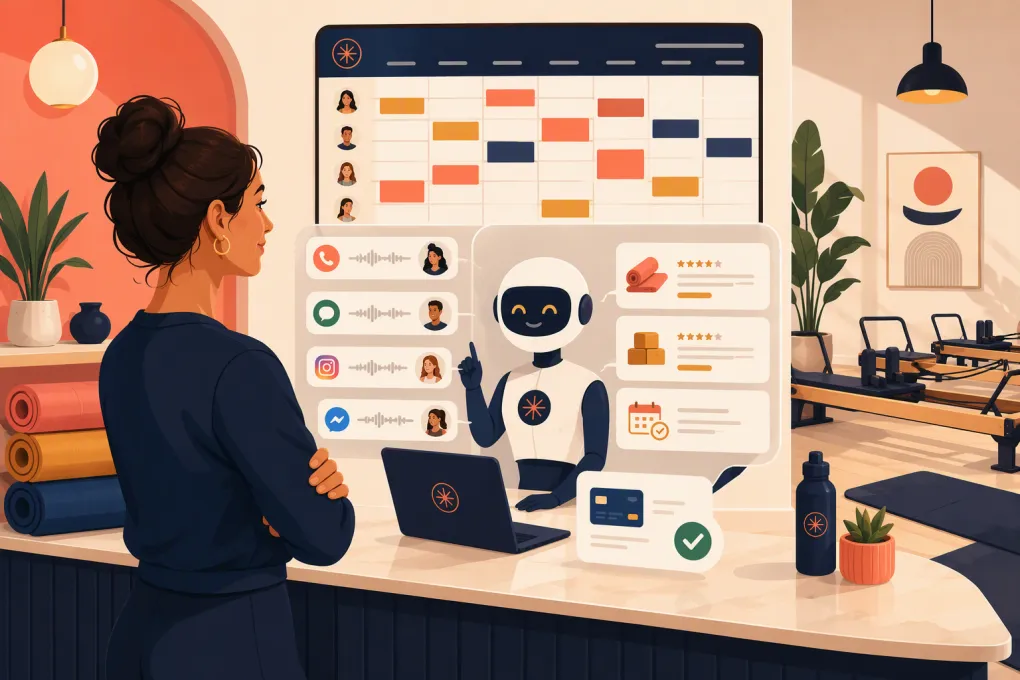
That is the practical case for an AI receptionist for fitness studio class package sales. It is not simply a chatbot that repeats prices. A useful AI receptionist responds when interest is high, identifies what the prospect needs, recommends an appropriate offer, answers policy questions, books the next step, and follows up when the conversation stalls.
The quality of that process matters. If the AI pushes the wrong package, invents an answer, or traps people in a conversation with no human escape route, it creates more work instead of more sales.
Why fitness studio package sales stall
Class packages look straightforward from inside the business. Prospects often see a wall of unfamiliar choices: drop-ins, introductory offers, class packs, memberships, private sessions, expiration rules, and eligibility restrictions.
A lead may also be unsure about matters that have little to do with price:
- Whether the class is suitable for beginners
- What to bring and when to arrive
- Whether an injury or limitation requires instructor guidance
- Which location offers the right format
- Whether a package expires or can be shared
- What happens after an introductory offer ends
- Whether there is space in a convenient class
A receptionist normally resolves these questions through conversation. The operational problem is availability. Leads arrive during classes, after hours, on weekends, and while staff members are helping clients in person.
An AI receptionist closes that coverage gap without asking instructors to become full-time sales reps.
See how Fitty handles class-package inquiries when your staff is unavailable →
What an AI receptionist should actually do
A studio sales agent needs to move the conversation forward, not merely provide information. The core workflow should include the following jobs.
Respond to the lead’s actual question
If someone asks whether an intro package includes reformer classes, the first response should answer that question. Forcing the lead through a long qualification script before providing a useful answer creates friction.
The AI can then ask one focused question, such as whether the person is new to the studio or has prior reformer experience.
Identify fit without interrogating the prospect
Most package recommendations require only a small amount of context:
- Is the person a new or returning client?
- What class type or goal interests them?
- How often do they expect to attend?
- Which location and schedule work for them?
- Do they want group classes, private sessions, or guidance choosing?
Avoid collecting information that will not change the recommendation. Every extra question gives the lead another place to abandon the conversation.
Recommend one primary option
Listing every package transfers the work back to the prospect. A better approach is to recommend one offer and briefly explain why it fits.
For example: a new client who wants to try two formats before committing may be best served by an introductory package. A returning client who attends irregularly may be better suited to a flexible class pack. A frequent attendee may need a membership comparison or a human consultation.
The AI should present an alternative only when it meaningfully differs from the first recommendation.
Complete a concrete next step
Every conversation should lead toward one of these outcomes:
- Purchase the appropriate package through a secure checkout
- Book a first class, visit, or consultation
- Send the requested information and schedule follow-up
- Transfer the conversation to a staff member
- Record that the prospect is not interested or has opted out
A friendly conversation with no next step is not a functioning sales workflow.
Build the offer logic before automating it
AI cannot repair a confusing package structure. Before switching on automated sales conversations, create an internal package matrix that staff and the AI can both use.
For every offer, document:
- Exact package name and current price source
- Who is eligible to purchase it
- Included class types and excluded services
- Participating locations
- Activation and expiration rules
- Booking and cancellation policies
- Sharing, transfer, freeze, and refund rules
- Whether it renews automatically
- What happens when the package ends
- The next recommended offer
- Situations that require staff approval
Do not rely on marketing copy alone. A landing page may say that a package is flexible without explaining whether credits can be used at another location. The AI needs the operational policy, not an adjective.
Assign one person to own these records. When a package, schedule, or rule changes, updating the AI’s approved information should be part of the same launch checklist.
Design the class-package sales conversation
A strong conversation can be short. Use this structure as a starting point.
1. Answer
Address the initial question directly using approved studio information.
2. Qualify
Ask the minimum number of questions needed to determine eligibility and fit. Ask one at a time rather than sending a form disguised as a message.
3. Recommend
Present one offer with a plain-English reason. Include the important commitment, renewal, and expiration terms before checkout.
4. Resolve
Answer the next concern. Common concerns include schedule compatibility, beginner readiness, cancellation rules, and uncertainty about committing.
5. Convert
Provide a secure purchase path or book the next step. If the prospect is not ready, obtain permission for relevant follow-up.
6. Confirm
After the transaction, confirm what was purchased, how to book, when to arrive, and where to find studio policies.
Fitty is built for this operational handoff: answering leads, booking classes, following up, and collecting dues around the clock rather than leaving each task in a separate staff queue.
Explore how Fitty can turn package questions into booked classes and paid accounts →
Use scripts as guardrails, not rigid dialogue
The AI needs approved language for recurring situations. These templates illustrate the structure; adapt every detail to your actual offers and policies.
New client unsure which package to choose
I can help narrow it down. Are you mainly looking to try the studio first, or do you already know you want to attend regularly?
After the answer, recommend the eligible package and explain why it matches the stated intent.
Prospect asks only for the price
The current package options and terms are available here. Before I point you to the best fit, are you new to the studio or have you attended before?
Answer the price question first. Do not withhold basic information as a qualification tactic.
Prospect is concerned about an injury
I can explain our class formats and booking options, but I cannot determine whether a class is medically appropriate. I can connect you with the studio team so they can discuss instructor support and any relevant studio requirements.
The AI should not diagnose, promise safety, or substitute for medical guidance.
Prospect is not ready to purchase
No problem. Would you like the package details sent here, and may we follow up after you have reviewed the schedule?
This creates an explicit follow-up path instead of repeatedly messaging an unresponsive lead.
Automate follow-up without becoming noise
Package sales often require more than one interaction. The lead may need to compare schedules, speak with a partner, or wait for a suitable class.
Build follow-up around the prospect’s situation rather than a generic blast:
- Send the requested package and schedule information immediately.
- Follow up on the unresolved question, not with a vague check-in.
- If a class was discussed, mention its current booking path without promising availability.
- If an intro offer was purchased, remind the client how to book and use it.
- If checkout was started but not completed, offer help with the process.
- Stop promotional follow-up after an opt-out.
- Route direct replies and sensitive issues to the appropriate person.
Keep service messages separate from marketing messages in both purpose and consent handling. Review applicable telephone, text messaging, privacy, and marketing rules with qualified counsel rather than assuming an AI channel is exempt.
Set non-negotiable safety and escalation rules
The AI should have clearly defined limits. At minimum, require human escalation for:
- Refunds, disputes, and chargebacks
- Requests for policy exceptions
- Medical or injury-specific questions
- Complaints involving staff or client safety
- Accessibility needs not covered by approved information
- Minors and guardian requirements
- Conflicting account or payment records
- Questions the knowledge base cannot answer confidently
Never collect card details in ordinary chat messages. Use a secure payment flow provided by your payment system. The AI should also identify itself appropriately and avoid pretending to be a specific employee.
Review conversation logs regularly. Look for wrong recommendations, dead ends, repeated questions, missed handoffs, and policy language that prospects find confusing.
Measure the full sales path
Do not judge the AI receptionist solely by message volume. Track whether it advances qualified prospects through the actual package-sales funnel.
Useful operational measures include:
- Time to first response
- Leads that receive a package recommendation
- Purchase links opened and checkouts completed
- Consultations, visits, or first classes booked
- Conversations requiring human escalation
- Follow-ups that receive a reply
- Intro-package clients who book their included sessions
- Refund requests or complaints tied to incorrect information
- Reasons prospects decline or delay
Review results by channel, location, offer, and lead source when your systems allow it. A high number of conversations can hide a weak checkout process or a schedule that does not match demand.
Launch without disrupting the front desk
Start with a controlled use case instead of automating every conversation at once.
- Choose one location or a limited set of packages.
- Document eligibility, terms, policies, and approved answers.
- Map purchase, booking, follow-up, and human handoff paths.
- Test common questions, misspellings, vague requests, and policy exceptions.
- Confirm that package and schedule information comes from maintained sources.
- Train staff on where escalated conversations appear and who owns them.
- Review real conversations frequently during the initial rollout.
- Expand only after the workflow is accurate and manageable.
The goal is not to remove people from hospitality. It is to prevent good prospects from waiting while your team is teaching, serving clients, or off the clock. Staff can then focus on the conversations where judgment and human care matter most.
For studios that want lead response, booking, follow-up, and collections inside one operating system, WTF Go and Fitty provide a direct path from inquiry to action.
See how WTF Go can automate your studio’s package-sales workflow →
Frequently asked questions
Can an AI receptionist sell class packages without staff involvement?
It can handle routine qualification, recommendations, checkout links, booking, and follow-up when package rules are clearly documented. Exceptions, disputes, medical questions, and unusual account issues should go to a staff member.
What information does an AI receptionist need from a fitness studio?
It needs current package terms, eligibility rules, class and location details, booking policies, payment paths, approved answers, and clear escalation instructions.
Can an AI receptionist answer leads after business hours?
Yes. A system such as Fitty can answer leads and continue approved booking, follow-up, and payment workflows around the clock.
Should the AI recommend memberships as well as class packages?
Yes, when the prospect's expected attendance and eligibility make a membership relevant. It should explain the meaningful differences and avoid pushing a longer commitment without clear consent.
How should a studio evaluate an AI receptionist?
Track response time, recommendations, completed purchases, bookings, follow-up replies, escalations, and errors. Review conversation quality alongside conversion outcomes.
Keep reading


Run your gym on autopilot with WTF Go
Fitty — your AI receptionist — answers calls and DMs, fills classes, follows up with every lead, and collects dues while you coach.