AI & Automation
AI Receptionist for Facial Spas: 24/7 Booking and Follow-Up
Learn how an AI receptionist for facial spas answers leads 24/7, books appointments, follows up, collects dues, and gives staff more time for clients.
 Watch · 20s
A facial spa can lose a booking while the esthetician is still in the treatment room. A prospect calls about a hydrating facial, gets voicemail, and moves to the next spa in the search results. Another submits a form after closing but hears nothing until the next morning. A member asks about an overdue payment while the front desk is checking in three clients.
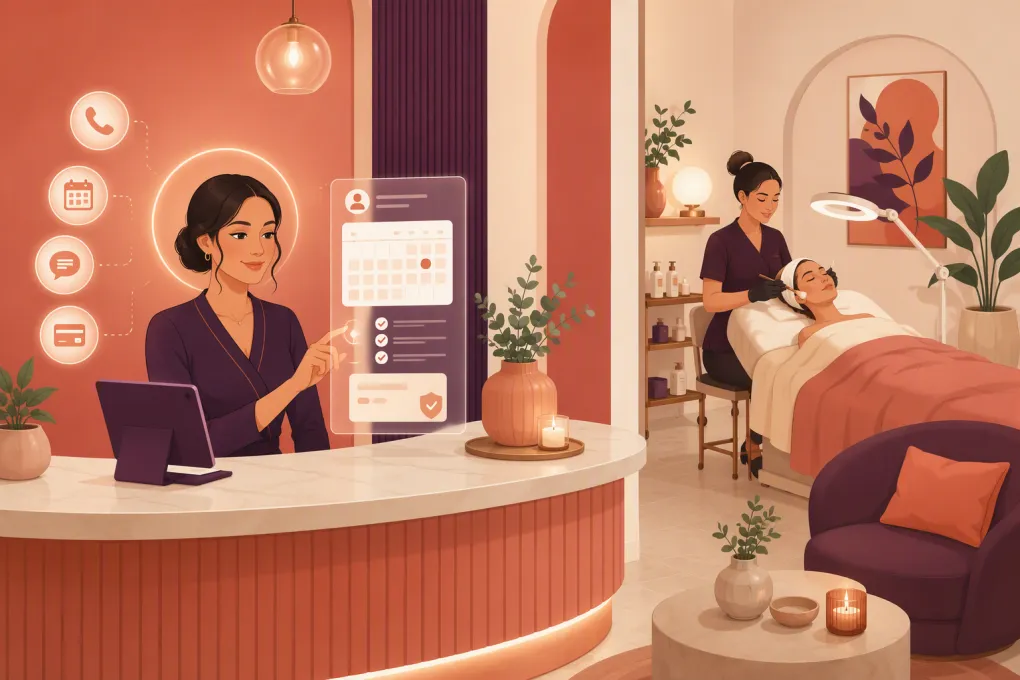
An AI receptionist for facial spas addresses that gap. It can respond when the team is busy or off the clock, answer approved questions, guide prospects toward the right appointment, book available times, and keep following up until the inquiry reaches a clear outcome.
The value is not replacing a capable receptionist. It is removing the repetitive communication load that keeps the receptionist—and often the owner—from doing higher-value work.
Why facial spa inquiries are easy to lose
Facial spa leads rarely ask only whether you have an opening. They want to know:
- Which facial fits their concern
- How long the service takes
- Whether there is downtime
- What products or techniques are used
- Whether they can book before an event
- What the cancellation or deposit policy is
- Whether a membership covers the treatment
- Whether a specific provider is available
These questions arrive through calls, website forms, texts, and other channels at unpredictable times. The front desk must also check clients in, process payments, manage provider schedules, and resolve same-day changes.
That creates a response problem even in a well-run spa. If every inquiry depends on an employee becoming available, leads wait. If the reply is rushed or incomplete, they ask more questions—or disappear.
See how Fitty can handle facial spa inquiries, booking, and follow-up 24/7 →
What an AI receptionist should handle
The right system should own defined front-desk workflows rather than improvising its way through every conversation.
Answer routine service questions
Give the receptionist an approved knowledge base covering:
- Service names and plain-language descriptions
- Appointment durations
- Published prices or starting prices
- Provider and location availability
- Preparation and general aftercare instructions
- Membership inclusions
- Deposit, cancellation, and late-arrival policies
- Parking, accessibility, and arrival information
The AI should answer from this source, not invent treatment details. Assign one employee to update the information whenever services, hours, policies, or prices change.
Move the conversation toward a booking
A useful receptionist does more than send a scheduling link. It narrows the options and presents a practical next step.
For example, it could ask:
- What result or concern are you hoping to address?
- Is this your first facial with the spa?
- Do you have a preferred provider, date, or location?
- Are you preparing for a specific event?
The resulting workflow can recommend an appropriate non-clinical service category, offer available appointments, and book once the client chooses. Questions requiring professional judgment should go to an esthetician or clinician.
Follow up without creating more front-desk work
Many leads do not book during the first interaction. They may need to check a calendar, compare services, or wait until payday. The system should place those inquiries into a controlled follow-up sequence.
A basic sequence might include:
- An immediate response to the original inquiry
- A reminder that repeats the relevant service and booking option
- A later check-in offering human assistance
- A final message that closes the loop without endless outreach
Stop the sequence when the client books, declines, unsubscribes, or needs a staff member. Review applicable calling and messaging consent requirements before launching automated outreach.
Handle payment-related workflows safely
For memberships, packages, and recurring plans, an AI receptionist can identify an account issue, explain the approved policy, and direct the client to a secure payment process. It can also follow up on unpaid dues when that workflow is part of the operating system.
Do not ask clients to type full payment-card details into an ordinary chat. Use a secure payment page and confirm that every vendor involved follows the standards applicable to your business.
Build the workflow before turning on the AI
AI does not fix a disorganized booking process. It exposes it. Before launch, map the exact path from first contact to completed appointment.
A clean facial spa workflow looks like this:
- Capture: Record the lead’s name, contact information, source, requested service, preferred time, and location.
- Qualify: Ask only the questions needed to determine the next step.
- Educate: Answer from approved service and policy information.
- Book: Show current availability and reserve the selected appointment.
- Confirm: Send the appointment details, preparation guidance, and relevant policies.
- Follow up: Re-engage unbooked leads and address incomplete payment steps.
- Escalate: Route clinical, sensitive, unusual, or high-value questions to the right employee.
- Close: Mark the lead as booked, declined, unreachable, or transferred.
Each stage needs an owner. The AI may manage the conversation, but a staff member still needs responsibility for exceptions and escalations.
Explore how Fitty combines lead response, scheduling, follow-up, and dues collection →
Set clear boundaries for treatment questions
Facial services sit close to health, skin, and sometimes medical concerns. That makes boundaries essential.
An AI receptionist can explain how your spa describes a service. It should not diagnose a skin condition, assess a suspicious lesion, guarantee a result, or decide whether a client is medically suitable for a procedure.
Create immediate handoff rules for messages mentioning:
- Active irritation, infection, or unexpected reactions
- Pregnancy-related treatment questions
- Prescription medications or recent procedures
- Allergies or prior adverse reactions
- Requests for diagnosis
- Complaints involving injury or urgent symptoms
- Services that require clinical screening or consent
A safe response acknowledges the question, avoids a clinical conclusion, and routes the conversation to a qualified person. If your facial spa also provides medical services, assess privacy, recordkeeping, consent, and vendor requirements with appropriate legal and compliance advisers.
Give the receptionist operator-approved language
Tone affects conversion. Facial spa clients expect clarity and care, not a robotic wall of policy text.
Instead of a vague reply such as, “Someone will contact you soon,” use a response that advances the decision:
I can help you find the right appointment. Are you mainly looking for hydration, help with congestion, a brighter appearance, or guidance from an esthetician before choosing?
For an unavailable time:
That time is no longer open. I can offer Tuesday at 4:30 p.m. or Wednesday at 11 a.m. with the same provider. Would either work?
For a question that needs expertise:
An esthetician should review that before we recommend a service. I can collect your contact information and preferred callback time for the team.
Review real conversations after launch. Add missing answers, shorten confusing messages, and tighten handoff rules when the system encounters questions it cannot resolve.
What to check before choosing a system
Do not evaluate an AI receptionist solely on how natural its demo sounds. The operational details matter more.
Ask whether the system can:
- Read current appointment availability rather than offering stale times
- Respect provider, room, equipment, and location constraints
- Recognize existing clients and memberships
- Capture leads in the same place your team works
- Stop follow-up after a booking or opt-out
- Escalate a conversation with context attached
- Separate general service education from clinical advice
- Support multiple locations without mixing schedules or policies
- Show conversation history and booking outcomes
- Restrict staff access based on role
- Provide a clear migration and onboarding process
Also ask what happens when the system is uncertain. A reliable “I need to bring in a team member” is better than a confident but incorrect answer.
Measure outcomes that affect the schedule
Conversation volume alone does not tell you whether the receptionist is working. Track the movement of inquiries through the booking process.
Useful operating measures include:
- New inquiries by channel and location
- Time from inquiry to first response
- Appointments booked from new inquiries
- Leads requiring human handoff
- Unbooked leads still in follow-up
- Cancellations and rescheduling requests handled
- Membership or dues issues resolved
- Questions the AI could not answer
- Bookings by service, provider, and time window
Review these weekly during rollout. Look at the actual conversations behind the numbers. A high handoff count may mean the knowledge base is incomplete, but it could also mean the rules are correctly protecting clinical boundaries.
Where WTF Go and Fitty fit
WTF Go is an operating system for gyms, studios, spas, and wellness businesses. Fitty is its AI receptionist and agent, built to answer leads, book appointments or classes, follow up, and collect dues around the clock.
For a facial spa, that means the inquiry does not need to sit in a separate inbox waiting for someone to copy it into the booking workflow. Fitty can keep the lead moving while the team remains focused on clients, treatment quality, and in-person service.
The strongest setup still starts with your rules: approved service information, accurate availability, clear escalation paths, and consistent policies. Fitty then applies those rules to the repetitive conversations that otherwise consume the front desk.
See how WTF Go and Fitty can support your facial spa’s front desk workflow →
An AI receptionist should make the spa easier to reach and easier to book—not make the client experience feel less personal. Keep the automation focused on speed, consistency, and routine execution, while your team handles judgment, relationships, and care.
Frequently asked questions
Can an AI receptionist book facial appointments directly?
Yes, if it has access to current availability and the booking rules for providers, rooms, services, and locations. It should confirm the appointment and stop lead follow-up once booking is complete.
Can an AI receptionist recommend a facial treatment?
It can guide clients using operator-approved service descriptions and non-clinical questions. Diagnosis, contraindication decisions, and personalized clinical advice should be escalated to a qualified professional.
Will an AI receptionist replace my spa front desk staff?
It is better used to absorb routine inquiries, scheduling, follow-up, and payment reminders. Staff remain essential for exceptions, sensitive conversations, client relationships, and professional treatment guidance.
What information should a facial spa provide before launch?
Prepare accurate services, prices, durations, provider schedules, booking rules, memberships, preparation instructions, cancellation policies, location details, and clear human-handoff criteria.
How should a facial spa evaluate AI receptionist performance?
Track response time, inquiry-to-booking movement, unresolved leads, handoffs, missed questions, cancellations, and payment issues. Review conversation quality as well as operational outcomes.
Keep reading
Run your gym on autopilot with WTF Go
Fitty — your AI receptionist — answers calls and DMs, fills classes, follows up with every lead, and collects dues while you coach.