AI & Automation
AI Receptionist for Eyebrow Threading Salons: Practical Guide
Learn how an AI receptionist for eyebrow threading salons answers calls, books clients, handles FAQs, and follows up without extra front-desk work.
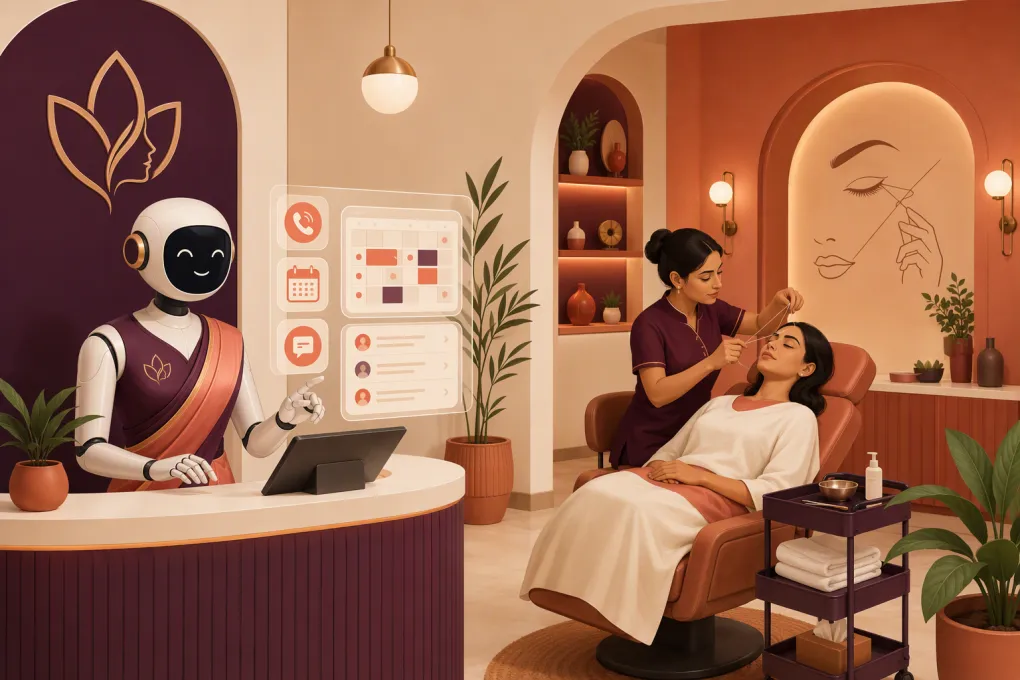 Watch · 20s
A ringing phone creates an awkward choice in an eyebrow threading salon: interrupt the client in the chair or let a potential booking go unanswered. Neither is good for business. An AI receptionist gives salons a third option by answering common questions, capturing client details, booking eligible appointments, and following up without pulling the threading artist away from the service.
That does not mean handing every customer interaction to a bot. The practical goal is to automate predictable front-desk work while giving clients a clear path to a person when judgment, sensitivity, or an exception is involved.
Why eyebrow threading salons lose bookings at the phone
Threading salons often operate with lean teams. The person answering the phone may also be performing services, checking out clients, cleaning stations, or managing walk-ins. Calls commonly arrive when nobody can stop to answer.
The questions are usually straightforward:
- Do you accept walk-ins?
- Can I come in today?
- How much is eyebrow threading?
- How long does the service take?
- Can I book with a particular artist?
- Do you offer tinting, waxing, or facial threading?
- What is your cancellation or late-arrival policy?
- Which location has availability?
A missed call does not automatically become a voicemail. A prospective client can simply call the next salon in the search results. Existing clients can also become frustrated if booking, rescheduling, or confirming an appointment requires repeated attempts.
An AI receptionist for eyebrow threading salons is most useful when it removes those dead ends. It should respond immediately, use the salon’s actual policies, and move the conversation toward a confirmed next step.
See how Fitty can answer threading inquiries and book clients around the clock →
What an AI receptionist should actually do
An AI receptionist is more than a recorded phone menu. It uses natural-language conversation to understand what a caller or message sender needs, retrieve approved business information, and complete defined actions.
For a threading salon, those actions should include:
- Answering during services, breaks, busy periods, and after hours
- Identifying whether the person is a new or returning client
- Explaining services using salon-approved descriptions
- Checking availability by service, artist, location, and duration
- Booking or initiating the correct appointment workflow
- Capturing contact details when no suitable time is available
- Sending confirmations, reminders, and follow-up messages
- Escalating complaints, reactions, payment disputes, or unusual requests
The system should not improvise prices, make medical claims, or promise exceptions to salon policy. Good automation operates inside clear boundaries.
High-value workflows to automate first
1. Convert missed and after-hours calls
Start with calls that would otherwise go unanswered. The AI receptionist should introduce the salon, ask how it can help, and determine whether the caller wants information or an appointment.
If the caller wants to book, collect only the information necessary to continue:
- Requested service
- Preferred date or time range
- Preferred artist, if any
- Location, for multi-location salons
- Name and contact details
- New or returning client status
If there is no matching opening, offer approved alternatives rather than ending the conversation. That might mean another artist, another location, a nearby time, or a request for staff follow-up.
2. Handle walk-in questions without creating confusion
Walk-in availability can change quickly. Avoid programming the receptionist to guarantee immediate service unless capacity is updated in real time.
A safer response explains the policy accurately. For example, the salon may accept walk-ins subject to artist availability while recommending an appointment during busy periods. The AI can offer to book an open slot rather than telling the client to arrive based on an assumption.
3. Book the correct service length
Not every brow request belongs in the same calendar slot. First-time shaping may require a different duration than routine cleanup. Brow tinting, lamination, upper-lip threading, or full-face threading may require different staff skills, equipment, or buffers.
Build a service map containing:
- Public service name and internal booking name
- Appointment duration
- Cleanup or preparation buffer
- Eligible artists
- Location availability
- Add-on compatibility
- New-client restrictions
- Deposit or prepayment rules, if applicable
This prevents the AI from creating technically valid but operationally impossible appointments.
4. Answer repetitive pre-service questions
Create an approved knowledge base for questions about preparation, timing, age policies, contact lenses, makeup, retinoid-related concerns, and aftercare. Have a qualified person review the wording.
The receptionist should distinguish general salon guidance from medical advice. If a client reports swelling, persistent irritation, an allergic response, broken skin, or another health concern, the system should escalate rather than diagnose.
5. Follow up on incomplete inquiries
Some people ask about availability but do not book. A useful system records the inquiry and sends a short follow-up through an approved channel. The message can offer help completing the booking or finding another time.
Keep the follow-up tied to the original request. A client who asked about Saturday brow threading should not receive a generic promotion that ignores the conversation.
Fitty is built to answer leads, book services, follow up, and keep routine conversations moving without requiring an employee to monitor every inquiry. See how Fitty handles missed salon leads from first question to booking →
How to set up an AI receptionist without damaging the client experience
Create one source of truth
Do not make the AI reconstruct policies from an old website, a social media caption, and staff memory. Build one maintained source containing:
- Hours and holiday closures
- Addresses, parking, and accessibility details
- Service menu and current prices
- Artist qualifications and schedules
- Walk-in rules
- Cancellation, lateness, refund, and no-show policies
- Membership or package terms
- Escalation contacts
Assign one person to approve changes. When a price, schedule, or policy changes, update the receptionist at the same time as the website and booking system.
Define escalation rules
Automation needs an exit ramp. Route the conversation to a person when it involves:
- A complaint or refund request
- A possible injury or skin reaction
- A minor when guardian consent may be required
- A bridal party or large group
- An accessibility accommodation
- A payment dispute
- An exception to published policy
- Repeated misunderstanding by the AI
Escalation can mean a live transfer during staffed hours or a clearly labeled callback task. Do not tell clients someone will respond immediately if that is not how the salon operates.
Match the salon’s communication style
The receptionist should sound direct, warm, and concise. It does not need exaggerated enthusiasm or long explanations. Callers often want a price, an opening, or a policy answer quickly.
Use pronunciation guidance for artist names, neighborhood names, and services. Test how the system handles different accents, background salon noise, callers who change their request midway through a conversation, and people who ask several questions at once.
Respect consent, privacy, and payment requirements
Collect only the information required for the interaction. Restrict staff access, define how long conversation records are retained, and use payment workflows designed for secure processing rather than asking callers to state sensitive card information unnecessarily.
Calling, recording, and text-message consent rules can vary by jurisdiction and use case. Review the applicable requirements with qualified counsel, disclose automation or recording where required, and honor opt-out requests.
What to evaluate before choosing a salon AI receptionist
A polished demo is not enough. Test the system against the conditions of a real threading business.
Ask vendors to demonstrate:
- Booking accuracy: Can it select the correct service, duration, artist, and location?
- Availability controls: Does it read current availability rather than promise stale time slots?
- Phone and messaging coverage: Which channels can it answer and follow up through?
- Human handoff: What happens when the caller asks for a person or the system is uncertain?
- Knowledge management: Can your team update prices and policies without filing a support request?
- Conversation records: Can managers review outcomes and identify incorrect answers?
- Multi-location routing: Can each branch have separate hours, staff, services, and escalation contacts?
- Payment handling: Does it use an appropriate secure workflow for deposits, packages, or membership dues?
- Implementation support: Who maps services, tests calls, and fixes booking logic before launch?
Also ask what the system does when an integration is unavailable. A responsible fallback may capture the request for staff review instead of pretending an appointment is confirmed.
A practical rollout plan
Do not automate every workflow on day one. Use a controlled rollout:
- Document services, schedules, policies, and escalation rules.
- Begin with missed and after-hours calls.
- Test common questions and booking scenarios internally.
- Review early conversations daily for incorrect or awkward responses.
- Add rescheduling, follow-up, packages, or payment workflows only after the core booking flow is reliable.
- Re-test whenever services, artists, hours, or policies change.
Track operational outcomes rather than vanity metrics. Review how many inquiries reached a clear resolution, how many booking attempts failed, why calls were escalated, and which questions lacked an approved answer. Listen to a sample of conversations instead of relying only on dashboard summaries.
For multi-location operators, pilot at one representative location before applying the workflow everywhere. Preserve branch-level differences rather than forcing every salon into the same rules.
The right role for AI in a threading salon
AI should protect the service experience, not replace hospitality. Threading requires focus and trust; the artist should not have to pause midway through a brow to answer whether the salon closes at six or seven.
A well-configured receptionist handles the predictable work, records what happened, and brings staff into the conversation when human judgment matters. That gives prospective clients a faster path to booking while letting the team stay present with the person already in the chair.
Explore WTF Go and Fitty for your salon’s booking, follow-up, and front-desk workflows →
Frequently asked questions
Can an AI receptionist book eyebrow threading appointments?
Yes, if it is connected to an accurate scheduling workflow and configured with service durations, artist eligibility, location rules, and buffers. It should capture the request for staff review when it cannot confirm availability reliably.
Can an AI receptionist answer calls after the salon closes?
Yes. It can answer common questions, capture lead details, and help clients book or request a callback outside staffed hours.
Will clients know they are speaking with AI?
The introduction should be transparent and comply with applicable disclosure and recording requirements. Clients should also have a clear way to request human assistance.
What salon questions should not be fully automated?
Possible skin reactions, injuries, payment disputes, complaints, policy exceptions, and unusual accommodation requests should be escalated to a qualified person.
Does a small threading salon need an AI receptionist?
It can be especially useful for a small team when artists cannot answer calls during services. The value depends on call volume, missed inquiries, booking complexity, and how consistently the system is maintained.
Keep reading
Run your gym on autopilot with WTF Go
Fitty — your AI receptionist — answers calls and DMs, fills classes, follows up with every lead, and collects dues while you coach.