AI & Automation
AI Receptionist for Esthetician Studios: The Operator's Guide
Learn how an AI receptionist for esthetician studios handles inquiries, books services, follows up with leads, and protects the client experience 24/7.
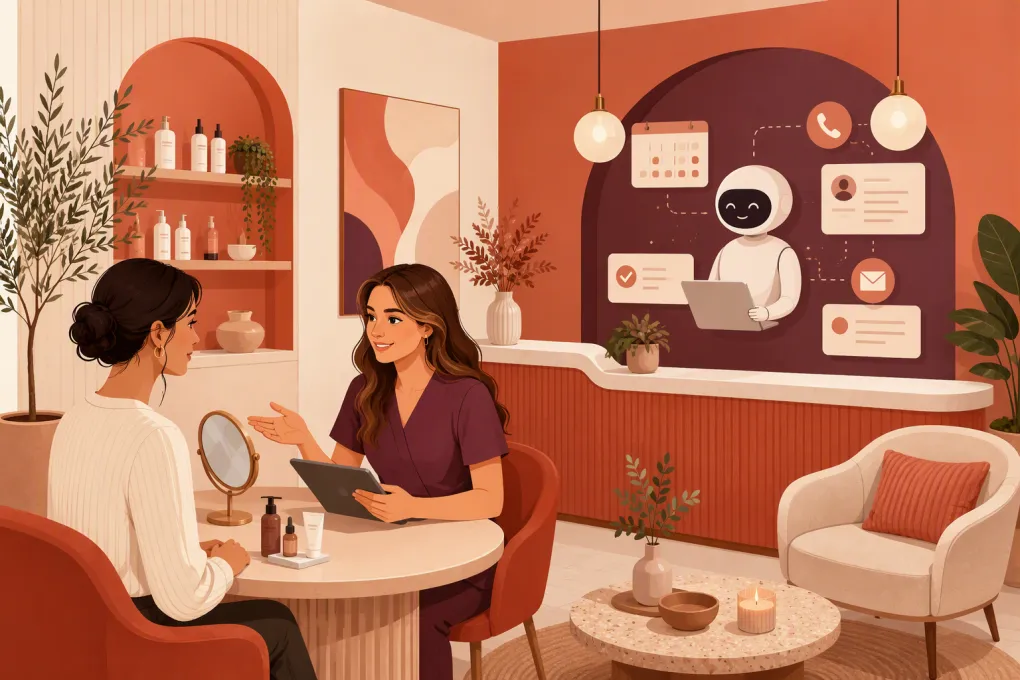 Watch · 20s
A potential client finds your studio after dinner. She wants to know which facial to book, whether you treat sensitive skin, and if anything is available Saturday. She calls, gets voicemail, and keeps searching.
That is the problem an AI receptionist for esthetician studios should solve. It is not simply a chatbot on your website. Properly configured, it can answer common questions, collect lead details, guide clients toward appropriate services, book within your rules, and follow up when someone does not finish scheduling.
The key phrase is properly configured. Esthetician studios have service-specific timing, contraindications, preparation instructions, deposits, room constraints, and scope-of-practice boundaries. An effective receptionist must understand those operational details without pretending to diagnose skin conditions or replace a licensed professional.
See how Fitty can answer esthetician leads and move them toward a booking →
What an AI receptionist should handle
The best use of AI is not to automate every conversation. It is to remove repetitive front-desk work while escalating situations that need judgment.
Answer routine questions immediately
Most inquiries revolve around a predictable set of topics:
- Services offered and how they differ
- Appointment length and general pricing
- Available days and times
- Studio location, parking, and accessibility
- Deposit, cancellation, and rescheduling policies
- Pre-appointment and post-treatment instructions
- Memberships, packages, and gift cards
- Whether a service is appropriate for a broad concern
Your AI receptionist should answer from an approved knowledge base, not improvise. If your policy says deposits are nonrefundable but transferable with sufficient notice, the assistant should use that exact rule consistently.
Review answers whenever you change a service, price, provider schedule, or policy. A polished response based on outdated information is still a bad response.
Help clients choose without diagnosing
Clients do not always know the name of the service they need. They ask for outcomes: help with congestion, dryness, uneven texture, unwanted hair, or a special-event glow.
An AI receptionist can ask basic routing questions and explain how services are positioned. It should not diagnose a skin disorder, guarantee results, evaluate a suspicious lesion, or tell someone to ignore medical advice.
A safe routing flow might be:
- Ask what the client would like help with.
- Ask whether this is a first visit.
- Present relevant service descriptions approved by the studio.
- Recommend a consultation when suitability is uncertain.
- Escalate medical, medication-related, pregnancy-related, or adverse-reaction questions to a qualified person.
Use language such as “This service is generally designed for…” rather than “This will fix…” That distinction protects the client experience and keeps the assistant within its role.
Book according to real operating rules
Booking is where a generic chatbot often falls apart. An esthetician studio does not merely need an open calendar slot. It needs the right combination of provider, room, equipment, service duration, cleanup time, and client eligibility.
Configure rules for:
- Which providers perform each service
- New-client versus returning-client appointment lengths
- Required buffers between services
- Room or equipment availability
- Patch tests or consultations that must happen first
- Add-ons that change appointment duration
- Minimum booking notice
- Deposit requirements
- Provider-specific schedules
- Services that cannot be booked online without review
If the system cannot confirm all required conditions, it should create a clear staff task instead of forcing a questionable appointment onto the calendar.
Where studios lose leads after the first inquiry
Answering the phone is only one part of front-desk performance. Many prospective clients ask a question, receive an answer, and still do not book. They may be comparing studios, checking their calendar, or waiting until payday.
A useful AI receptionist tracks the conversation and follows up with context. The message should reference the service or concern discussed and provide a simple next action.
For example:
- After an unanswered inquiry: offer to help by text and ask what service the person is considering.
- After service questions but no booking: send the relevant booking link or offer available times.
- After an abandoned booking: ask whether the client needs help choosing a provider or appointment.
- Before an appointment: send preparation instructions and required forms.
- After a missed appointment: explain the studio policy and provide the approved rebooking path.
Do not flood every lead with generic messages. Set a defined sequence, stop it when the person books or opts out, and preserve the conversation history so staff can take over without asking the client to repeat everything.
See how Fitty combines lead response, booking, and follow-up in one workflow →
Build the knowledge base before turning on automation
An AI receptionist is only as reliable as the studio information behind it. Before launch, create one source of truth for the assistant and your staff.
Document each service
For every service, record:
- Client-facing description
- Duration and general price
- Eligible providers
- Appropriate add-ons
- Basic preparation instructions
- General aftercare guidance
- Known booking prerequisites
- Situations requiring a consultation or staff review
- Claims or phrases the assistant must not use
Keep clinical judgment out of automated scripts. The objective is to route and schedule, not practice esthetics through a text conversation.
Define escalation triggers
Write down exactly when the AI must hand the conversation to a person. Common triggers include:
- Possible allergic reaction or treatment complication
- Questions involving medications or medical conditions
- Requests to diagnose a lesion, rash, or skin disorder
- Complaints, refund requests, or charge disputes
- Minors and consent questions
- Accessibility needs that require confirmation
- Requests outside the provider’s scope of practice
- Uncertainty about a contraindication
The handoff should include the client’s contact details, the conversation, the service under discussion, and the unresolved question. “Someone will get back to you” is not enough; create an assigned task with an internal owner.
Set the assistant’s communication style
The AI should sound like your studio, but clarity matters more than personality. Give it rules such as:
- Use short, direct responses.
- Ask one or two questions at a time.
- Never shame a client about skin concerns.
- Do not promise outcomes.
- Do not criticize another provider or studio.
- State policies plainly and consistently.
- Identify itself as a virtual or AI assistant when appropriate.
- Offer a human handoff without making the client fight for one.
Test realistic misspellings and vague requests. Clients may type “micro needling,” ask for “the acne thing,” or send only “price?” The system needs to clarify intent rather than guess.
Protect consent, privacy, and payment information
Esthetician conversations can include sensitive personal details. Collect only the information needed to answer, route, and book the inquiry. Do not use ordinary chat fields as a substitute for secure intake or clinical documentation.
Your setup should address:
- Who can access conversation history
- How long messages and lead records are retained
- Where intake and consent forms are stored
- How clients opt in to and out of marketing texts
- Which messages are transactional versus promotional
- Whether payment collection uses a secure payment provider
- How staff verify identity before discussing account details
Privacy and messaging requirements depend on what your studio does, where it operates, and how it communicates. A medical spa may have obligations that differ from those of a nonmedical esthetics studio. HIPAA also does not automatically apply to every beauty or wellness business. Get qualified legal or compliance guidance for your specific operation rather than relying on a software label.
Measure whether the receptionist is actually helping
Do not judge the system by how many conversations it handles. Measure whether those conversations create clean bookings and less front-desk work.
Track:
- Inquiries by channel and time of day
- Time from first inquiry to first response
- Leads that reach the booking step
- Completed bookings from AI-assisted conversations
- Abandoned booking conversations
- Human handoff volume and reasons
- Scheduling errors or manual corrections
- Opt-outs and communication complaints
- No-shows, late cancellations, and deposit status
- Frequently unanswered questions
Review conversation samples every week during rollout. Look for incorrect answers, awkward loops, unnecessary escalations, and questions missing from the knowledge base. Later, establish a regular review schedule and audit again whenever services or policies change.
A practical rollout plan
Start with a narrow job rather than automating the entire front desk on day one.
Phase 1: Questions and lead capture
Let the assistant answer approved FAQs, collect names and contact details, and notify staff when it cannot help. Test it with your team before exposing it to every channel.
Phase 2: Controlled booking
Enable straightforward services first. Keep advanced treatments, uncertain contraindications, and consultation-required services behind a human review step.
Phase 3: Follow-up and reminders
Add follow-up for unbooked leads, appointment reminders, preparation instructions, and approved rebooking workflows. Confirm that messages stop when a client responds, books, or opts out.
Phase 4: Revenue and retention workflows
Once the basics are reliable, connect appropriate package, membership, payment, rebooking, and overdue-account workflows. These should follow your written policies rather than pressure clients with improvised sales language.
Fitty is WTF Go’s AI receptionist and agent for handling leads, booking, follow-up, and payment-related workflows around the clock. The broader WTF Go platform gives operators a shared system for the customer journey instead of leaving conversations disconnected from scheduling and account activity.
Explore WTF Go and configure Fitty for your studio’s front desk workflows →
What to ask before choosing a system
Use a live demonstration based on your actual studio rules. Ask the vendor to show what happens when a new client wants the wrong appointment length, mentions a possible contraindication, abandons booking, or requests a human.
Evaluate whether the system can:
- Use your service, provider, room, and equipment rules
- Keep one conversation history across supported channels
- Distinguish informational questions from professional judgment
- Escalate with context and assign staff follow-up
- Respect consent and opt-out preferences
- Connect conversations to bookings and client records
- Support multiple locations without mixing policies or schedules
- Show why leads did not book
- Let your team correct knowledge without technical work
The goal is not to replace hospitality. It is to make sure prospective clients receive a useful answer when your estheticians are in treatment rooms, while reserving professional judgment and sensitive conversations for the right person.
Frequently asked questions
Can an AI receptionist recommend esthetician services?
It can explain approved service options and ask routing questions, but it should not diagnose skin conditions or guarantee results. Uncertain or medically sensitive situations should go to a qualified professional.
Can an AI receptionist book appointments after hours?
Yes, if it is connected to current availability and configured with provider, service, room, duration, buffer, and deposit rules.
Will an AI receptionist replace my front-desk staff?
It is better used to handle repetitive inquiries, lead follow-up, and routine booking. Staff should retain complaints, complex scheduling, professional judgment, and sensitive client conversations.
What information should an esthetician studio give the AI?
Provide current service descriptions, pricing, schedules, booking rules, policies, preparation instructions, escalation triggers, and approved language. Review that information whenever the studio changes an offering or policy.
Is an AI receptionist suitable for a medical spa?
Potentially, but medical spas may have additional privacy, supervision, consent, and record-handling requirements. The system should be assessed against the specific services, jurisdictions, and compliance obligations involved.
Keep reading
Run your gym on autopilot with WTF Go
Fitty — your AI receptionist — answers calls and DMs, fills classes, follows up with every lead, and collects dues while you coach.