AI & Automation
AI Receptionist for Boxing Gyms: More Leads, Less Admin
Learn how an AI receptionist for boxing gyms answers leads, books intro sessions, follows up, and handles member questions without more front-desk work.
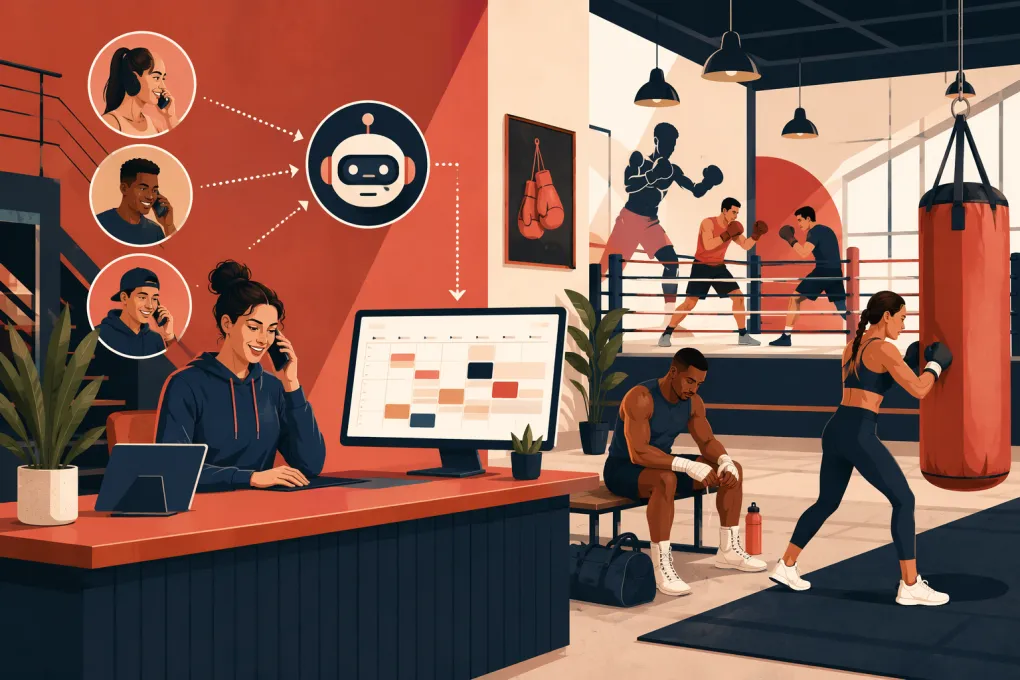 Watch · 20s
A boxing lead often starts with a basic question: Do you have beginner classes? What should I bring? Can my teenager train? The problem is not answering the question. It is answering quickly, qualifying the prospect, booking the right first visit, and following up if they disappear.
That work usually lands on an owner, coach, or front-desk employee who is already checking in members, wrapping hands, cleaning equipment, and running classes. Calls go to voicemail during training. Instagram messages sit unanswered. Web leads get a reply the next morning, after the prospect has contacted another gym.
An AI receptionist for boxing gyms closes those operational gaps. It can respond around the clock, handle routine questions, book approved services, follow up with prospects, and route sensitive issues to a person. The goal is not to replace your coaches. It is to stop using coaching time for repetitive reception work.
See how Fitty handles boxing gym inquiries and bookings 24/7 →
Where boxing gyms lose leads and staff time
Boxing gyms have a different customer journey from standard open-access fitness clubs. A new prospect may not know the difference between a fundamentals class, conditioning session, open gym, and sparring. They may worry that they are too old, too inexperienced, or not fit enough to start.
That creates several recurring front-desk problems:
- Slow first response: Coaches cannot answer calls or texts while holding pads or supervising the floor.
- Incomplete qualification: Staff may book someone into a class that is inappropriate for their age or experience.
- Inconsistent explanations: Different employees give different answers about trials, gear, waivers, cancellations, or sparring requirements.
- Weak follow-up: Prospects who ask a question but do not book are rarely contacted consistently.
- Routine interruptions: Members call about schedules, freezes, payments, and account access while staff are handling live gym operations.
These are workflow problems. Hiring another person may help, but it still leaves nights, early mornings, busy class blocks, and staff absences uncovered. An AI receptionist provides a consistent first layer of coverage without asking a coach to keep checking a phone.
What an AI receptionist should do for a boxing gym
A useful AI receptionist does more than display a chatbot and collect an email address. It should move the conversation toward a clear next step while following your gym’s rules.
Answer boxing-specific questions
The receptionist should learn from an approved knowledge base covering topics such as:
- Beginner and fundamentals classes
- Youth age ranges and guardian requirements
- Class schedules and location details
- Trial sessions or intro appointments
- Required gear and what the gym provides
- Waivers and arrival instructions
- Membership options and billing policies
- Parking, entrances, and facility access
- Private training availability
- Prerequisites for advanced classes or sparring
Good answers should be direct. If a beginner asks whether they need gloves, the AI should explain exactly what your gym requires for the first visit rather than returning a generic description of boxing equipment.
Qualify and book the right first visit
A first-time visitor should not be placed into any available class. The AI can ask a short set of questions before offering eligible times:
- Is the training for an adult or a minor?
- Has the person trained in boxing before?
- Are they interested in fitness, technical development, competition, or private coaching?
- Which location and general time range work best?
- Does the selected session require coach approval?
The answers can determine whether the prospect receives a beginner class, gym tour, assessment, private session, or staff callback. Booking rules should come from the business, not from the AI improvising.
Follow up without relying on staff memory
Many prospects do not book during the first conversation. Others book and then miss the visit. An AI receptionist can run defined follow-up sequences for situations such as:
- A lead asked about classes but did not schedule
- A trial was booked but not confirmed
- A prospect missed an intro session
- A visitor attended but did not choose a membership
- A former member asked about returning
Each message should have one useful next step: answer a question, select another time, speak with staff, or complete enrollment. Repeated generic messages create noise. Timely, context-aware follow-up creates a path back into the conversation.
Handle routine member requests
Existing members also consume front-desk capacity. An AI receptionist can answer approved questions about schedules, closures, account access, payment methods, and policy basics. Fitty can also support dues collection workflows, helping the gym follow up on routine payment issues instead of leaving every reminder to staff.
Billing disputes, unusual account changes, and hardship conversations should go to an authorized employee. Automation should simplify administration without making sensitive decisions on the gym’s behalf.
See how Fitty follows up with leads and supports dues collection →
What should not be fully automated
Boxing involves safety, judgment, and coach oversight. The receptionist needs clear boundaries.
Do not allow an AI system to independently:
- Clear an athlete to spar or compete
- Assess an injury or provide medical advice
- Override age, waiver, or guardian requirements
- Promise acceptance into a fight team
- Resolve serious complaints or disciplinary matters
- Make exceptions to contracts or refund policies
- Guess when information is missing
Build escalation triggers for mentions of injuries, head impacts, legal threats, harassment, emergencies, refund disputes, or requests to speak with an owner. The system should acknowledge the message, avoid making unsupported claims, collect essential context, and route it to the right person.
The same principle applies to emergencies: the AI should follow your approved emergency language and direct people to appropriate emergency services when required. It is a receptionist, not a coach, clinician, or emergency dispatcher.
How to set up an AI receptionist for your gym
The quality of the result depends on the operating rules behind it. Start with a narrow, well-documented deployment rather than trying to automate every conversation at once.
1. Audit real inquiries
Review recent calls, texts, emails, website forms, and social messages. Group them into categories such as beginner questions, youth programs, pricing, private training, schedules, billing, and cancellations.
Use the wording customers actually use. Someone may ask whether the gym is suitable for complete beginners rather than asking for a fundamentals class. Your receptionist needs to understand both.
2. Build one source of truth
Create an approved document containing current schedules, policies, offers, booking rules, and escalation contacts. Assign an owner for every section. When the schedule or trial offer changes, that person updates the source rather than relying on staff to correct the AI one conversation at a time.
Avoid vague policies. Specify details such as how early first-time visitors should arrive, which classes accept drop-ins, and whether loaner gloves are available.
3. Define booking eligibility
Map each lead type to an allowed next step. For example:
- Adult with no experience: beginner class or intro session
- Youth prospect: age-appropriate program after guardian details are collected
- Experienced boxer seeking sparring: coach review rather than automatic booking
- Competition inquiry: staff callback
- Private coaching request: approved trainer availability or consultation
This protects the training environment and reduces rescheduling.
4. Write the handoff rules
Decide who receives each escalation and how quickly staff should respond. Sales questions might go to a membership manager, while injury-related messages go to an owner or designated coach. Include a fallback contact so conversations do not stall when one employee is unavailable.
5. Connect calendars and customer records
The receptionist should work from live availability and record conversations against the correct lead or member. Otherwise, staff end up reconciling duplicate bookings, disconnected text threads, and incomplete notes.
Test cancellations, rescheduling, full classes, waitlists, and multi-location searches before launch. Edge cases reveal more than a perfect booking test.
6. Review conversations every week
Look for unanswered questions, incorrect routing, abandoned bookings, and phrases prospects repeatedly use. Update the knowledge base and workflows accordingly.
AI reception is not a set-and-forget project. It is an operating process that improves when someone owns quality control.
How to evaluate an AI receptionist
Before choosing a system, test it against actual boxing gym scenarios. Ask vendors to demonstrate the complete workflow rather than only showing a polished sample chat.
Evaluate whether the system can:
- Respond across the channels your prospects use
- Maintain context through follow-up conversations
- Apply class, age, location, and experience rules
- Book from live availability
- Escalate sensitive conversations with a transcript
- Distinguish prospects from current members
- Respect messaging consent and opt-out requests
- Support multiple locations without mixing schedules or policies
- Show staff what was asked, answered, and booked
- Update its knowledge without a technical rebuild
Also clarify implementation ownership. Determine who imports business information, configures workflows, tests booking rules, trains staff, and supports changes after launch.
WTF Go combines gym operations with Fitty, its AI receptionist and agent. That matters because lead response, booking, follow-up, and dues workflows are more effective when they are connected rather than spread across unrelated tools.
Explore WTF Go and put Fitty to work on your front desk →
Measure operational outcomes, not chatbot activity
A high conversation count does not prove the system is useful. Track whether it advances the customer journey and reduces avoidable staff work.
Useful measures include:
- Time from inquiry to first response
- Leads that book an intro or eligible class
- Booked prospects who attend
- Missed visits that reschedule
- Conversations successfully resolved without staff
- Conversations escalated for the correct reason
- Booking errors or policy corrections
- Overdue accounts that re-engage with payment outreach
Review results by location, channel, and inquiry type. If prospects are responding but not booking, inspect the offer, qualification questions, and available times. If staff are receiving too many handoffs, improve the knowledge base before loosening escalation rules.
The practical bottom line
An AI receptionist for boxing gyms should create disciplined coverage around the work your team already does. It answers immediately, explains the gym clearly, directs beginners to the right starting point, follows up consistently, and keeps routine administration away from the training floor.
The best implementation is not the one that automates every interaction. It is the one that knows what to handle, what to book, and when to bring in a human.
Frequently asked questions
Can an AI receptionist book boxing classes automatically?
Yes, if it is connected to live availability and configured with your age, experience, location, capacity, and coach-approval rules. Advanced sessions and sparring should generally require human approval.
Will an AI receptionist replace boxing gym staff?
It is better used as a coverage and workflow layer. It handles repetitive inquiries, booking, follow-up, and routine requests while staff focus on coaching, sales conversations, and sensitive member issues.
Can it answer calls and messages after hours?
An AI receptionist can provide around-the-clock responses on the channels supported by the chosen platform. Confirm channel coverage, handoff behavior, and what happens when a prospect requests a person.
What information is needed to set up an AI receptionist?
Prepare your schedules, programs, age limits, experience requirements, pricing policies, trial process, gear guidance, booking rules, and escalation contacts. Clear source information produces safer, more useful answers.
Is an AI receptionist suitable for multi-location boxing gyms?
Yes, provided it can separate each location's schedule, programs, policies, staff, and booking availability. Test location switching carefully so prospects are not sent to the wrong gym.
Keep reading

Run your gym on autopilot with WTF Go
Fitty — your AI receptionist — answers calls and DMs, fills classes, follows up with every lead, and collects dues while you coach.