AI & Automation
AI Receptionist for Biohacking Centers: A Practical Guide
Learn how an AI receptionist for biohacking centers can capture leads, explain services, book sessions, follow up, and collect dues around the clock.
 Watch · 20s
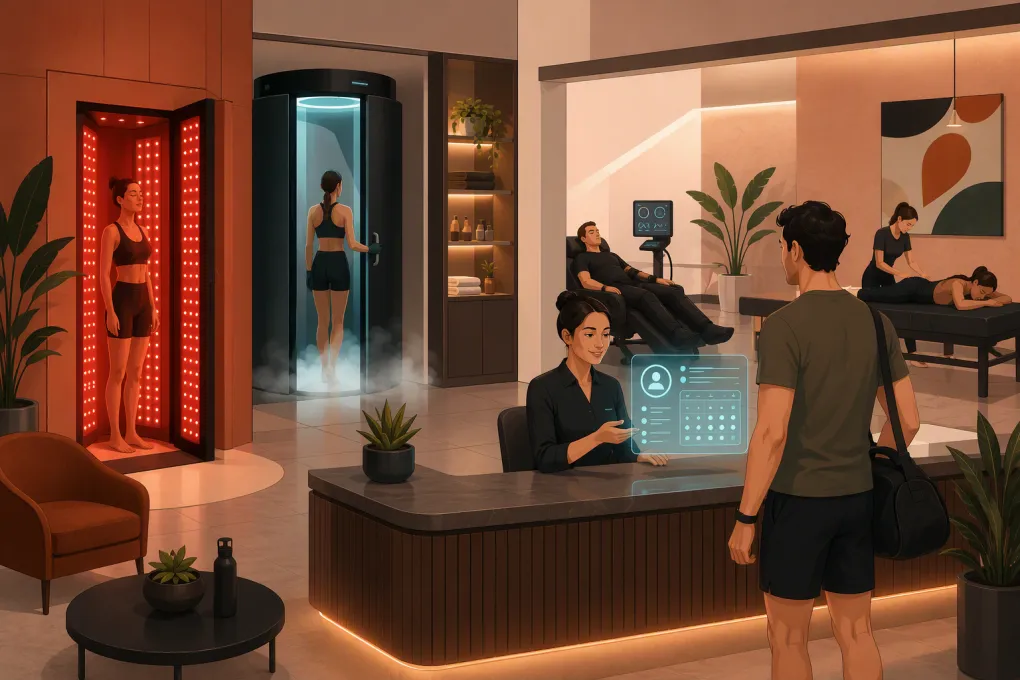
Biohacking centers have a reception problem that ordinary appointment reminders do not solve. Prospects want to know which service to try, whether a session fits their goals, what preparation is required, and how soon they can get in. Members need to book, reschedule, check package balances, or resolve payment issues. Many of those questions arrive while the front desk is helping someone else—or after the building has closed.
An AI receptionist can take the first operational layer off your team without pretending to be a clinician. Used correctly, it answers routine questions, captures leads, books eligible services, follows up with prospects, and escalates sensitive conversations to a qualified person.
The important phrase is used correctly. Biohacking services can involve health conditions, contraindications, waivers, and medical claims. Your AI needs defined boundaries, not just a large library of answers.
See how Fitty handles after-hours biohacking inquiries and follow-up →
What an AI receptionist should handle
A useful AI receptionist is connected to actual operating workflows. It should not be a website chatbot that collects an email address and leaves your staff another inbox to monitor.
For most biohacking centers, the job includes five areas.
Lead capture and qualification
A prospect asking about red light therapy is more valuable when the system also captures:
- Name and preferred contact method
- Location, if you operate multiple centers
- Service of interest
- General goal, stated in the prospect’s own words
- Preferred day or time
- Whether the person is a first-time or returning visitor
- Whether staff follow-up is required
Keep qualification operational. Asking which service interests someone is appropriate. Diagnosing why the person is tired or recommending treatment for a medical condition is not.
The system should create a usable contact record, apply the right service or location tags, and initiate the next step. Otherwise, your staff still has to copy information between tools.
Service explanations
Prospects often do not understand the difference between modalities. Your receptionist should be able to explain:
- What happens during a session
- Typical session length
- What clothing or preparation may be required
- Whether the service is private, shared, or staff-assisted
- Your published pricing, packages, and membership rules
- What forms or waivers must be completed
- Which questions require staff or clinical review
Descriptions should reflect your approved language. Avoid unsupported outcome guarantees and phrases that turn a wellness service into a promise to diagnose, treat, or cure a condition.
Booking and schedule management
Biohacking schedules can become complicated quickly. A single location may have private rooms, equipment with limited capacity, shared recovery areas, and services that require staff supervision.
Your AI receptionist needs rules for:
- Eligible appointment or class types
- Resource and room availability
- Setup or cleaning buffers
- New-client orientation requirements
- Membership or package eligibility
- Cancellation and rescheduling windows
- Location-specific hours
- Services that require manual approval
A fast response is not useful if it creates a double booking or puts a first-time client into a service without the required intake process.
Follow-up that moves the conversation forward
Many leads are not ready to book during the first exchange. Good follow-up should reference what they asked about and offer a clear next action.
For example, a prospect who asked about contrast therapy should receive a relevant booking option or an invitation to speak with staff—not a generic message promoting every service in the building.
Useful follow-up triggers include:
- An inquiry that did not become a booking
- An abandoned booking conversation
- A requested callback
- A missed introductory session
- An expiring package or membership, where permitted by your policies
- A failed or overdue payment that needs resolution
Set stopping rules. Automation should pause when someone replies, opts out, books, disputes a charge, or asks a question that requires human judgment.
Dues and payment resolution
An AI receptionist can also help members understand what is due and direct them through an approved payment workflow. It should never request full card details in an ordinary chat.
Use secure payment links or the payment process built into your management platform. Route disputes, refund requests, duplicate-charge concerns, and financial hardship conversations to staff.
See how WTF Go connects lead response, booking, follow-up, and dues collection →
Build the conversation around intent
Do not force every visitor through the same script. Start by identifying intent, then collect only the information needed for that path.
New prospect
A practical flow looks like this:
- Identify the service, goal, or question.
- Confirm the appropriate location.
- Provide an approved explanation of the relevant options.
- Ask whether the person wants to book or speak with staff.
- Collect contact details with consent.
- Book an eligible session or create a clear staff task.
- Send preparation instructions and required forms.
Existing member
First verify the member using your approved process. Then determine whether the request concerns scheduling, account access, package usage, dues, or a policy question.
Do not expose account details based solely on a name. Decide which changes the AI may complete and which require staff review.
Health or safety question
The AI should recognize phrases involving pregnancy, implants, recent procedures, medications, injuries, fainting, cardiovascular concerns, or other contraindication-related topics relevant to your services.
It should not improvise an answer. A safer flow is to acknowledge the question, avoid medical guidance, provide your approved screening direction, and route the conversation to the appropriate staff member or clinician. Emergency language should trigger clear instructions to contact emergency services rather than wait for your business to respond.
Put firm guardrails around the AI
An AI receptionist represents your business every time it responds. Before launch, document what it can say, what it cannot say, and where it must escalate.
Your operating rules should cover:
- Medical boundaries: No diagnosis, treatment recommendations, or personalized safety clearance.
- Approved claims: Use only service descriptions and benefits your business has reviewed.
- Privacy: Collect the minimum necessary information and control who can access it.
- Consent: Honor channel-specific communication consent and opt-out requests.
- Payments: Use secure payment workflows; do not collect sensitive card information in free-form messages.
- Pricing: Pull from a maintained source rather than guessing at packages or promotions.
- Escalation: Create an owner, role, and response process for each escalated conversation.
- Transparency: Do not mislead customers into believing the AI is a human or licensed provider.
If your center provides services through licensed medical professionals or handles protected health information, involve your legal, compliance, and clinical teams. Do not assume that calling a tool an AI receptionist makes every workflow appropriate for sensitive health information.
How to evaluate an AI receptionist
A polished demonstration can hide weak operations. Test the system with real scenarios your front desk encounters.
Ask each vendor to show how the system handles:
- A first-time visitor comparing two services
- A request outside business hours
- A fully booked time slot
- A multi-location booking request
- A contraindication or medical question
- A member disputing a payment
- A prospect who stops responding
- A cancellation inside your policy window
- An outdated price in the knowledge base
- A request to stop receiving messages
Also evaluate the administrative side. Your team should be able to update hours, pricing, policies, service descriptions, and escalation contacts without rebuilding every conversation.
Key questions include:
- Does it connect to the same customer and booking records your staff uses?
- Can it distinguish leads from existing members?
- Does it respect availability, resource, and location rules?
- Can staff see the full conversation history?
- Can a person take over without making the customer repeat everything?
- Are follow-up rules configurable?
- How are permissions, data retention, and account access handled?
- What happens when an integration or payment workflow fails?
Roll it out without creating front-desk chaos
Start with a controlled set of high-volume, low-risk conversations. Hours, directions, published pricing, basic service explanations, lead capture, and straightforward bookings are sensible starting points.
Then follow a phased process:
1. Audit actual inquiries
Review recent calls, messages, contact forms, and front-desk questions. Group them by intent and identify the answers staff gives repeatedly.
2. Create one approved source of truth
Document service descriptions, preparation instructions, pricing, memberships, cancellation terms, age requirements, waivers, operating hours, and escalation rules. Assign someone to keep this information current.
3. Configure booking rules
Map each service to the correct location, resource, duration, buffer, eligibility rule, and intake requirement. Test edge cases rather than only the perfect booking path.
4. Run parallel review
Have staff review conversations before allowing the system to operate broadly. Look for incorrect claims, dead ends, unnecessary questions, and cases that should have escalated sooner.
5. Measure operational outcomes
Track outcomes that reveal whether the system is helping:
- Inquiry-to-booking movement
- Unanswered or abandoned conversations
- Time to first response
- Escalation volume and reason
- Booking errors
- Opt-outs and complaints
- Overdue accounts resolved through approved workflows
Do not optimize only for automation rate. A high automation rate is harmful if customers receive unsafe answers or incorrect bookings.
Where Fitty fits for biohacking operators
Fitty is the AI receptionist inside WTF Go, an operating system built for gyms, studios, spas, and wellness businesses. It can answer leads, book eligible classes or sessions based on your setup, follow up, and help collect dues around the clock.
That matters because lead response should not live apart from scheduling and account workflows. When the receptionist works within the operating system, your team has a clearer path from first question to booking, follow-up, and payment resolution.
Your staff still owns service policy, safety escalation, clinical boundaries, and customer relationships. Fitty handles the repetitive operational layer so the front desk can focus on the people physically in the center and the conversations that require judgment.
Explore Fitty for your biohacking center and map your reception workflow →
Frequently asked questions
Can an AI receptionist recommend biohacking treatments?
It can explain approved services and help customers compare operational details, but it should not diagnose conditions, prescribe treatments, or provide personalized medical clearance.
Can an AI receptionist book cryotherapy or red light therapy sessions?
Yes, if the system is configured with the correct service, resource, location, eligibility, intake, and scheduling rules. Services requiring clinical approval or special screening should be escalated.
How should an AI handle contraindication questions?
It should avoid improvising medical advice, provide your approved screening guidance, and route the customer to qualified staff or a clinician when appropriate.
Will an AI receptionist replace front-desk staff?
It is better used to cover repetitive inquiries, routine booking, follow-up, and payment workflows. Staff remain essential for sensitive questions, exceptions, safety decisions, and in-person service.
What should a biohacking center automate first?
Start with hours, directions, approved service explanations, lead capture, simple bookings, and routine follow-up. Add sensitive account or health-related workflows only after establishing clear guardrails.
Keep reading

Run your gym on autopilot with WTF Go
Fitty — your AI receptionist — answers calls and DMs, fills classes, follows up with every lead, and collects dues while you coach.