AI & Automation
AI Receptionist for Aerial Arts Studios: A Practical Guide
See how an AI receptionist for aerial arts studios can answer leads, book intro classes, manage follow-up, and protect instructor time around the clock.
 Watch · 20s
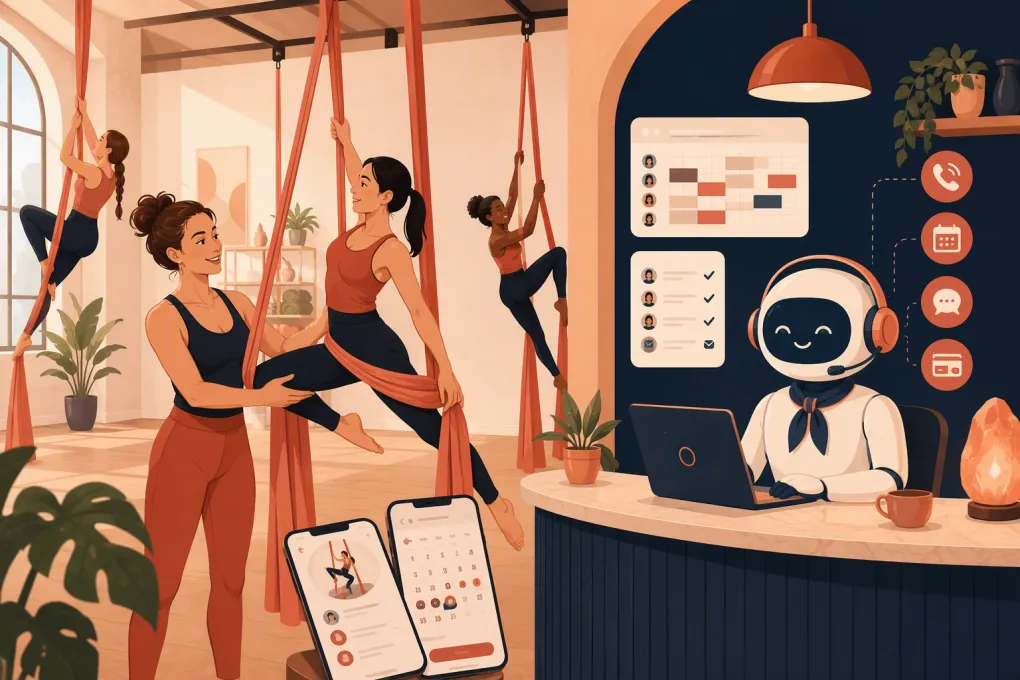
Aerial studios do not lose leads because instructors lack sales ability. They lose them because instructors are spotting students, rigging equipment, checking waivers, or teaching when the phone rings. An AI receptionist for aerial arts studios closes that coverage gap by answering routine questions, guiding prospects toward the right entry point, booking eligible classes, and following up when no employee is available.
The technology is useful, but it must be configured around how aerial businesses actually operate. A generic chatbot that treats every class as interchangeable can create safety issues, book students into the wrong level, and generate more front-desk work instead of less.
The goal is not to remove people from the studio experience. It is to let instructors teach while routine reception work continues in the background.
See how Fitty can handle after-hours aerial studio inquiries →
Why aerial studios need a different reception workflow
Aerial arts businesses have more booking complexity than a conventional open-gym model. A receptionist may need to account for:
- Apparatus, including silks, lyra, hammock, trapeze, straps, or rope
- Adult and youth programming
- True beginner classes versus classes with prerequisites
- Intro series, drop-ins, private lessons, and parties
- Capacity limits tied to equipment and instructor coverage
- Waivers, arrival instructions, and clothing requirements
- Studio-specific rules for late arrivals and missed classes
- Questions involving injuries, pregnancy, accessibility, or physical readiness
These details matter. Someone asking whether they can try aerial silks for the first time should not receive the same booking path as an experienced student looking for an intermediate lyra class.
A properly configured AI receptionist uses the studio’s approved rules to narrow the options. It does not invent a recommendation or make a medical judgment.
What an AI receptionist should handle
The best starting point is repetitive, high-volume work with clear answers and defined escalation rules.
New lead response
A prospect may discover the studio after seeing a performance, receiving a referral, or searching for an unusual fitness activity. Their first questions are often basic:
- Do I need upper-body strength?
- Which class is appropriate for a beginner?
- Is there an age requirement?
- What should I wear?
- Can I attend if I have never done aerial before?
- Do you offer private lessons or parties?
An AI receptionist can respond using studio-approved information and move the conversation toward a booking. This is more useful than sending every prospect to a long FAQ page and hoping they find the right answer.
Class and introductory-session booking
Once eligibility is clear, the agent should display only appropriate options. A simple beginner inquiry flow might be:
- Determine whether the booking is for an adult or a minor.
- Ask whether the student has prior aerial experience.
- Identify the preferred apparatus or offer the studio’s standard introduction.
- Show eligible dates, locations, and available spaces.
- Explain the waiver, clothing, and arrival requirements.
- Complete the booking or send the studio’s approved payment link.
The schedule must remain the source of truth. The agent should never promise space based on an old spreadsheet, cached page, or manually copied timetable.
Lead follow-up
Many prospects ask a question without booking immediately. They may need to coordinate childcare, compare class times, or talk to a parent. Those leads should not disappear into an inbox.
An AI receptionist can continue the approved follow-up sequence, answer additional questions, and return the prospect to the correct booking page. Follow-up should stop when the person books, declines, asks to stop, or needs a human response.
Studios should also respect communication consent and opt-out requests. Automation does not remove the operator’s responsibility to use lawful, clearly identified messaging practices.
Payment and dues reminders
Aerial studios often combine recurring memberships with class packs, series, workshops, or private training. Failed or overdue payments create awkward administrative work.
An AI agent can send a neutral reminder, explain how to update the account, and provide a secure payment path. It should not request full card information through an ordinary message or improvise policies around refunds, chargebacks, or financial hardship.
Explore how Fitty follows up with leads and helps collect dues →
Where the AI should hand off to a person
Automation needs boundaries, especially in a movement practice involving height, equipment, and physical risk.
Create mandatory human handoffs for:
- Injury reports or requests for medical guidance
- Questions about participating while pregnant or recovering from surgery
- Accessibility needs that require instructor review
- Placement into classes with skill prerequisites
- Rigging, equipment, or safety-policy disputes
- Refund exceptions and sensitive billing complaints
- Behavioral concerns involving youth students
- Private event requests with unusual staffing or facility needs
- Any question not covered by an approved studio answer
The AI can collect relevant details, but it should not decide whether a person is physically safe to participate. That decision belongs to the student, their medical professional when appropriate, and qualified studio staff applying established policies.
A good handoff includes context. Instead of telling an employee that “someone has a question,” the system should provide the prospect’s name, contact information, requested class, concern, and conversation history.
How to prepare your studio before switching it on
AI reception works best when the studio’s policies are already clear. If instructors give different answers to the same question, automation will expose the inconsistency.
Build an approved knowledge base
Document the information a capable front-desk employee would need:
- Class descriptions and prerequisites
- Age ranges and guardian requirements
- Introductory offers and eligibility rules
- Clothing, jewelry, and arrival guidance
- Cancellation, transfer, and late-arrival policies
- Waiver requirements
- Membership and class-pack rules
- Private lesson and party inquiry procedures
- Parking, entrance, and accessibility information
- Holiday closures and schedule changes
Use plain language. If a prospect would not understand “level one inversion pathway,” rewrite it in terms a first-time student can follow.
Clean up class names
Internal shorthand creates poor customer conversations. Names such as “Mixed Aerial 2/3” may make sense to instructors but leave prospects unsure whether they qualify.
Each public class should have:
- A recognizable name
- A short description
- Explicit prerequisites
- Appropriate age range
- Apparatus used
- Required prior skills, if any
- Instructions for students who are uncertain about placement
Define booking permissions
Not every offering should be instantly bookable. Decide whether the agent may:
- Book beginner classes directly
- Sell or reserve introductory series
- Schedule private-lesson consultations
- Add students to waitlists
- Move existing reservations
- Cancel within the standard policy
- Route advanced placement requests to an instructor
Start with low-risk, clearly defined transactions. Expand only after reviewing real conversations.
Create a clear escalation map
Assign each exception to an actual role. Billing questions might go to an owner, youth-program concerns to a program director, and placement questions to a senior coach.
Also define operating expectations. If the AI says a person will respond, the team needs a process for reviewing and closing that handoff.
A practical conversation design for first-time students
The reception flow should reduce anxiety without making promises the studio cannot keep. A useful opening might be:
“You do not need previous aerial experience for our beginner options. Are you looking for an adult class, a youth class, or a private session?”
The next response should depend on the answer. For an adult beginner, the agent can explain the studio’s designated entry class and show availability. For a child, it should collect the student’s age and apply the studio’s guardian and youth-program rules.
Avoid broad claims such as “aerial is safe for everyone” or “any fitness level can participate.” Even if intended as encouragement, those statements ignore individual circumstances. Use accurate language based on the studio’s program design.
How to measure whether it is working
Do not judge the system by how many messages it sends. Judge it by whether it produces clean operational outcomes.
Track:
- Median time to first response
- Inquiry-to-booking conversion by lead source
- Intro bookings that attend
- Conversations requiring human intervention
- Incorrect booking or placement incidents
- Unanswered questions added to the knowledge base
- Overdue accounts resolved after reminders
- Staff time spent reviewing routine inquiries
Read conversation transcripts regularly, particularly during the first several weeks and whenever schedules, policies, or introductory offers change. Look for unclear wording, repeated handoffs, and questions the knowledge base does not answer.
What AI reception does not replace
An AI receptionist does not replace instructor judgment, safety briefings, relationship-building, or the nuanced conversations that keep members engaged. It also cannot repair a confusing schedule or inconsistent cancellation policy.
What it can replace is the avoidable delay between a prospect asking a routine question and receiving a useful answer. It can also reduce the manual chasing associated with missed calls, incomplete bookings, and overdue accounts.
Fitty, the AI receptionist inside WTF Go, is built to answer leads, book classes, follow up, and collect dues while your team is teaching. The most effective setup combines those capabilities with your studio’s actual class rules and clear human escalation paths.
See how WTF Go can automate reception around your aerial class schedule →
The bottom line
For an aerial arts studio, the value of AI reception is not novelty. It is dependable coverage during the exact hours when instructors cannot stop to answer a phone or work an inbox.
Start with beginner inquiries, approved class booking, basic follow-up, and payment reminders. Keep placement, health, safety, and sensitive exceptions with qualified staff. With those boundaries in place, an AI receptionist can help the studio respond faster without weakening the personal, safety-conscious experience students expect.
Frequently asked questions
Can an AI receptionist book students into aerial classes?
Yes, when it is connected to current availability and given clear rules for age, experience, prerequisites, and class eligibility. Advanced placement and unusual circumstances should be sent to an instructor.
Can AI answer aerial safety or injury questions?
It can share approved studio policies and general preparation instructions, but it should not provide medical advice or determine whether someone is safe to participate. Those questions require a human handoff.
Will an AI receptionist work for youth aerial programs?
Yes, if the workflow accounts for age ranges, guardian information, waivers, communication permissions, and program-specific booking rules.
What information should an aerial studio provide during setup?
Prepare class descriptions, prerequisites, age rules, schedules, waiver requirements, clothing guidance, billing policies, cancellation rules, location details, and escalation contacts.
Does an AI receptionist replace aerial studio staff?
No. It handles repeatable reception tasks so staff can focus on instruction, safety, member relationships, and situations requiring judgment.
Keep reading

Run your gym on autopilot with WTF Go
Fitty — your AI receptionist — answers calls and DMs, fills classes, follows up with every lead, and collects dues while you coach.