AI & Automation
AI Receptionist for Acupuncture Clinics: Practical Guide
Learn how an AI receptionist for acupuncture clinics can answer calls, book patients, follow up, collect payments, and protect the patient experience.
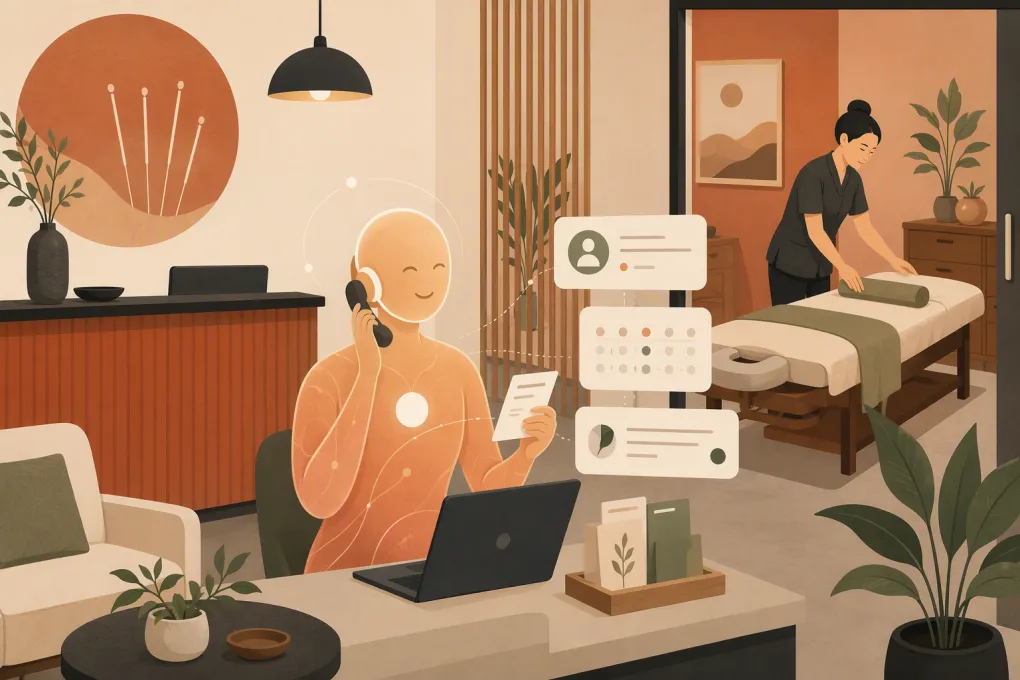 Watch · 20s
A missed call at an acupuncture clinic is rarely just a missed call. It may be a prospective patient comparing providers, an existing patient trying to reschedule, or someone unsure whether acupuncture is appropriate for their concern. If the call reaches voicemail, the person may contact the next clinic before your staff can respond.
An AI receptionist gives clinics another way to manage that demand. It can answer routine questions, capture patient information, apply scheduling rules, send follow-ups, and route sensitive issues to a person. The goal is not to make care feel automated. It is to remove administrative delays without letting software wander into clinical decisions.
That distinction matters. A useful AI receptionist operates within a carefully defined front-desk role. It should know what it can answer, what it must never answer, and when a patient needs a human.
See how Fitty handles inquiries and follow-up around the clock →
What an AI receptionist should handle
Start with high-volume, low-risk interactions. These are tasks that already follow repeatable front-desk procedures.
New-patient inquiries
An AI receptionist can explain operational details such as:
- Clinic location, parking, accessibility, and business hours
- Whether new patients are being accepted
- Appointment types and typical visit structure
- Published pricing and payment policies
- What patients should bring to an initial visit
- Cancellation and late-arrival policies
- How to request an appointment
It can also capture the caller’s name, contact details, preferred times, and general reason for contacting the clinic. Avoid asking for a detailed health history during an initial lead conversation unless the system, consent process, and data handling are designed for it.
Appointment booking and changes
Booking is where a receptionist becomes operationally valuable. The system should do more than place any caller into any open slot. It needs rules that reflect how the clinic actually runs.
Those rules may include:
- Different durations for initial and returning visits
- Practitioner-specific services and availability
- Buffers between treatment types
- Rooms or equipment required for certain appointments
- Limits on same-day or online booking
- Scheduling restrictions for insurance-based visits
- Whether consultations must precede treatment
- When a cancellation requires staff approval
The AI should repeat the selected practitioner, service, date, time, location, and relevant policy before confirming. It should then send a written confirmation through an approved channel.
Follow-up and reactivation
Many clinics respond quickly to new inquiries but lose track of people who do not book immediately. An AI agent can run a defined follow-up sequence without requiring the front desk to maintain a manual callback list.
Useful workflows include:
- Following up after an unanswered inquiry
- Reminding someone to complete intake forms
- Confirming or reminding patients about appointments
- Contacting patients who requested a later callback
- Inviting inactive patients to schedule, when appropriate and permitted
- Sending a payment link for an outstanding balance
Every message should identify the clinic, give the recipient a clear next step, and respect applicable consent and opt-out requirements.
Explore how WTF Go connects lead response, follow-up, scheduling workflows, and collections →
Build the conversation around patient intent
A rigid phone tree forces patients to translate their needs into menu options. A conversational AI receptionist can identify intent from ordinary language, but it still needs a controlled workflow behind the conversation.
A practical top-level call map might include:
- New patient seeking information
- New patient ready to schedule
- Existing patient changing an appointment
- Billing or insurance question
- Clinical question for a practitioner
- Vendor, employment, or unrelated call
- Urgent or emergency language
Each route needs a defined action and an escalation point. For example, the AI may answer a question about the clinic’s published fees but transfer a disputed charge to staff. It may explain that the clinic offers acupuncture for certain categories of care, but it should not tell a caller that treatment will resolve a specific condition.
Use scripts that preserve scope
A safe answer to a clinical suitability question might be:
Our practitioners can discuss whether their services may be appropriate for your needs. I can help you request an initial appointment or send your question to the clinic.
That response is useful without diagnosing, promising an outcome, or improvising medical advice.
For insurance questions, separate general policy from patient-specific verification. The AI can state whether the clinic generally works with certain plans if that information is current. It should not guarantee coverage or reimbursement. A better workflow is to collect the necessary information securely and assign verification to the appropriate person or process.
Protect privacy and clinical boundaries
An acupuncture clinic may handle protected health information even when the first interaction looks like a basic scheduling call. Privacy and security therefore need to be part of vendor selection and setup, not an afterthought.
If your clinic is a HIPAA covered entity or business associate, determine whether the AI provider will create, receive, maintain, or transmit protected health information. When required, obtain an appropriate business associate agreement. Review any connected scheduling, messaging, transcription, payment, and call-recording services as well; the receptionist is only one part of the data path.
Ask practical questions before launch:
- What information is collected and where is it stored?
- Is conversation data used to train external models?
- Who can access recordings, transcripts, and summaries?
- Can retention periods be configured?
- How is data removed when it is no longer needed?
- Are staff permissions role-based?
- Is there an audit trail for bookings and record changes?
- How are callers notified about recording where notification is required?
Payment collection also requires care. Use a payment workflow designed to keep card details out of general chat transcripts and staff notes. Confirm how the vendor supports applicable payment-card security obligations.
Create non-negotiable escalation rules
The system should immediately stop normal booking dialogue when it detects emergency or high-risk language. Clinic-approved instructions should direct the caller to appropriate emergency services rather than attempting to assess the situation.
Human escalation should also cover:
- Questions requiring clinical judgment
- Adverse reactions or post-treatment concerns
- Complaints and refund disputes
- Complex insurance issues
- Requests involving records or legal matters
- Repeated failures to understand a caller
- Accessibility or language needs the system cannot support reliably
Give callers an easy way to request a person. Automation should reduce friction, not trap someone in a conversation they cannot exit.
Prepare your clinic before turning it on
An AI receptionist will expose unclear policies quickly. Before implementation, create a single source of truth for hours, practitioners, services, prices, appointment lengths, policies, and escalation contacts.
Then document the booking logic staff currently carry in their heads. Ask questions such as:
- Which services can new patients book directly?
- Can every practitioner see every patient type?
- Which appointments require forms, deposits, or verification?
- What happens when a preferred time is unavailable?
- When should the AI offer a waitlist?
- Which situations require a same-day staff response?
Test realistic conversations rather than ideal ones. Include callers who change their minds, use informal service names, ask several questions at once, have duplicate records, or request an unavailable practitioner. Confirm that cancellations, time zones, daylight saving changes, and multi-location routing behave correctly.
A controlled rollout is safer than handing over every interaction at once. Begin with after-hours calls or new-patient inquiries, review transcripts and outcomes, then expand the scope after correcting gaps.
See how Fitty can support your clinic’s after-hours response and follow-up workflow →
Measure operational results, not conversation volume
The number of calls or messages handled does not tell you whether the system is helping. Track outcomes tied to front-desk performance:
- Inquiries that result in a scheduled appointment
- Time from initial inquiry to first response
- Appointments booked without staff intervention
- Calls transferred or escalated to staff
- Booking errors and manual corrections
- Form-completion and confirmation status
- Cancellations, reschedules, and no-shows
- Outstanding balances resolved through approved workflows
- Opt-outs, complaints, and failed conversations
Review failures by category. A high number of escalations may indicate that the AI needs better source information, but it may also show that the guardrails are working. Do not reduce escalation simply to make automation metrics look better.
What to look for in an AI receptionist
A clinic needs more than a generic chatbot attached to a phone number. Evaluate whether the system can operate inside your existing workflow.
Prioritize:
- Configurable booking and escalation rules
- Accurate access to current clinic information
- Phone, text, and web inquiry handling where needed
- Scheduling and patient-record integration options
- Clear privacy, security, and data-retention terms
- Human handoff with conversation context
- Logs that let staff review what happened
- Support for multiple practitioners or locations
- Follow-up and payment workflows
- A practical process for updating policies and answers
Ask the vendor to demonstrate difficult scenarios, not just a perfect booking. Test an insurance question, a request for medical advice, an appointment that requires a specific room, and a caller who asks for a human. The quality of those edge cases will tell you more than a polished standard demo.
An AI receptionist for acupuncture clinics works best as a disciplined extension of the front desk. Give it reliable information, narrow permissions, explicit safety rules, and measurable responsibilities. Done well, it can make the clinic easier to reach while allowing staff to spend more time on patients already in the building.
Frequently asked questions
Can an AI receptionist book acupuncture appointments?
Yes, if it is connected to an appropriate scheduling workflow and configured with rules for appointment type, duration, practitioner availability, rooms, buffers, and patient eligibility.
Is an AI receptionist for an acupuncture clinic HIPAA compliant?
Compliance depends on the clinic, vendor, contracts, configuration, and complete data flow. If protected health information is involved, determine whether a business associate agreement is required and review every connected service.
Can AI answer patient questions about acupuncture treatment?
It can provide clinic-approved general information, but it should not diagnose, recommend treatment, promise outcomes, or handle concerns requiring clinical judgment. Those questions should be escalated to a qualified practitioner.
Should an AI receptionist replace front-desk staff?
Usually, it is better used to cover routine and after-hours work while staff handle complex, sensitive, and relationship-driven interactions. Clear human handoff remains essential.
Keep reading

Run your gym on autopilot with WTF Go
Fitty — your AI receptionist — answers calls and DMs, fills classes, follows up with every lead, and collects dues while you coach.