AI & Automation
AI Receptionist Call Flow Template for Med Spas That Books
Use this AI receptionist call flow template for med spas to qualify leads, book consultations, handle FAQs, route risks, and build consistent follow-up.
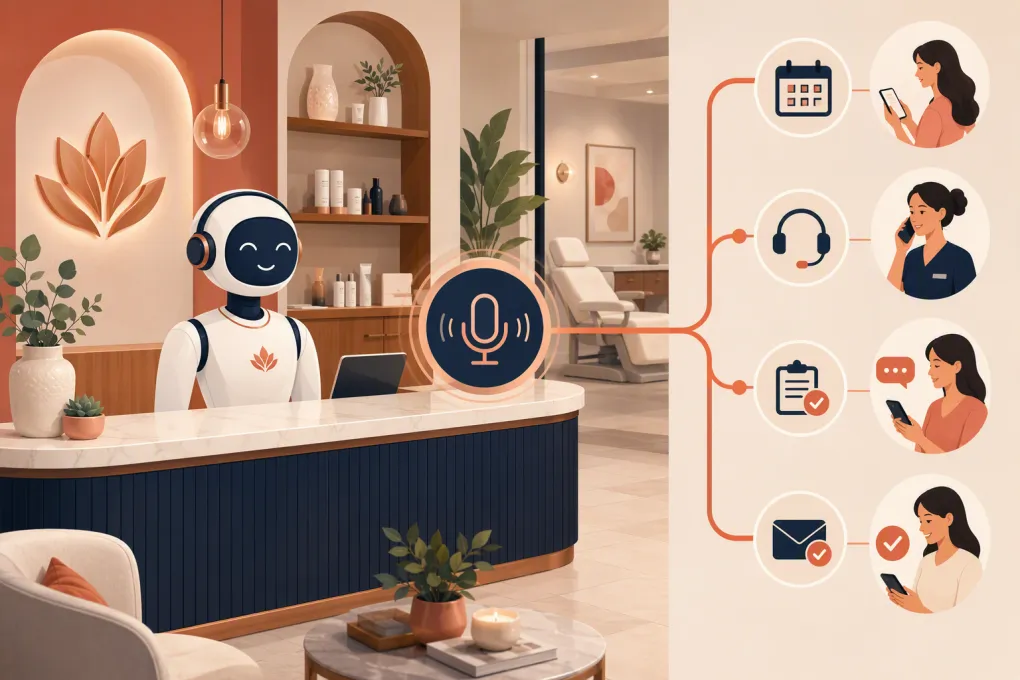 Watch · 20s
A med spa call is rarely just a request for an appointment. The caller may be comparing treatments, asking about candidacy, checking prices, trying to reschedule, or reporting a post-treatment concern. A useful AI receptionist has to identify that intent quickly, complete the administrative work, and know when to stop talking and involve a qualified person.
That makes the call flow more important than the voice itself. A natural-sounding agent with a weak workflow will still lose leads, create scheduling errors, and wander into questions it should not answer.
The template below gives med spa operators a practical starting point for building an AI call flow that books consultations without treating every conversation like a generic sales call.
See how Fitty can answer and route med spa calls around the clock →
What a med spa AI receptionist should accomplish
Your AI receptionist does not need to replace your front desk, providers, or patient care team. Its job is to handle predictable administrative conversations consistently.
A well-designed flow should be able to:
- Identify whether the caller is a new lead or an existing client
- Determine the main reason for the call
- Answer approved nonclinical questions
- Collect the minimum information needed for the next step
- Book an appropriate consultation or appointment
- Explain approved deposit and cancellation policies
- Transfer sensitive, urgent, or complex calls
- Capture leads when no suitable appointment is available
- Send confirmations and follow-up messages with proper consent
- Record the outcome in the client record or CRM
The flow should also protect clear boundaries. An AI receptionist should not diagnose conditions, determine medical eligibility, recommend treatment settings, interpret symptoms, or promise results.
Set the guardrails before writing the script
Do not begin by writing a greeting. Begin by deciding what the agent is and is not authorized to do.
Create an approved knowledge base
Give the AI controlled answers for topics such as:
- Locations, hours, parking, and contact information
- Services offered at each location
- Consultation requirements
- Typical appointment duration ranges, if approved
- Published starting prices or price ranges
- Membership and package basics
- Accepted payment methods
- Deposit, cancellation, and late-arrival policies
- Pre-visit instructions approved by your clinical team
- Current promotions and their restrictions
Do not let the system improvise answers from general internet knowledge. Med spa services and protocols vary by provider, location, and client.
Define mandatory transfer triggers
Create a written list of conversations that must go to a person. Common triggers include:
- Adverse reactions or post-treatment concerns
- Requests for diagnosis or medical advice
- Pregnancy, medication, allergy, or contraindication questions
- Complaints, refund disputes, or threats of legal action
- Requests involving medical records or sensitive account access
- Callers who repeatedly ask for a person
- Emergencies or potentially urgent symptoms
Work with qualified counsel and your clinical leadership on privacy, call recording, AI disclosure, texting consent, and healthcare compliance requirements. Applicable rules can depend on your location, vendors, data handling, and the type of information collected.
The med spa AI receptionist call flow template
Use this structure as the operational blueprint. The exact language should match your brand, policies, and clinical review.
1. Open and identify intent
Keep the opening short. Do not make callers listen to a menu disguised as a conversation.
Thanks for calling [Med Spa Name]. I’m the virtual receptionist. I can help with appointments, service information, and account questions. How can I help today?
The agent should classify the response into one of these primary paths:
- New treatment inquiry
- Book, reschedule, or cancel
- Pricing, membership, or promotion question
- Existing-client account question
- Post-treatment or clinical concern
- Human assistance requested
- Other or unclear intent
If intent is unclear, ask one clarifying question rather than presenting a long list.
Are you looking to schedule a visit, learn about a service, or get help with an existing appointment?
2. Separate new leads from existing clients
This determines what information the agent needs and which records it may access.
Have you visited us before?
For an existing client, verify identity using your approved process before discussing account or appointment details. Avoid reading sensitive information aloud before verification.
For a new lead, collect only what is needed to serve the request. Usually that starts with name, preferred contact method, and service interest—not a full medical intake over the phone.
3. Qualify the request without practicing medicine
The AI can perform administrative qualification. It should not make clinical decisions.
Useful questions include:
- Which service are you interested in?
- Is there a particular area you would like to discuss with a provider?
- Is this your first time considering this service?
- Which location do you prefer?
- What days or times usually work for you?
- Would you like an in-person consultation if one is required?
If someone asks, “Am I a good candidate?” the agent should use a controlled response:
A qualified provider will need to evaluate that with you. I can schedule a consultation so the team can review your goals, history, and options safely.
The same boundary applies to questions about dosage, expected results, side effects, interactions, and treatment selection.
4. Answer approved questions, then return to booking
Many callers ask a few questions before they are ready to schedule. Answer from the approved knowledge base and then offer a concrete next step.
The consultation is [approved description]. Would you like me to check availability at our [location] office?
Avoid vague prompts such as “Is there anything else?” They invite the call to drift. Use directed choices that move the conversation forward.
See how Fitty turns service questions into booked consultations and tracked follow-up →
5. Offer specific appointment options
Once the correct appointment type and location are established, offer a small number of actual openings.
I can offer Tuesday at 3:00 p.m. or Thursday at 11:30 a.m. Which works better?
Before confirming, verify:
- Correct location
- Appointment or consultation type
- Date and time
- Provider, if applicable
- New or existing client status
- Required duration or resource
- Deposit requirement
The AI should only book appointment types it is explicitly authorized to book. Anything requiring clinical screening, unusual timing, or special equipment should enter a staff-review queue.
6. Explain deposits and policies before confirmation
Do not hide important terms at the end of the call. If a deposit, card on file, or cancellation policy applies, disclose it before the caller commits.
This appointment requires [approved deposit or card policy]. The cancellation policy is [approved concise explanation]. Would you like to continue?
The agent should not invent exceptions. Requests to waive a deposit or dispute a policy should go to an authorized employee.
7. Confirm contact details and messaging permission
Confirm spelling and repeat critical details. If the caller wants text reminders or follow-up, collect consent through a process that reflects your legal requirements and messaging platform.
What mobile number should we use for appointment updates? May we send your confirmation and scheduling messages by text?
A booking confirmation should include only appropriate information. Be careful about placing sensitive treatment details in voicemail, SMS, or email where another person could see them.
8. Close with a complete recap
The final recap reduces avoidable errors.
You’re scheduled at [location] on [date] at [time] for [approved appointment description]. You’ll receive a confirmation at [channel]. Please review the preparation and cancellation information included there.
The system should then log the call outcome, booking status, service interest, assigned location, and any promised follow-up.
Build branches for calls that do not book
A call flow should not treat “no appointment booked” as one outcome. Track why the caller stopped.
Use distinct dispositions such as:
- Requested time unavailable
- Not ready to schedule
- Needs provider review
- Asked for pricing only
- Requested human callback
- Deposit objection
- Wrong service or location
- Existing-client issue
- Clinical or post-treatment escalation
- Disconnected before completion
Each disposition needs a next action. For example, a lead who cannot find a suitable time might receive a waitlist option. A caller who needs provider review should generate a prioritized staff task with a concise summary.
After-hours flow
After-hours callers should not hit a dead end. The AI can answer approved questions, book eligible appointment types, or capture a callback request.
For urgent or post-treatment language, use your clinically approved escalation message. If the caller describes a possible emergency, the agent should clearly advise them to contact emergency services rather than waiting for the med spa to reopen.
No-availability flow
Do not merely say that nothing is open.
Offer, where operationally supported:
- Another approved provider
- Another location
- The closest appropriate date
- A waitlist
- A staff callback
This is where connected scheduling matters. The agent needs accurate appointment types, provider rules, room or equipment dependencies, and location-specific availability.
Test the flow before sending every call to it
Run structured test calls using real scenarios your staff hears each week. Include easy calls and edge cases.
Test whether the agent:
- Recognizes service names, abbreviations, and common mispronunciations
- Distinguishes consultations from treatments
- Checks the correct location and time zone
- Avoids double-booking restricted resources
- Stops when a caller asks a clinical question
- Transfers or creates a task when required
- Handles interruptions and corrections
- Repeats names, phone numbers, dates, and times accurately
- Explains policies using approved language
- Records a useful call summary
- Follows the correct path when the caller declines texting
Review failed and abandoned calls regularly. The goal is not to make the script longer. It is to remove ambiguity, strengthen routing, and improve the next action.
Common call-flow mistakes
Asking too many questions before showing availability
A new lead should not have to complete an intake interview to learn whether you have an appointment. Collect the minimum required information, offer availability, and reserve deeper intake for the appropriate secure workflow.
Letting the AI answer beyond the knowledge base
A confident but unauthorized answer is more dangerous than a clean handoff. Give the agent approved content and explicit refusal language.
Treating every service the same
Injectables, facials, body treatments, consultations, follow-ups, and post-treatment concerns may require different booking rules. Build appointment-specific paths.
Failing to create a staff task
A transfer that goes unanswered is not a completed handoff. If a person cannot take the call, create a task containing the caller’s name, contact details, intent, urgency, and relevant summary.
Automating calls without automating follow-up
The call is only one part of the workflow. Your system should connect the conversation to scheduling, reminders, lead status, staff tasks, and approved follow-up so the caller does not have to start over.
Build a med spa call flow with Fitty handling answers, booking, routing, and follow-up →
The practical standard: safe, bookable, and accountable
A med spa AI receptionist should be judged by operational outcomes, not how human it sounds. Can it identify intent? Can it book the right appointment without breaking scheduling rules? Does it stay out of clinical decision-making? Does every unresolved call create a clear next step?
Start with one location or a limited set of appointment types. Review the calls, tighten the knowledge base, and expand only after the handoffs and booking logic work reliably. That creates a receptionist workflow your staff can trust—and one that helps more qualified callers reach the right next step.
Frequently asked questions
Can an AI receptionist answer medical questions for a med spa?
It should answer only approved administrative and service-information questions. Diagnosis, candidacy, symptoms, contraindications, and treatment recommendations should be routed to a qualified provider.
Should a med spa disclose that callers are speaking with AI?
Disclosure, recording, privacy, and consent requirements can vary by jurisdiction and workflow. Use clear language and have qualified counsel review your setup.
What information should an AI receptionist collect from a new med spa lead?
Collect the minimum needed to help: name, contact method, service interest, location preference, and scheduling availability. Keep clinical intake in the appropriate secure, provider-approved workflow.
Can an AI receptionist book med spa treatments directly?
It can book appointment types that your team has explicitly approved and configured. Services requiring clinical screening, special resources, or provider review should be routed to a consultation or staff task.
How should after-hours post-treatment calls be handled?
Use a clinically approved escalation flow that routes concerns to the appropriate on-call or callback process. Potential emergencies should be directed to emergency services rather than left for routine follow-up.
Keep reading
Run your gym on autopilot with WTF Go
Fitty — your AI receptionist — answers calls and DMs, fills classes, follows up with every lead, and collects dues while you coach.