AI & Automation
AI Phone Answering Service for Med Spas: Operator Guide
Learn how an AI phone answering service for med spas captures leads, books consultations, handles FAQs, and protects the patient experience 24/7 with care.
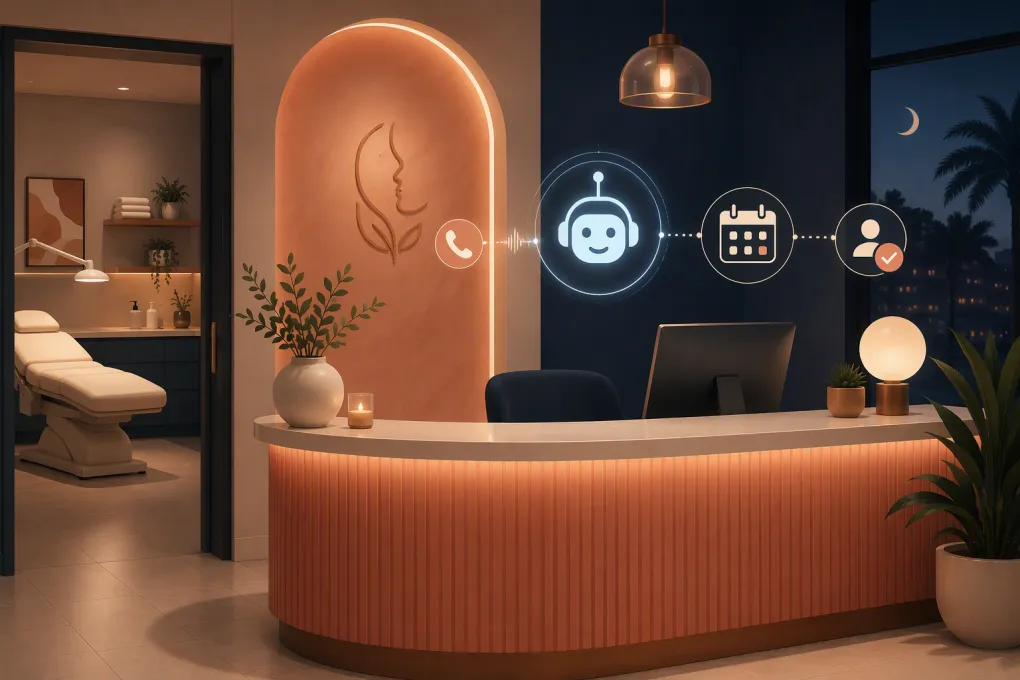 Watch · 20s
A prospective patient calls your med spa at 7:12 p.m. They want to know whether you offer a specific treatment, what the consultation involves, and how soon they can get in. Nobody answers, so they call the next provider on their list.
That is the operational problem an AI phone answering service for med spas is meant to solve. It gives callers an immediate, consistent response without requiring your front desk to remain staffed around the clock.
But answering the phone is only the starting point. The right system should qualify inquiries, schedule appropriate appointments, capture contact details, answer approved nonclinical questions, and trigger follow-up. It must also know when to stop and hand the conversation to a trained person.
See how Fitty can handle after-hours med spa inquiries and booking requests →
What an AI phone answering service actually does
An AI answering service uses conversational software to speak with callers, interpret their requests, and complete configured actions. Unlike a basic phone tree, callers do not have to navigate a rigid menu of numbered options.
For a med spa, useful workflows can include:
- Answering calls during business hours, after hours, or only when staff cannot pick up
- Identifying whether someone is a new lead or an existing patient
- Explaining approved services in nonclinical language
- Sharing location, parking, hours, preparation policies, and accepted payment methods
- Scheduling consultations or other eligible appointment types
- Rescheduling or canceling appointments according to your rules
- Capturing a caller’s name, phone number, email, and service interest
- Sending confirmations and follow-up messages
- Routing urgent, clinical, billing, or complaint-related matters to staff
The important distinction is that an AI receptionist operates from your approved information and workflows. It should not diagnose conditions, recommend treatment, determine candidacy, or improvise medical advice.
Where med spas lose calls and leads
Most med spa phone problems are workflow problems rather than effort problems. Your receptionist may be checking in a patient, collecting payment, supporting a provider, cleaning up the schedule, and responding to text messages when the phone rings.
Common gaps include:
Calls during treatments and front-desk rushes
Even during normal hours, staff cannot always interrupt an in-person patient interaction to answer a new inquiry. An AI service can cover unanswered or overflow calls instead of sending every caller to voicemail.
After-hours shopping
Prospective patients often research treatments outside business hours. If they are comparing several local providers, delayed follow-up introduces an avoidable disadvantage. Immediate assistance can move the caller from curiosity to a scheduled consultation while interest is active.
Repetitive questions
Your team may answer the same questions about parking, appointment length, consultation requirements, financing availability, or cancellation policies throughout the week. Automating approved answers gives staff more time for conversations that require judgment.
Incomplete lead handoffs
A voicemail that says, “I have a question about Botox,” leaves your team with limited context. A structured AI conversation can capture the caller’s interests, preferred location, scheduling window, and contact information before creating a follow-up task.
The calls AI should and should not handle
A safe implementation starts by drawing a firm boundary between administrative assistance and clinical care.
Good use cases for AI
Let the AI handle low-risk, repeatable workflows such as:
- New-patient consultation requests
- General service availability
- Office hours and directions
- Provider or location selection based on stated preferences
- Approved starting-price language, if your practice publishes it
- Membership or loyalty-program basics
- Appointment confirmations and administrative changes
- Lead capture when no suitable appointment is available
Calls that need a human
Configure immediate escalation for:
- Questions about symptoms, complications, reactions, or post-treatment concerns
- Treatment candidacy and contraindications
- Requests for personalized medical recommendations
- Complaints or requests for a manager
- Refunds, charge disputes, and sensitive billing issues
- Prescription questions
- Emergencies or callers expressing immediate danger
- Any situation the system cannot confidently classify
Your escalation message should be direct. For example: “I can’t assess symptoms or provide medical advice. I can notify the practice team, or if this may be an emergency, please call 911 or seek immediate medical care.” Have clinical and legal reviewers approve the final language used by your practice.
How to evaluate a med spa AI receptionist
A polished demo is not enough. Test the service against the way your med spa actually operates.
1. Booking controls
The AI should follow real scheduling constraints rather than placing every caller into the next open slot. Check whether you can define:
- Appointment types the AI may book
- New-patient versus existing-patient rules
- Provider, room, equipment, and location availability
- Consultation requirements
- Buffers and minimum notice
- Deposit or card-on-file requirements
- Cancellation and rescheduling limits
Ask what happens if calendar access fails or no eligible time is available. The fallback should capture the lead and create a clear staff task—not end the call with a dead end.
2. Conversation quality
Listen for accuracy and control, not just a humanlike voice. The system should confirm names, phone numbers, dates, times, and locations before completing an action. It should also recover gracefully when a caller changes topics or gives an unclear answer.
Test callers with background noise, interruptions, varied speaking speeds, and common treatment-name pronunciations. Include callers who ask several questions before agreeing to book.
3. Knowledge management
Your team needs a practical way to update hours, providers, services, policies, and promotions. If every change requires a lengthy support request, the information will eventually drift out of date.
Assign an owner for the knowledge base and establish an approval process. Clinical descriptions and safety-related language deserve more review than parking instructions.
4. Escalation and visibility
Staff should be able to see what happened without replaying every call. Look for structured summaries, caller details, stated intent, booking status, and the promised next action.
Define separate escalation paths for clinical concerns, sales opportunities, billing questions, and dissatisfied patients. A single general inbox can recreate the same follow-up problem the AI was supposed to fix.
5. Privacy, consent, and vendor controls
Med spas operate at the intersection of healthcare, aesthetics, payments, and consumer marketing. Do not assume that labeling a product “AI” or “healthcare-ready” answers your compliance questions.
Review with qualified counsel and your compliance team:
- What information the service collects and stores
- Whether protected health information will enter the system
- Data retention and deletion settings
- Access controls and staff permissions
- Call recording and transcription practices
- Applicable state call-recording consent requirements
- Vendor agreements, including whether a business associate agreement is required and available
- Rules governing automated calls and text-message follow-up
- How callers can opt out or reach a person
Minimize the information collected over the phone. An administrative booking assistant usually does not need a detailed medical history.
Explore how WTF Go and Fitty connect lead response, booking, and follow-up in one workflow →
A practical call flow for new med spa leads
A reliable call flow can be simple:
- Welcome and disclosure: Identify the practice and explain that the caller is speaking with an automated assistant if required by your policies or applicable law.
- Determine intent: Ask whether the caller wants to book, change an appointment, ask an administrative question, or speak with the team.
- Capture the lead: Confirm name and callback information early enough that the lead is not lost if the call disconnects.
- Identify general interest: Record the service or concern category without attempting diagnosis.
- Offer the correct next step: Book an eligible consultation, collect a booking request, or route the call.
- Confirm details: Repeat the location, provider if applicable, date, time, and any approved arrival instructions.
- Trigger follow-up: Send confirmation and create a task when human action is required.
Keep the conversation focused. A phone assistant should help the caller advance, not force them through a long intake questionnaire.
How to launch without disrupting the front desk
Start with a narrow scope and expand after reviewing real calls.
Phase one: missed-call and after-hours coverage
Route calls to AI only when the team does not answer or the business is closed. Begin with FAQs, lead capture, and consultation requests. This creates a controlled environment for finding knowledge gaps.
Phase two: direct booking
Enable booking only for appointment types with clear rules. Review early bookings daily to catch provider, duration, resource, or location mismatches.
Phase three: overflow and follow-up
Once the workflow is stable, use AI during busy periods and connect it with your broader lead follow-up process. Fitty is designed to keep inquiries moving instead of treating the call as an isolated event.
See how Fitty can turn missed med spa calls into trackable follow-up and booking workflows →
What to measure after launch
Do not judge the service only by how many calls it answers. Review whether it creates correct outcomes.
Track:
- Calls answered by AI, segmented by after-hours and overflow
- New leads captured with valid contact information
- Consultations booked correctly
- Booking requests requiring staff action
- Transfers and escalation reasons
- Calls abandoned before the workflow is completed
- Incorrect answers or policy mismatches
- Rescheduling and cancellation outcomes
- Staff response time for promised callbacks
- Appointments that require manual correction
Sample calls regularly. Tag failures by cause: missing knowledge, unclear wording, scheduling configuration, integration error, or a request that should always go to a human. That gives you a concrete improvement queue.
The bottom line
An AI phone answering service for med spas should not replace clinical judgment or remove people from sensitive conversations. Its job is to eliminate preventable gaps around answering, qualifying, booking, and follow-up.
The strongest setup is intentionally limited: approved information, clear scheduling rules, conservative escalation, visible call outcomes, and ongoing review. When those pieces are in place, your front desk can stay focused on patients in the building while every new caller still receives a useful next step.
Frequently asked questions
Can an AI phone answering service book med spa appointments?
Yes, if it can access the appropriate scheduling workflow and follow rules for appointment type, provider, location, duration, and availability. Start with consultations or other appointments that have straightforward booking requirements.
Can an AI receptionist answer medical questions?
It should provide only approved general information and must not diagnose, determine treatment candidacy, or give personalized medical advice. Clinical questions and post-treatment concerns should be escalated to qualified staff.
Is an AI answering service for med spas HIPAA compliant?
Compliance depends on the vendor, configuration, data involved, contracts, and your practice's use of the system. Verify data handling, access controls, retention, and whether a business associate agreement is required and available.
Should a med spa disclose that callers are speaking with AI?
Clear disclosure is generally a sound patient-experience practice, and legal requirements may vary by jurisdiction and use. Have counsel review disclosure, recording, transcription, and consent requirements.
Can AI answer calls only when my front desk is unavailable?
Yes. Many operators begin with missed-call, overflow, or after-hours coverage before allowing broader call handling and direct booking.
Keep reading

Run your gym on autopilot with WTF Go
Fitty — your AI receptionist — answers calls and DMs, fills classes, follows up with every lead, and collects dues while you coach.