AI & Automation
AI Phone Answering Service for Martial Arts Schools Guide
Evaluate AI phone answering service for martial arts schools with provider comparisons, a sample call flow, setup templates, and a practical scorecard.
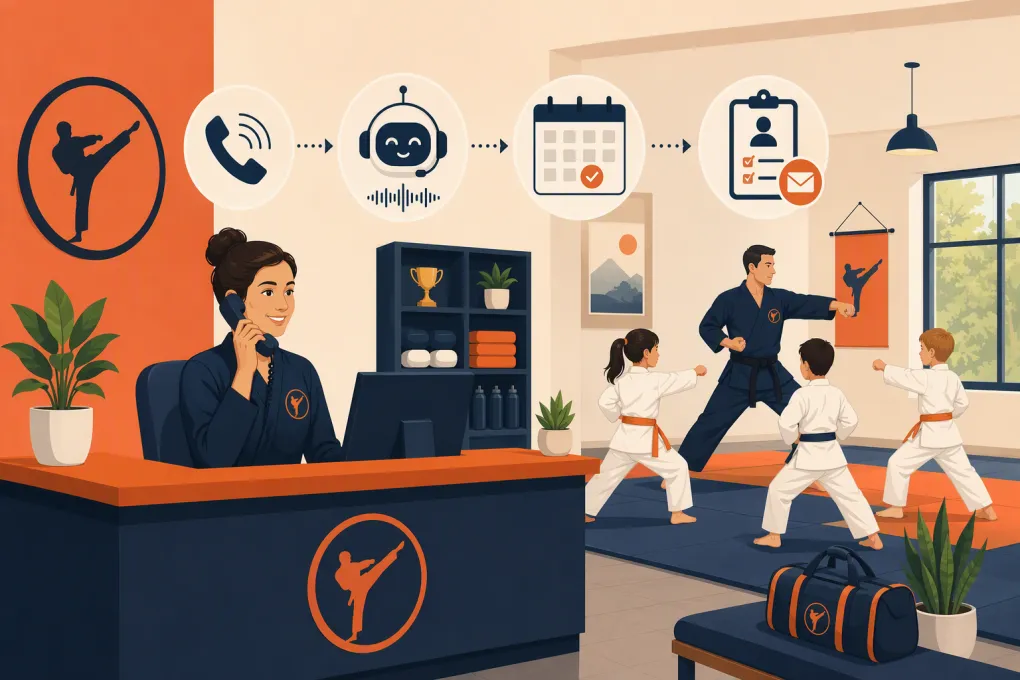 Watch · 20s
A parent calls while your youth class is lining up. Nobody at the desk can answer, so the call reaches voicemail. Whether that inquiry becomes a trial depends on how quickly someone notices the message, checks the schedule, calls back, and reaches the parent.
An AI phone answering service can close that gap, but answering the phone is only the first step. For a martial arts school, the useful outcome is an accurate program recommendation, a valid trial booking, a complete lead record, and a clear handoff when human judgment is required.
This guide gives you a framework for comparing providers and building that workflow. It does not rely on invented conversion claims or assume every school should replace its front desk. Product capabilities, prices, contracts, and integrations change, so confirm current terms directly with each provider and test the service using your own schedule.
What the service needs to handle
A martial arts call is rarely just “What time are you open?” A parent may have two children in different age groups. An adult beginner may not know which discipline fits. A current member may call about billing while a prospect wants tomorrow’s trial class.
A workable system must be able to:
- Separate new leads from current members and other callers
- Ask for the prospective student’s age, experience, interest, and availability
- Use approved information about programs, pricing, equipment, and policies
- Check the correct location and class schedule
- Book only eligible classes or introductory appointments
- Send confirmations and trigger an appropriate follow-up process
- Escalate safety, complaint, billing, and policy exceptions
- Save the disposition and caller details where staff can use them
WTF Go describes Fitty as an AI receptionist that answers leads, books classes, follows up, and collects dues around the clock. Those are connected workflows rather than a message-taking service, but buyers should still verify their exact booking rules, payment process, migration needs, and integrations in a live demonstration. Review Fitty’s stated phone, booking, follow-up, and dues capabilities →
AI and live answering providers to compare
The options below are not identical. Some are AI platforms, some provide human receptionists, and some combine automation with broader business software. That distinction matters more than whether every vendor uses the term “receptionist.”
| Provider | Service model and strengths | Scheduling and follow-up | Pricing model | Setup and contract questions | Best fit and limitations |
|---|---|---|---|---|---|
| WTF Go / Fitty | AI receptionist within an operating platform for gyms, studios, spas, and wellness businesses | WTF Go states that Fitty answers leads, books classes, follows up, and collects dues | Confirm current platform, usage, onboarding, and payment-processing charges directly | Ask for a configured demo, migration scope, expected launch process, support ownership, and current contract terms | Schools wanting calls tied to enrollment and operating workflows; confirm martial-arts-specific rules and existing-system compatibility |
| Smith.ai | Offers AI receptionist services and North America-based human virtual receptionists; established around call handling, qualification, intake, and scheduling | Booking and follow-up depend on the selected service, integrations, and configured playbooks | Typically plan- or usage-based; human and AI services are priced differently, so verify current inclusions and overages | Ask about onboarding, included calls, spam treatment, overages, cancellation terms, and integration work | Useful when human reception or a hybrid approach is important; may require separate membership software and workflow coordination |
| Goodcall | AI phone agent designed for business calls, FAQs, lead capture, routing, and connected actions | Capabilities depend on configured knowledge, workflows, and supported connections | Generally subscription or usage-oriented; verify current tiers, limits, and add-ons | Ask who builds the agent, how quickly schedule changes publish, whether commitments apply, and how usage is measured | Suitable for operators comfortable configuring an AI agent; not a martial arts management system by itself |
| Ruby | Human virtual receptionist service known for live call answering, message taking, routing, and customer-facing coverage | Receptionists can follow approved instructions; scheduling depth and automated nurture depend on the plan and connected tools | Commonly sold through monthly plans tied to receptionist usage; obtain current pricing and overage terms | Confirm onboarding lead time, minute accounting, after-hours coverage, term length, and cancellation policy | Strong choice when callers should reach a person; potentially less suited to fully automated enrollment and membership workflows |
| PATLive | US-based live virtual receptionist and answering service with call handling, lead collection, transfers, and scheduling use cases | Follows scripts and can support appointment workflows; CRM and follow-up depth should be verified | Commonly offered in usage-based monthly plans; verify included time, overages, and add-ons | Ask about setup fees, scripting revisions, coverage, minimum commitments, and cancellation terms | Practical for schools prioritizing live coverage; separate systems may still be needed for nurture, dues, and member management |
Do not infer total cost from an advertised starting price. Request a written estimate based on expected call volume, average call length, after-hours coverage, number of locations, implementation work, integrations, and overages. Ask whether spam, transfers, outbound follow-up, recordings, and test calls count toward usage.
A sample martial arts inquiry call flow
Use this as a starting point, not a script to deploy unchanged.
1. Open and classify
“Thanks for calling Northside Martial Arts. Are you looking for a program, or are you a current member?”
If the caller is a prospect, collect the caller’s name, student’s name, age, phone number, and email with appropriate consent. If the caller is a current member, identify the request before accessing or discussing account information.
2. Qualify without interrogating
Ask only what affects the recommendation:
- What age is the student?
- Is this their first martial arts program?
- Are they interested in a specific discipline?
- Which location and days generally work?
- Are they looking for group classes, private instruction, or a camp?
3. Recommend an eligible next step
Match the answers to an approved program rule. For example: “The beginner youth class is the appropriate starting point for that age. I can check introductory-class availability at the West location.”
The agent should not promise placement, rank eligibility, competition-team access, accommodations, or medical suitability unless the school has explicitly approved that response.
4. Book and confirm
Before booking, repeat the location, date, time, participant’s name, and arrival instructions. Send a confirmation containing parking details, clothing guidance, waiver requirements, and a rescheduling method.
5. Record the outcome
Use a small, consistent set of dispositions:
- Trial booked
- Interested; follow-up required
- No suitable time available
- Pricing or policy objection
- Existing-member request
- Human escalation
- Wrong number or spam
This makes call review more useful than a folder full of transcripts.
Knowledge-base template
Create one approved record for every program and location. A spreadsheet can work during evaluation, although the production system should have controlled publishing and revision ownership.
| Field | What to enter |
|---|---|
| Program name | Exact public-facing name |
| Location | Address, entrance, parking, and accessibility notes |
| Eligible ages | Approved minimum and maximum ages |
| Experience level | Beginner, intermediate, advanced, or instructor approval required |
| Schedule source | Authoritative calendar and person responsible for updates |
| Trial offer | What can be booked, prerequisites, capacity rules, and expiration |
| Pricing response | Published price or approved explanation of how pricing is determined |
| Equipment | What to wear, what is supplied, and what must be purchased |
| Arrival process | Arrival time, waiver, guardian, and check-in requirements |
| Prohibited claims | Statements the agent must never make |
| Escalation owner | Role, contact method, and expected response window |
| Last reviewed | Date and responsible employee |
Assign one owner to approve changes. If instructors, the website, and the phone agent use different schedules, automation will amplify the inconsistency.
Escalation matrix for sensitive calls
| Situation | AI action | Human owner | Priority |
|---|---|---|---|
| Injury or immediate danger | Direct the caller to emergency services when appropriate; alert on-site management | Manager on duty | Immediate |
| Child-safety complaint | Stop routine questioning, preserve the caller’s information, and escalate privately | Owner or designated safeguarding lead | Immediate |
| Refund or charge dispute | Verify only permitted details; do not promise a refund | Billing manager | Same business day |
| Instructor or member complaint | Capture a factual summary without arguing or assigning blame | General manager | Same business day |
| Schedule exception or full class | Offer only approved alternatives | Enrollment lead | During staffed hours |
| Unknown policy question | State that confirmation is required and create a task | Assigned staff member | Defined by your service standard |
| Threat, legal request, or law enforcement inquiry | Make no substantive statement; escalate | Owner and qualified counsel as needed | Immediate |
Have qualified counsel review call-recording, automated communication, privacy, and consent practices. Requirements vary by jurisdiction and communication channel.
Vendor scoring rubric
Score each provider from 1 to 5, then multiply by the weight. Define a 5 before testing—for example, “books the correct class and writes the complete lead record without staff repair.”
| Criterion | Weight |
|---|---|
| Accurate answers from your knowledge base | 20 |
| Correct age, program, location, and capacity logic | 20 |
| Booking and confirmation workflow | 15 |
| Human escalation and failure handling | 15 |
| CRM or member-system data quality | 10 |
| Reporting and call review | 5 |
| Implementation and ongoing administration | 5 |
| Security, consent, and permissions controls | 5 |
| Total cost and contract flexibility | 5 |
Run the same calls through every finalist: two siblings in different age bands, a full class, an unclear pricing question, a billing dispute, a holiday closure, and an upset parent requesting a manager. Review both the conversation and the resulting record.
A realistic implementation sequence
Actual timelines depend on provider capacity, integrations, locations, and the condition of your data. Instead of accepting a generic launch estimate, ask vendors to scope these stages:
- Export recent call reasons and identify the highest-volume workflows.
- Clean program, schedule, pricing, and policy information.
- Configure qualification, booking, and escalation rules.
- Connect the phone number, calendar, CRM, or management platform.
- Test routine, ambiguous, and high-risk scenarios.
- Start with after-hours calls or overflow coverage.
- Review failed calls daily during the initial rollout.
- Expand coverage only after correcting recurring errors.
This is also where an integrated product can reduce handoffs. According to WTF Go’s product positioning, Fitty connects answering with class booking, follow-up, and dues collection. The relevant buying test is whether those actions occur correctly inside your school’s actual workflow—not whether the demo voice sounds impressive. Ask WTF Go to demonstrate Fitty using your programs and call scenarios →
Editorial and evidence note
This guide uses operational requirements common to martial arts enrollment desks, but it does not claim a hidden hands-on test, unnamed customer result, or endorsement from a martial arts school. No performance statistics or implementation outcomes are presented. Provider descriptions should be treated as a shortlist for direct verification because features, pricing, and contract terms can change.
Before signing, request a live scenario test, written scope, sample reporting, security documentation, implementation responsibilities, complete fee schedule, renewal language, and data-export process. That evidence is more useful than a polished sales recording.
Choose based on completed work, not answered calls
The right service reliably turns a call into the correct next step. For some schools, that means a human receptionist. For others, it means an AI agent covering nights and class transitions. A school seeking tighter integration may prefer a platform connecting conversations to booking, follow-up, and account workflows.
Whichever model you choose, keep the standard concrete: accurate information, valid bookings, clean records, safe escalation, understandable costs, and an exit path that preserves your phone number and data.
Frequently asked questions
How much does an AI answering service for a martial arts school cost?
Pricing varies by provider, call volume, usage limits, integrations, locations, and onboarding work. Request a written estimate that includes overages, transfers, outbound follow-up, implementation, support, and cancellation terms.
How long does implementation take?
It depends on the complexity of your programs, schedule data, integrations, and approval process. Ask for a staged plan covering knowledge setup, connections, testing, limited rollout, and full launch rather than relying on a generic estimate.
Can an AI receptionist book martial arts trial classes?
Yes, when it can access the correct calendar and follow rules for age, program, location, prerequisites, and capacity. Test edge cases such as siblings, full classes, and schedule exceptions before launch.
Is a live answering service better than AI?
Live receptionists can be better for nuanced or sensitive conversations, while AI can provide consistent around-the-clock coverage and automated actions. The right choice depends on call complexity, desired integrations, coverage needs, and budget.
What should a martial arts school test before signing a contract?
Test real booking, pricing, full-class, billing, complaint, and after-hours scenarios. Also verify total fees, minimum commitments, renewal and cancellation terms, data ownership, number portability, security controls, and escalation behavior.
Keep reading

Run your gym on autopilot with WTF Go
Fitty — your AI receptionist — answers calls and DMs, fills classes, follows up with every lead, and collects dues while you coach.