AI & Automation
AI Phone Answering Service for Gyms: The Operator's Guide
Learn how an AI phone answering service for gyms handles leads, bookings, FAQs, follow-up, and dues—and what operators should check before buying one.
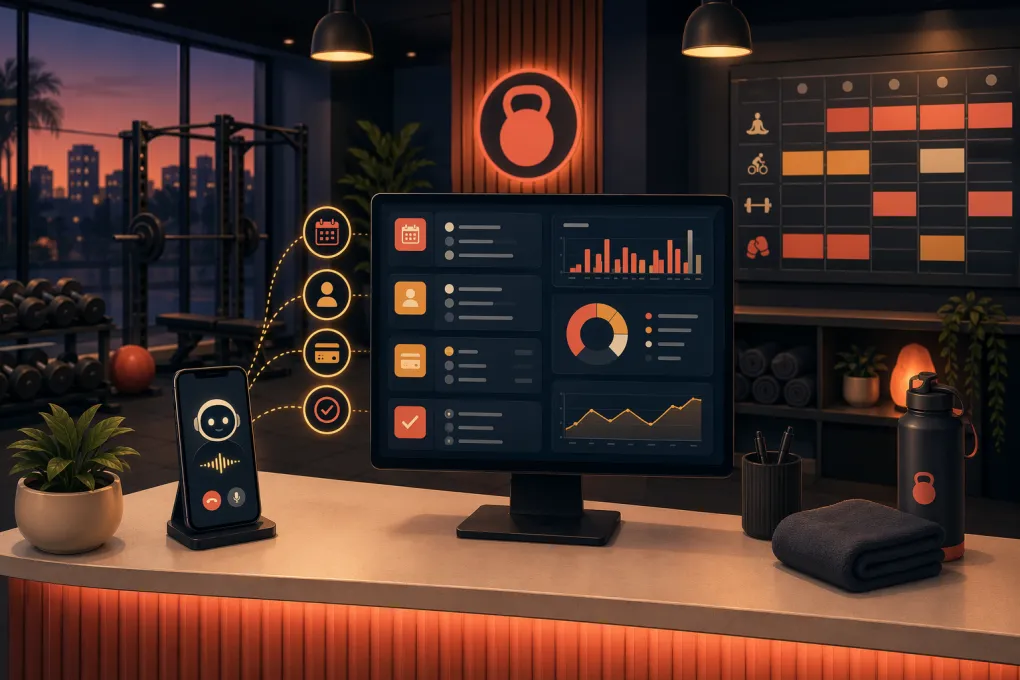 Watch · 20s
A missed phone call is rarely just a missed phone call. It may be a prospect asking about tonight’s class, a member trying to update a card, or a parent checking whether a program has space. If nobody answers—and the caller does not leave a voicemail—the conversation often ends before your team knows it started.
An AI phone answering service for gyms is designed to close that gap. It can answer routine questions, capture and qualify leads, book eligible appointments or classes, and route exceptions to staff. But the quality varies widely. The right system should operate like a trained front-desk teammate, not a generic voice bot bolted onto your phone line.
Here is what gym, studio, and wellness operators should evaluate before putting AI on the phones.
What an AI phone answering service actually does
An AI answering service uses conversational voice technology to respond to inbound calls. Unlike a basic phone tree, callers can speak naturally instead of pressing numbers for predefined departments.
A gym-specific setup may handle tasks such as:
- Answering questions about hours, location, parking, amenities, and policies
- Explaining memberships, intro offers, programs, and class formats
- Capturing names, contact details, goals, and preferred times
- Booking tours, consultations, trials, classes, or appointments
- Sending confirmation and follow-up messages
- Transferring urgent or sensitive calls to a person
- Helping members reach a secure payment-update or dues-resolution workflow
- Creating a record of the conversation for staff review
The important distinction is whether the service merely takes messages or completes work. A caller asking for a tour should ideally leave with a confirmed time, not a promise that somebody will call back tomorrow.
Where phone coverage breaks down in a gym
Most facilities do not run a conventional call center. The person responsible for the phone may also be checking in members, coaching, cleaning equipment, handling a cancellation, or opening the building.
Coverage commonly breaks during:
- Early-morning and evening classes
- Lunch periods and shift changes
- Peak check-in windows
- Weekends and holidays
- Staff training or coaching sessions
- After-hours marketing campaigns
- High-volume periods following a promotion
Voicemail provides a place to leave a message, but it does not answer the question or secure the booking. A general virtual receptionist can provide live coverage, but may need scripts and manual handoffs for facility-specific workflows. AI can offer continuous coverage, provided it has accurate business information and access to the systems required to take action.
AI, voicemail, and live answering services compared
The best model depends on your call volume, service complexity, and tolerance for automation.
| Option | What it handles well | Main limitation | Best fit |
|---|---|---|---|
| Voicemail | Basic message collection at low operational complexity | Does not resolve questions or book in real time | Facilities receiving very few calls |
| Staff answering | Nuanced conversations, relationship building, and sensitive issues | Coverage depends on availability and competing front-desk duties | Complex sales and member-service conversations during staffed hours |
| Live answering service | Human coverage, message taking, and scripted qualification | Agents may lack deep knowledge of schedules, policies, and gym systems | Operators wanting outsourced human coverage |
| AI phone answering service | Immediate answers, consistent qualification, booking, routing, and after-hours coverage | Requires careful setup, integrations, monitoring, and escalation rules | Gyms with repetitive calls, missed leads, or limited front-desk coverage |
| Hybrid model | AI handles routine calls while staff receive exceptions and valuable sales opportunities | Requires clear ownership and routing logic | Most established gyms, studios, and multi-location operators |
For many operators, hybrid coverage is the practical choice. Let AI handle predictable requests, but preserve human access when judgment, empathy, or negotiation matters.
The capabilities that matter most
Accurate answers grounded in your business
A generic model should not improvise answers about contracts, childcare, cancellation terms, age restrictions, or medical concerns. It needs an approved knowledge base containing your actual information.
At minimum, provide:
- Staffed and access hours
- Location details and parking instructions
- Current programs and class descriptions
- Trial, tour, and consultation options
- Membership information the agent is permitted to discuss
- Guest, cancellation, freeze, and late-arrival policies
- Amenities and accessibility information
- Escalation contacts and transfer hours
Assign someone to update this information whenever an offer, schedule, or policy changes.
Booking tied to live availability
Ask whether the service can read current availability and create a booking in the system your staff actually uses. A disconnected appointment request creates another queue for employees to process and can lead to double booking.
Test different scenarios: a first-time visitor booking a consultation, an existing member reserving a class, a full session requiring a waitlist, and a caller requesting a time outside staffed hours.
Lead capture and follow-up
The phone conversation should create a usable contact record. Decide which fields are necessary without turning the call into an interrogation. For a typical fitness lead, that may include:
- Name and preferred contact method
- Program or service of interest
- Primary goal
- Preferred location
- Scheduling preference
- Source or campaign, when known
- Agreed next step
The system should also distinguish a new lead from an existing member. Otherwise, duplicate records and irrelevant sales messages will create cleanup work.
Transfers and human escalation
AI should not trap callers in a conversation it cannot resolve. Define triggers for transfer, callback, or staff review.
Common escalation categories include injuries, billing disputes, cancellation requests, complaints, accessibility needs, emergencies, and questions requiring professional medical or legal judgment. The agent should never present itself as qualified to provide advice outside its approved role.
Conversation records and visibility
Operators need to know what happened without listening to every recording. Look for concise call summaries, outcomes, contact records, booking status, follow-up tasks, and searchable transcripts where legally appropriate.
Recording and transcription laws vary by jurisdiction. Determine whether consent is required for your business and callers, and configure the opening disclosure accordingly.
Integration matters more than the voice
A natural-sounding voice is useful, but workflow integration determines whether the service saves labor or creates another inbox.
Map the full path before choosing a provider:
- Where does the call originate?
- How does the agent identify the location and caller?
- Where does it retrieve approved answers?
- Which calendar or class schedule does it use?
- Where is the lead or member record stored?
- What confirmation is sent?
- How is follow-up assigned?
- What happens when the request cannot be completed?
If the phone service, CRM, booking calendar, messaging platform, and payment process are separate, ask exactly how data moves between them. Confirm whether integration is native, API-based, or dependent on a third-party connector. Also ask what happens when an integration is unavailable.
WTF Go approaches this as an operating-system workflow rather than a standalone call bot. Fitty, its AI receptionist, can answer leads, book classes, follow up, and support dues collection around the clock. That model is most relevant to operators who want phone, CRM, booking, messaging, and revenue workflows coordinated in one place rather than patched together across multiple tools.
How to design calls that convert without frustrating people
Do not start by writing a long script. Start with call intents and desired outcomes.
For each common reason someone calls, document:
- The information the agent needs
- The approved answer or action
- The system it must update
- The successful outcome
- The point where a human takes over
For example, a prospective member asking about beginner strength classes may need a short explanation, two qualifying questions, available intro times, and a confirmed booking. They probably do not need every membership tier read aloud.
Keep spoken responses brief. Offer choices in small groups. Confirm critical details such as names, dates, times, email addresses, and payment-related next steps. Give callers a clear way to request a person.
Security, payments, and compliance questions to ask
Phone automation may handle personal information, so security cannot be an afterthought. Ask prospective providers:
- What call data is stored, where, and for how long?
- Who can access recordings, transcripts, and contact records?
- Can retention periods and user permissions be configured?
- How are sensitive payment details kept out of transcripts?
- Does payment processing use an appropriate secure, compliant workflow?
- Can outbound calls and texts respect consent and opt-out requirements?
- How are transfers, emergency language, and prohibited topics controlled?
Requirements depend on the communication channel, location, and information collected. Have qualified counsel review your consent, recording, marketing, and privacy practices when necessary. Do not assume that buying a compliant tool automatically makes every workflow compliant.
A practical rollout plan
Avoid sending every call to AI on day one. Roll out in controlled stages.
1. Audit recent calls
Review call reasons, missed-call logs, voicemails, and front-desk notes. Identify repetitive requests and high-value calls that need immediate handling.
2. Choose a narrow first scope
Start with after-hours calls, basic FAQs, or new-lead tour bookings. Keep sensitive billing disputes and complex membership changes with staff until the workflow is proven.
3. Build and verify the knowledge base
Use current source documents. Remove conflicting policies and expired promotions. Have the employees who answer calls review the final material.
4. Test realistic edge cases
Call from noisy environments. Use vague questions, interruptions, different accents, schedule conflicts, and requests to speak with a person. Verify what appears in your CRM and calendar afterward.
5. Monitor business outcomes
Track operational measures rather than novelty metrics. Useful indicators include answered versus missed calls, qualified leads created, bookings completed, transfers, unresolved requests, duplicate records, and staff corrections.
Review failed conversations regularly. Improve the underlying information or workflow instead of simply adding more script language.
How pricing is commonly structured
Providers may charge by minute, call, usage tier, phone number, location, feature package, or a combination of platform and usage fees. Some include setup; others charge separately for implementation, integrations, or custom workflows.
Compare total operating cost, not just the advertised base rate. Include:
- Call usage and overages
- Additional locations or numbers
- Implementation and training
- CRM and scheduling integrations
- Text or email follow-up
- Call recording and storage
- Ongoing workflow changes
- Human transfer or answering charges
The cheapest service can become expensive if employees must repair records, return avoidable calls, or manually re-enter every booking.
The bottom line
An AI phone answering service for gyms should do more than pick up the phone. It should give accurate answers, complete routine actions, preserve context, and hand off exceptions cleanly.
Before buying, test the service against real calls from your business. Confirm booking and CRM behavior, inspect its escalation rules, and calculate the full cost of running the workflow. The right setup removes repetitive front-desk work while making it easier for prospects and members to get help when they are ready to act.
Frequently asked questions
Can an AI phone answering service book gym classes?
Yes, if it connects to the gym’s live scheduling or booking system. Verify that it can handle capacity limits, eligibility rules, cancellations, and waitlists without creating duplicate bookings.
Will callers know they are speaking with AI?
The service should identify itself clearly and explain any recording or transcription practices required for the call. Callers should also have a straightforward way to request a person.
Can AI handle gym membership payments over the phone?
AI can guide callers into an approved secure payment or card-update workflow. Sensitive card information should not be exposed in ordinary transcripts or handled outside compliant payment systems.
Should AI replace a gym’s front-desk staff?
Usually, no. AI is best used for routine questions, lead capture, booking, and after-hours coverage, while staff handle relationship-driven sales, disputes, emergencies, and requests requiring judgment.
How long does implementation take?
It depends on the number of locations, call types, integrations, and policies involved. A narrow after-hours or lead-booking rollout is generally simpler than automating billing, membership changes, and multi-location routing at once.
Keep reading

Run your gym on autopilot with WTF Go
Fitty — your AI receptionist — answers calls and DMs, fills classes, follows up with every lead, and collects dues while you coach.