AI & Automation
AI Phone Answering Service for Dance Studios That Works
Learn how an AI phone answering service for dance studios captures leads, books trial classes, handles FAQs, and follows up without missed calls every day.
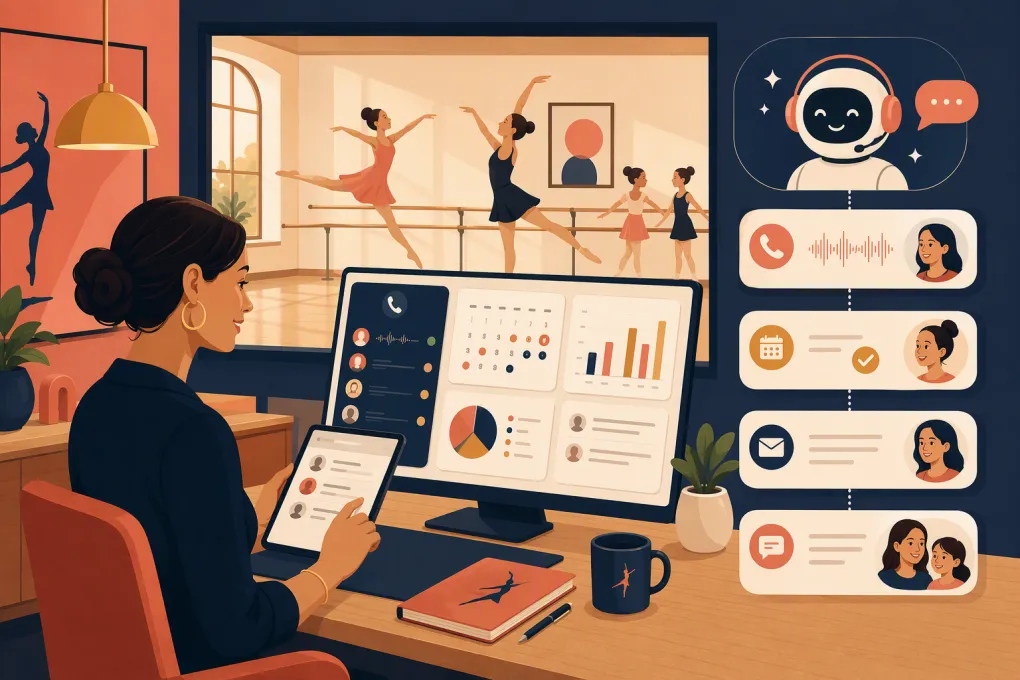 Watch · 20s
A prospective student calls your dance studio between school pickup and dinner. The front desk is helping families, instructors are teaching, and nobody answers. The caller may leave a voicemail, but they may also call the next studio on the list.
That is the operational problem an AI phone answering service for dance studios should solve. It should answer promptly, handle routine questions accurately, capture useful lead information, and move qualified callers toward a trial class or another clear next step.
The goal is not simply to pick up the phone. It is to turn phone demand into trackable enrollment opportunities without forcing instructors or owners to interrupt classes.
See how Fitty can answer dance studio leads and book the next step →
What an AI phone answering service actually does
An AI phone answering service uses a conversational voice agent to handle inbound calls. Unlike a recorded phone tree, the caller can explain what they need in normal language and receive a relevant response.
For a dance studio, the service may be configured to:
- Answer questions about dance styles, age groups, levels, and locations
- Explain how trial classes or introductory offers work
- Check appropriate class availability
- Book a trial, consultation, or studio visit
- Collect the caller’s name, contact details, and student information
- Route unusual or sensitive situations to a staff member
- Follow up when the caller is not ready to book
- Answer common account or payment questions within defined limits
- Send the conversation outcome into the studio’s operating workflow
The quality depends heavily on setup. An AI agent that only repeats generic information is a more polished voicemail system. A useful agent understands your actual programs, follows your enrollment rules, and records what happened so staff do not have to reconstruct the conversation later.
Why dance studio calls are unusually easy to lose
Dance studios have a difficult overlap between peak inquiry time and peak operating time. Families often call after school or after work, which is also when the lobby is busy and classes are running.
The person answering may need to determine:
- The student’s age
- Previous dance experience
- Preferred style
- Desired day or time
- Whether the caller wants recreational or competitive training
- Which location is practical
- Whether registration is open
- Whether the class requires an evaluation or prerequisite
That is more complex than taking a name and number. If the conversation is rushed, the lead may be placed in the wrong class, given incomplete information, or told someone will call back without a defined follow-up task.
An AI receptionist can handle the repeatable first layer. Staff should remain responsible for exceptions requiring judgment, such as placement disputes, injury-related questions, accommodations, complaints, and complex billing issues.
AI answering service vs. the common alternatives
The right model depends on call volume, staff coverage, enrollment process, and how much control you need over booking.
| Option | Strengths | Limitations | Best fit |
|---|---|---|---|
| Voicemail | Simple, familiar, and easy to maintain | Delays the conversation; requires manual callbacks; cannot qualify or book callers | Studios with very low call volume and reliable callback coverage |
| Live studio staff | Strong context and human judgment; can handle complex situations | Staff are interrupted; coverage disappears during classes, breaks, and closed hours | Studios with dedicated front-desk coverage throughout inquiry hours |
| Traditional answering service | Provides human pickup and message taking outside normal hours | Agents may have limited studio context; booking and CRM updates depend on the service | Studios mainly needing message capture and basic overflow coverage |
| AI phone answering service | Consistent availability; can answer FAQs, qualify leads, book defined appointments, and trigger follow-up | Requires careful setup, approved answers, escalation rules, and ongoing review | Studios with repeatable inquiries and meaningful missed-call volume |
| Hybrid AI and human coverage | Automates routine calls while escalating exceptions to staff | Requires clear ownership and handoff design | Most growing or multi-location dance studios |
For many operators, the hybrid model is the practical answer. Let automation manage repetitive enrollment questions and scheduling while protecting access to a human for issues where empathy or discretion matters.
The call flows your studio should build first
Do not launch with one giant script intended to cover every possible situation. Start with the calls that are frequent, valuable, and easy to define.
New student or parent inquiry
The agent should collect only the information needed to recommend a next step. A practical sequence is:
- Identify the student’s age.
- Ask about dance experience and interests.
- Confirm the preferred location, if applicable.
- Ask about schedule constraints.
- Match the caller to eligible beginner classes, trials, or evaluations.
- Book the approved next step or collect details for staff review.
- Confirm what will happen next and when.
Avoid making the caller answer a long questionnaire before receiving help. Additional details can be collected after the trial is booked.
Existing family with a schedule question
The agent can answer approved questions about class times, closures, makeup policies, dress requirements, and arrival instructions. Information should come from a maintained source rather than a script copied at the start of the season and forgotten.
When a policy has exceptions, the agent should explain the standard rule and escalate the case instead of improvising.
Billing or overdue account call
Billing conversations require tighter controls. Define what the agent may disclose, how identity is verified, which payment methods are allowed, and when a staff member must take over.
Fitty, WTF Go’s AI receptionist, can support dues collection as part of a broader lead, booking, and follow-up workflow. The important operational advantage is continuity: the call should not become an isolated note that someone has to process later.
See how Fitty connects calls, follow-up, booking, and dues workflows →
Missed booking or undecided lead
Not every caller will schedule immediately. The system should classify the outcome instead of treating every completed call as a success.
Useful outcomes include:
- Trial booked
- Evaluation requested
- Needs staff recommendation
- Schedule did not fit
- Asked for pricing information
- Not ready to enroll
- Existing customer issue
- Wrong number or irrelevant inquiry
Each outcome should have an owner and next action. For example, a lead who cannot find a suitable class may need a staff call, while an undecided parent may need a concise follow-up message with the recommended program.
What to require before choosing a provider
A polished demonstration is not enough. Test how the service behaves with the messy calls your studio receives in practice.
Scheduling accuracy
Ask whether the agent can use live availability or only submit a booking request. Confirm how it handles age restrictions, full classes, waitlists, prerequisites, multiple locations, and sibling bookings.
A system should never promise a spot based on outdated schedule information.
Reliable escalation
Define the situations that must go to a person. These may include injuries, child-safety concerns, angry callers, charge disputes, accessibility requests, and questions the agent cannot answer confidently.
Also decide what happens when nobody is available. The fallback might create a priority task, send an internal notification, or schedule a callback window.
Conversation records and ownership
Staff should be able to see why the person called, what information was provided, what was booked, and what remains unresolved. A transcript alone is not an operating process. Look for structured outcomes and assigned next steps.
Controlled knowledge
Your approved information should be easy to update when schedules, tuition policies, recital dates, or enrollment rules change. Assign one employee to own those updates and establish a review cadence during busy registration periods.
Privacy and payment controls
Ask how caller data is stored, who can access it, and how long it is retained. If calls are recorded, review applicable consent requirements with qualified counsel because rules can vary by jurisdiction.
For payments, confirm that the provider’s process fits your payment processor and security obligations. Do not have an AI agent repeat or store sensitive payment information in an uncontrolled transcript.
How to implement AI phone answering without disrupting enrollment
A controlled rollout is better than switching every call on the first day.
1. Review recent call reasons
Use call notes, voicemails, and staff experience to identify the most common inquiries. Group them into lead, schedule, policy, billing, and exception categories.
2. Define the source of truth
Document where the agent should obtain class schedules, age rules, tuition explanations, dress codes, closure dates, and trial policies. Resolve contradictions before automation exposes them to callers.
3. Write boundaries, not just answers
Specify what the agent may answer, what it may book, and what it must escalate. Good boundaries reduce confident but incorrect responses.
4. Test realistic scenarios
Have staff pose as different callers: a parent with two children, an adult beginner, a current family disputing a charge, and a caller requesting a full class. Test interruptions, vague questions, and changes of mind.
5. Launch with overflow or after-hours calls
This provides immediate coverage while giving the team time to inspect outcomes. Once accuracy is established, the service can take a larger role in routine call handling.
6. Review operational outcomes
Track more than the number of answered calls. Review whether calls resulted in correct bookings, clear escalations, completed follow-up, and accurate records. Listen for recurring questions that indicate confusing website copy or policies.
WTF Go combines Fitty with the operating workflows used to manage leads, bookings, follow-up, and collections. That matters because answering a call is only useful when the promised next action actually happens.
Explore an AI receptionist built around the full dance studio lead journey →
The standard is a completed next step
The best AI phone answering service for a dance studio is not necessarily the one with the most human-sounding voice. It is the one that follows your rules, protects the caller experience, books accurately, escalates responsibly, and leaves a clear record for your team.
Start with the calls you lose most often. Build a narrow, reliable workflow, review real conversations, and expand only when the service consistently produces the right next step.
Frequently asked questions
Can an AI phone answering service book dance classes?
Yes, if it has access to the appropriate schedule and booking workflow. The studio should define age rules, prerequisites, capacity limits, and when a booking requires staff approval.
Will callers know they are speaking with AI?
Disclosure practices depend on the provider and your configuration. Be transparent, avoid implying the agent is a specific employee, and make it easy for callers to request human help.
Can AI handle calls for multiple dance studio locations?
It can when location-specific schedules, policies, routing, and booking rules are configured correctly. Test ambiguous requests so callers are not booked at the wrong location.
What calls should an AI receptionist escalate?
Escalate safety concerns, injuries, complaints, payment disputes, accessibility requests, unusual placement questions, and anything outside the agent's approved knowledge.
How should a dance studio measure whether the service works?
Review booking accuracy, resolved inquiries, qualified leads, completed follow-up, escalation quality, and unresolved call reasons. Answered-call volume alone does not show whether the workflow is effective.
Keep reading

Run your gym on autopilot with WTF Go
Fitty — your AI receptionist — answers calls and DMs, fills classes, follows up with every lead, and collects dues while you coach.