AI & Automation
After-Hours AI Receptionist for Yoga Studios That Works
Learn how an after-hours AI receptionist for yoga studios captures leads, books classes, answers questions, and protects your team's time every night.
 Watch · 20s
A prospective student finds your studio at 9:40 p.m. They want to know whether the beginner class is truly beginner-friendly, whether mats are available, and how to use the intro offer. Nobody answers, so they open another studio’s website.
That is the after-hours problem in practical terms. Yoga studios do not only miss calls; they miss high-intent moments. A contact form that promises a reply tomorrow is not the same as a helpful conversation now.
An after-hours AI receptionist for yoga studios can handle that first interaction, answer approved questions, book the right next step, and follow up without asking an instructor or manager to monitor the phone all night. The value depends on how well it is configured. A generic chatbot with weak booking access will create more cleanup than revenue.
See how Fitty handles after-hours yoga studio inquiries and bookings →
Why yoga studio inquiries require more than a basic answering service
Yoga prospects often need reassurance before they need a sales pitch. First-time students may be uncertain about flexibility, class difficulty, etiquette, injuries, what to bring, parking, or arriving late. Existing members may ask about waitlists, passes, schedule changes, or account issues.
A useful AI receptionist must distinguish between these intents. It should know when to answer, when to book, when to collect information, and when to hand the conversation to a person.
The core after-hours jobs are:
- Respond immediately with a clear studio introduction.
- Identify whether the person is a prospect or current member.
- Answer routine questions from an approved knowledge base.
- Recommend an appropriate class category without giving medical advice.
- Check current availability before offering a time.
- Complete a booking or capture the information needed to finish it.
- Explain intro offers and studio policies accurately.
- Follow up when the person does not complete the booking.
- Escalate sensitive, unusual, or urgent requests.
If the system can only take a message, it is an answering service. If it can move a qualified prospect into an actual class while respecting your operating rules, it functions as a receptionist.
Build the after-hours conversation around one outcome
Do not start by loading every policy document into an AI tool. Start with the outcome you want from the most common inquiries.
For a new-student conversation, the primary outcome may be a booked beginner class or intro appointment. A practical flow looks like this:
1. Establish intent
The receptionist should ask a short question such as: “Are you looking to try your first class, or do you need help with an existing membership?”
This prevents current-member service requests from being pushed through a lead script.
2. Gather only necessary context
For a new student, useful questions might include:
- Have you practiced yoga before?
- Are you looking for a gentler, heated, restorative, or more athletic class?
- What days or times usually work?
- Do you have a preferred location?
Avoid turning the interaction into an intake form. The receptionist needs enough context to present a sensible option, not the person’s life history.
3. Present a small number of bookable choices
Offering every class on the schedule creates friction. Provide one or two appropriate options based on the person’s preferences and actual availability.
The AI should use your live schedule as the source of truth. It should not promise a place in a full class, overlook prerequisites, or treat a waitlist position as a confirmed booking.
4. Complete the next step
Depending on your process, completion may mean reserving a class, starting the intro-offer purchase, or scheduling a conversation with a staff member. The prospect should receive a clear confirmation explaining what happened and what they need to do next.
5. Follow up on incomplete bookings
If someone asks several questions but stops before booking, the inquiry should not disappear. A useful follow-up references the original interest and provides a direct path back to the recommended class.
Give the AI firm boundaries
Yoga businesses routinely receive questions that software should not answer independently. Your AI receptionist needs explicit escalation rules, not a vague instruction to “be helpful.”
It should hand off or take a message when someone:
- Requests medical guidance or asks whether yoga is safe for a specific condition.
- Reports an injury, safety issue, harassment, or serious complaint.
- Disputes a charge or requests an exception to a contract.
- Wants a refund that requires managerial approval.
- Asks about a private event, partnership, or unusual group booking.
- Needs an accessibility accommodation not covered in the approved information.
- Becomes distressed, threatening, or abusive.
For pregnancy, injury, and health-related questions, the system can explain relevant class descriptions and suggest speaking with a qualified healthcare professional or studio employee. It should never diagnose, promise safety, or improvise modifications.
Your escalation design should specify who receives the request, what details are captured, and when the person can expect a response. “Someone will get back to you” is not an operating procedure.
Connect reception to the real booking workflow
An AI receptionist is only as reliable as its access to studio operations. Before turning it on, map what it needs to read and what it is allowed to change.
At minimum, review:
- Class schedules and real-time capacity
- Instructor and location information
- Class descriptions and experience requirements
- Introductory offers and eligibility rules
- Cancellation, no-show, waitlist, and late-arrival policies
- Membership and class-pass basics
- Booking confirmation and reminder workflows
- Staff handoff destinations
Also decide whether the receptionist may create customer profiles, process or initiate purchases, apply promotions, cancel reservations, or modify account details. Use the narrowest permissions that still allow it to complete the intended job.
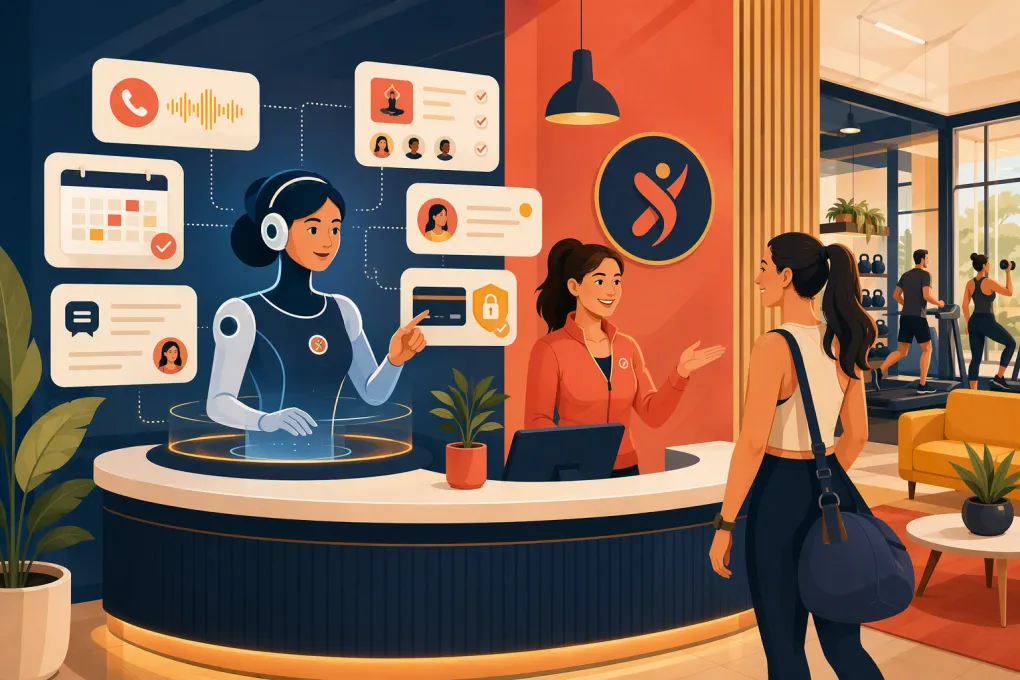
WTF Go brings the receptionist and operating workflows into one system. Fitty can answer leads, book classes, follow up, and collect dues around the clock, reducing the handoffs that occur when reception, scheduling, and payment recovery live in separate tools.
See how Fitty connects after-hours conversations to bookings and follow-up →
Create an operator-owned knowledge base
The studio, not the AI vendor, should decide what counts as a correct answer. Build a concise source document with approved language for recurring questions.
Include:
New-student basics
Document what to bring, how early to arrive, mat availability, changing facilities, parking, studio etiquette, age requirements, and what happens during a first visit.
Class guidance
Describe each class in plain language. Note pace, heat, experience expectations, physical intensity, equipment, and any prerequisites. Avoid unsupported claims about treating health conditions.
Commercial rules
State which intro offers are available, who qualifies, when they expire, and whether they renew. Include current cancellation and refund rules. If an exception requires approval, say so.
Location details
For multi-location studios, separate addresses, access instructions, amenities, schedules, and location-specific policies. Do not let the AI assume every site operates identically.
Assign an owner to this information. Schedule changes, promotions, instructor updates, and policy revisions must reach the receptionist before prospects encounter conflicting answers.
Test the difficult conversations before launch
A clean demo is not enough. Test the receptionist with realistic phrasing, interruptions, vague requests, and edge cases.
Use scenarios such as:
- “I’ve never done yoga and I’m not flexible.”
- “Can I use the new-client deal if I visited three years ago?”
- “The class says waitlist. Does that mean I can still come?”
- “I have a knee injury. Which class is safe?”
- “I was charged after I canceled.”
- “Can my 14-year-old attend hot yoga?”
- “I need to cancel tomorrow morning’s class.”
- “Which of your two locations has showers?”
Check whether the response is accurate, concise, on-brand, and operationally possible. Then verify the resulting record: Was the correct profile created? Was the class actually booked? Did the confirmation match the booking? Did an escalation reach the right employee?
Run tests whenever you change a major offer, policy, location, or booking workflow.
Measure outcomes, not conversation volume
A high number of AI interactions does not tell you whether the receptionist is useful. Track the full path from inquiry to resolution.
Useful operating measures include:
- Number of after-hours inquiries by source and intent
- Percentage resolved without staff intervention
- New-student bookings completed after hours
- Inquiries that started but did not finish booking
- Follow-ups that produced a booking or reply
- Escalation volume and reason
- Incorrect-answer and failed-booking incidents
- Duplicate profiles or scheduling errors created
- Staff time spent correcting conversations
Review failed and escalated interactions regularly. They reveal missing information, unclear policies, broken booking connections, and questions your marketing is not answering.
A practical rollout plan
Treat launch as an operations project rather than a switch you flip.
- Export the most common after-hours questions from calls, email, forms, and staff notes.
- Choose one primary workflow, usually new-student inquiry to first booking.
- Write approved answers and escalation rules.
- Confirm schedule, offer, payment, and customer-record access.
- Test routine questions and high-risk exceptions.
- Launch during a limited after-hours window and inspect every outcome.
- Expand responsibilities only after booking and handoff accuracy are stable.
This approach keeps the initial scope manageable while producing information you can use to improve the rest of the front desk.
Fitty is built for the work that happens between initial interest and collected revenue: answering, booking, following up, and collecting dues. For a yoga studio, that means the conversation can continue after the final class ends without forcing your instructors to become an overnight call center.
Explore an after-hours AI receptionist built for fitness and wellness operators →
Frequently asked questions
Can an AI receptionist book yoga classes after hours?
Yes, if it is connected to current scheduling and capacity data. It should confirm the booking in the studio's system rather than merely sending a class link or taking a message.
Can an AI receptionist answer questions about injuries or pregnancy?
It can share approved class information, but it should not provide medical advice or guarantee that a class is safe. Health-specific questions should be escalated appropriately.
What information should a yoga studio give its AI receptionist?
Provide current schedules, class descriptions, intro-offer rules, location details, studio policies, booking procedures, and clear escalation instructions. Assign someone to keep that information updated.
Will an after-hours AI receptionist replace front-desk staff?
It is better used to handle repetitive inquiries and transactions while routing sensitive or unusual issues to staff. Human employees remain important for judgment, relationships, and exceptions.
How should a studio evaluate an AI receptionist?
Test booking accuracy, answer quality, escalation behavior, follow-up, system access, and reporting. Measure completed outcomes and correction work, not just the number of conversations.
Keep reading

Run your gym on autopilot with WTF Go
Fitty — your AI receptionist — answers calls and DMs, fills classes, follows up with every lead, and collects dues while you coach.