AI & Automation
After Hours AI Receptionist for Pilates Studios: Buying Guide
Compare pricing, integrations, privacy, booking workflows, and vendors to choose an after hours AI receptionist for Pilates studios without costly gaps.
 Watch · 20s
A prospective client finds your Pilates studio after dinner. She wants to know whether your reformer class accepts beginners, whether an intro offer applies, and if a recent injury changes what she should book. Voicemail cannot qualify that request, but a poorly configured AI can create a different problem: the wrong class, an invented policy, or unsafe guidance.
An after hours AI receptionist for Pilates studios should do more than answer. It should use current studio rules, complete approved actions, preserve consent, and hand sensitive decisions to a person.
That makes this an operations purchase—not a voice-demo contest. Before signing a contract, evaluate the complete workflow from first ring to confirmed reservation, CRM record, payment status, and staff handoff.
See how Fitty can support your studio’s after-hours workflow →
What the receptionist should handle
A useful system can cover routine demand while your desk is closed:
- Capture names, contact details, goals, experience level, location, and preferred times
- Explain approved class formats, intro offers, attire, grip socks, parking, and arrival rules
- Read current availability and book eligible classes or consultations
- Manage permitted cancellations, reschedules, and waitlist requests
- Follow up with leads through consented channels
- Help with approved account or dues workflows
- Escalate health disclosures, disputes, exceptions, and unclear requests
These capabilities depend on configuration and integrations. A vendor saying it “books classes” may mean that it creates a real reservation, sends a booking link, or merely leaves a note for staff. Require the vendor to show which one happens in your system.
Compare the real service models
Not every studio needs the same type of coverage. Compare the operating result, not just whether someone—or something—answers.
| Option | Strengths | Limitations | Best fit |
|---|---|---|---|
| AI receptionist connected to studio systems | Immediate response, consistent rules, potential to book and follow up automatically | Requires careful setup, reliable integrations, monitoring, and escalation controls | Studios with recurring after-hours inquiries and documented workflows |
| Human answering service | Human judgment and conversational flexibility | Agents may not know Pilates-specific rules or have booking access; quality varies by staffing | Studios prioritizing live human coverage for lower call volume |
| Booking software automations | Useful confirmations, reminders, forms, and predefined sequences | Usually depends on the prospect starting inside the booking flow; may not resolve open-ended calls | Studios whose clients already self-book successfully |
| Voicemail with next-day callback | Simple and inexpensive | Delays qualification and booking; creates manual follow-up | Very low inquiry volume or temporary coverage |
| Hybrid AI and human escalation | Automation for routine work with human backup for exceptions | More vendors, routing rules, and costs to manage | Multi-location or higher-volume operators with varied request types |
During demos, ask every vendor to perform the same scenarios. A fair comparison requires identical inputs and a visible result in your live or sandbox systems.
Test the integrations, not the logo slide
A marketplace logo does not prove that the receptionist can complete your workflow. Ask what data is read, what data is written, how often it updates, and what happens when the integration fails.
Scheduling and membership systems
Pilates studios commonly use platforms such as Mindbody, Mariana Tek, WellnessLiving, Vagaro, Momence, ClubReady, Acuity Scheduling, or other studio-specific systems. Do not assume support based on familiarity with the name.
Verify whether the integration can:
- Read live class and private-session availability
- Distinguish reformer, tower, chair, mat, and consultation appointments
- Enforce prerequisites, capacity, waitlists, booking windows, and location rules
- Recognize intro-offer eligibility and existing-client status
- Create, cancel, or reschedule a reservation without duplicate records
- Return the booking confirmation or record ID
- Detect a failed write instead of claiming success
Ask whether access uses an official API, middleware, browser automation, or a booking link. Those methods have different reliability and maintenance implications.
CRM and lead management
The receptionist should search before creating a contact. Test whether it deduplicates by phone and email, records the original lead source, saves conversation notes, updates lifecycle status, assigns an owner, and creates a follow-up task when escalation is required.
For multiple locations, confirm that one person does not become separate, conflicting records every time she contacts a different studio.
Payments
If payments or dues are involved, determine whether the system uses your existing processor—such as the processor embedded in your management platform, Stripe, Square, or another provider—and whether it passes the client into a hosted payment flow.
The AI vendor should not expose full card numbers in transcripts, prompts, recordings, or CRM notes. Ask who is responsible for PCI compliance, whether card data is tokenized by the payment provider, and whether staff can restrict refund, credit, and payment-link permissions.
Phone and messaging
For phone coverage, confirm whether you must port your number, forward calls, add a new number, or connect through SIP or another telephony method. Test caller ID, voicemail fallback, transfer behavior, call queues, outages, and number portability if you leave.
For SMS and email, verify sender registration, delivery reporting, opt-out handling, quiet-hour controls, shared-inbox visibility, and whether replies return to the same client record. In the United States, automated outreach must follow applicable consent and messaging rules; a phone number on a form is not automatically permission for every marketing sequence.
Pilates-specific failure modes to test
Generic restaurant or dental demos reveal little about studio operations. Use scripts that expose Pilates-specific risks.
Script 1: The false beginner
Say: “I did mat Pilates years ago. Can I take your intermediate reformer class tonight?”
The system should apply your actual prerequisite rules. It should not treat mat experience as apparatus experience unless your policy does.
Script 2: The health disclosure
Say: “I have back pain after surgery. Which class will fix it?”
The AI should not diagnose, promise a result, or decide that participation is safe. It should use your approved response and escalate to the designated staff member or direct the caller to an appropriate professional.
Script 3: One space, two callers
Have two testers request the final reformer spot at nearly the same time. Confirm that only one valid reservation is created and the other person receives an accurate alternative or waitlist option.
Script 4: The expired intro offer
Use an existing client record and ask for a new-client offer. The system should check eligibility rather than applying the promotion based only on what the caller says.
Script 5: The policy exception
Say: “I missed class because parking was impossible. Remove the late-cancel charge.”
The AI may explain the published policy, but it should not grant an unauthorized waiver. It should capture the context and route the decision.
Script 6: Integration outage
Disconnect sandbox access or force a failed booking. The receptionist should say it cannot confirm the reservation, collect the request, and alert staff. It must not issue a false confirmation.
Privacy, recording, and consent requirements
Operational convenience does not remove your compliance responsibilities. Requirements vary by state, communication channel, data use, and business relationship, so obtain legal advice for your situation.
Before launch, document:
- Call recording consent: State laws differ. Decide how disclosure and consent are obtained before recording or transcription begins.
- Data retention: Set retention periods for audio, transcripts, summaries, and lead records. Ask whether deletion also covers backups and subprocessors.
- Access controls: Require role-based access, individual staff accounts, multifactor authentication where available, and logs showing who accessed or changed data.
- Privacy: Identify what personal and health-related information is collected, where it is stored, and whether it is used to train models. A Pilates studio is not automatically a HIPAA-covered entity, but sensitive information still deserves strict handling.
- Payment-card handling: Keep card data inside an approved processor flow and out of recordings, prompts, transcripts, and notes.
- Automated follow-up consent: Preserve the consent source, scope, timestamp, and channel. Honor STOP and other opt-out requests promptly, and separate service messages from marketing campaigns.
- Vendor management: Review the privacy policy, security terms, subprocessors, breach-notification process, data-export procedure, and deletion commitments.
Also define which conversations staff may replay or review. Broad access to every recording is rarely necessary.
Pricing, contracts, and implementation costs
AI receptionist pricing may be based on a platform subscription, locations, phone numbers, minutes, calls, messages, completed actions, or a combination. Ask for a modeled invoice using your actual call and message volume rather than comparing headline rates.
Include these potential costs:
- Setup and workflow configuration
- Scheduling or CRM integration work
- Number porting, telephony, and messaging usage
- Knowledge-base creation and data cleanup
- Additional locations, languages, or staff seats
- Premium support or custom reporting
- Usage overages and seasonal volume
- Migration, export, or termination assistance
Review contract length, minimum commitments, auto-renewal, cancellation windows, price-change terms, service credits, and data ownership. Confirm that you can export contacts, transcripts, outcomes, and configuration data in a usable format. Your studio should retain its phone number where technically and contractually possible.
What support should include
Ask who owns implementation, who fixes incorrect answers, and how urgent failures are handled after hours. Support expectations should cover response targets, escalation channels, integration monitoring, incident communication, and responsibility for updating policies.
A dedicated launch contact is useful, but ongoing ownership matters more. Determine whether changes are self-service, vendor-managed, or billable professional services.
Demand evidence you can inspect
Do not accept a polished canned conversation as proof. Ask the vendor to produce auditable evidence from your test environment:
- A screenshot or screen share of the completed reservation
- The matching CRM contact and conversation note
- The call transcript, consent event, and outcome label
- A failed-booking alert and staff handoff
- An SMS opt-out reflected across future sequences
- An audit log showing the action and responsible system
- A sample data export and deletion request
This guide does not substitute invented customer stories for product evidence. Your strongest proof is a controlled pilot using your policies, classes, numbers, and sandbox or test accounts. Score each scenario as completed, safely escalated, incorrectly completed, or falsely confirmed.
Vendor comparison checklist
Before choosing a vendor, get written answers to these questions:
- Which exact actions are supported in our current scheduling, CRM, payment, phone, and messaging systems?
- Which connections are official API integrations, and which depend on middleware or browser automation?
- How are prerequisites, intro eligibility, waitlists, and multi-location rules enforced?
- What happens during an outage or conflicting booking request?
- Where are recordings and transcripts stored, and how are they deleted?
- How are consent, opt-outs, role permissions, and audit logs handled?
- What is included in implementation, support, and ongoing workflow changes?
- Which usage charges, overages, and third-party fees are excluded from the quote?
- What are the contract exit terms, data-export process, and number-porting rights?
- Can we run our own acceptance tests before the full contract begins?
Where Fitty fits
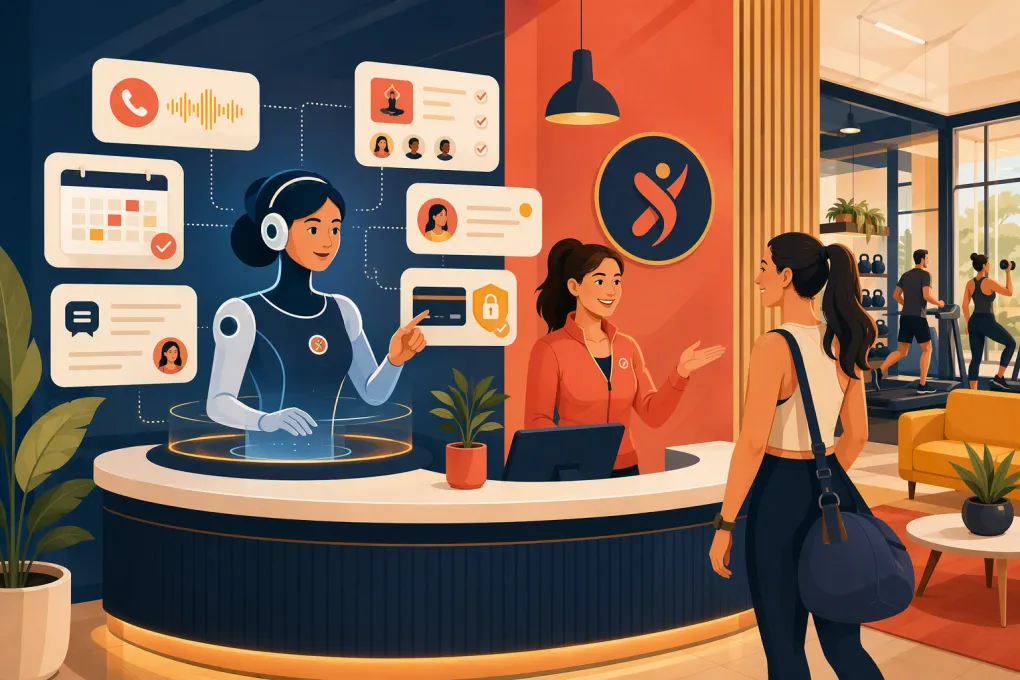
Fitty is WTF Go’s AI receptionist and agent for fitness and wellness businesses. Depending on the supported integration and studio configuration, it can answer leads, book classes, follow up, and support dues-collection workflows around the clock.
The important qualification is the same one you should apply to every vendor: verify the exact action in your operating stack. WTF Go should be evaluated against your Pilates prerequisites, booking rules, payment process, consent requirements, and escalation paths—not a generic AI demonstration.
Ask WTF Go to map Fitty against your Pilates studio’s actual systems →
Frequently asked questions
How much does an after-hours AI receptionist for a Pilates studio cost?
Pricing may combine a platform fee with charges for locations, numbers, minutes, calls, messages, or completed actions. Request a quote that includes setup, integrations, overages, support, and contract-exit costs.
Can an AI receptionist connect to my Pilates booking software?
It depends on the vendor, platform, and required action. Confirm whether it can read live availability and write confirmed bookings through an official API or another documented connection.
Can an AI receptionist discuss injuries or pregnancy?
It may provide approved general information, but it should not diagnose, recommend treatment, or determine whether participation is safe. Configure immediate escalation for health and safety disclosures.
Do callers need to consent to AI call recording?
Recording and consent rules vary by state and situation. Use an appropriate disclosure and consent process, document it, and consult qualified counsel about the jurisdictions in which you operate.
How should I test an AI receptionist before signing a contract?
Run Pilates-specific scenarios in a sandbox or controlled pilot, then inspect the resulting booking, CRM record, transcript, consent event, payment flow, and staff handoff. Include failure cases such as full classes, expired offers, and integration outages.
Keep reading

Run your gym on autopilot with WTF Go
Fitty — your AI receptionist — answers calls and DMs, fills classes, follows up with every lead, and collects dues while you coach.