Comparisons
Aerial Silks Studio Management Software: What to Look For
Compare aerial silks studio management software by booking, rig-point capacity, waivers, billing, automation, and multi-location support before you buy.
 Watch · 20s
Aerial silks studios do not operate like standard gyms. Your real capacity may be determined by rig points, apparatus setup, instructor coverage, student level, and whether a class involves solo or shared equipment. Put those constraints into generic scheduling software without a plan, and you can end up with overbooked apparatus, students in the wrong level, incomplete waivers, and a front desk buried in avoidable messages.
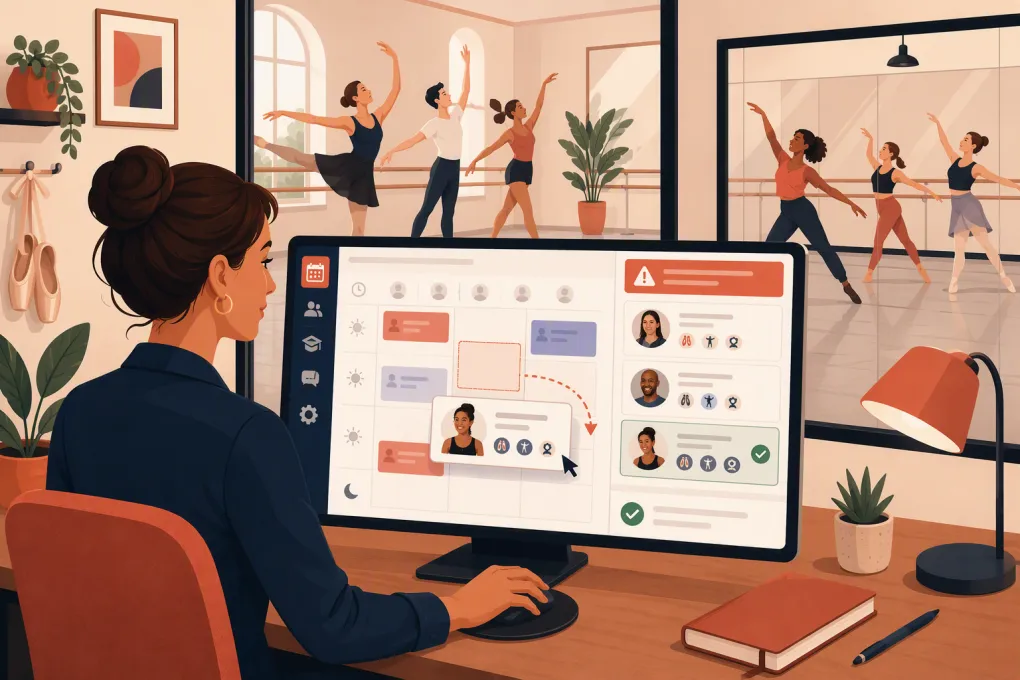
The right aerial silks studio management software should connect scheduling, lead response, enrollment, billing, waivers, and member communication. It should reduce administrative work without weakening the safety controls that require human oversight.
Before comparing brands, write down the workflows your software must support. Otherwise, a polished demo can distract you from the operational gaps that matter after launch.
See how WTF Go and Fitty handle inquiries, follow-up, booking, and dues around the clock →
What aerial silks software needs to handle
Capacity based on apparatus, not floor space
A room may accommodate more people than the available setup can safely serve. Capacity can change based on:
- Number of usable rig points
- Solo versus shared apparatus
- Silks, hammock, hoop, trapeze, or mixed-apparatus format
- Instructor-to-student coverage
- Youth versus adult programming
- Open practice versus structured instruction
- Apparatus taken offline for inspection or maintenance
At minimum, software should allow a different capacity for every class. Better configurations let you distinguish rooms, class types, instructors, and resources.
During a demo, ask the vendor to build one of your actual schedules. For example, have the representative configure a beginner silks class, a youth class, and an open studio session with different limits. Do not settle for a slideshow.
Levels, prerequisites, and enrollment control
A new student should not be able to place themselves into an advanced drops class simply because a spot is available. Look for tools such as:
- Member tags or skill-level labels
- Prerequisite notes
- Restricted or approval-based enrollment
- Introductory series before ongoing classes
- Instructor-visible student records
- Manual overrides with clear staff procedures
Software can support level control, but it cannot evaluate a student’s readiness. Define who assigns levels, where assessments are recorded, and who can override a restriction.
Waivers and minor information
Aerial studios commonly need signed waivers and additional information for minors. Your system should make waiver status easy to verify before participation.
Evaluate whether it can:
- Collect electronic signatures
- Link a parent or guardian to a minor
- Store emergency contact details
- Request a new signature when a waiver changes
- Show staff whether required documents are complete
- Export records when needed
Ask how the platform records timestamps and document versions. Have your attorney or insurance professional review your waiver language and retention practices; software does not make a waiver legally sufficient by itself.
Memberships, packs, drop-ins, and series
Aerial studios often sell several products at once: recurring memberships, class packs, single visits, introductory offers, workshops, private lessons, and fixed-term series.
Test the awkward cases, not just a straightforward monthly membership:
- What happens when a class pack expires?
- Can credits be limited to eligible class types?
- Can a member pause recurring billing?
- Can workshop registration have a separate cancellation policy?
- Can siblings or household members be managed cleanly?
- What happens when a payment fails?
- Can staff issue a credit without changing attendance history?
If those tasks require spreadsheets or repeated manual adjustments, the system is not truly managing the studio.
Comparison of aerial silks studio software options
There is no single platform that fits every aerial business. A one-room instructional studio has different needs from a multi-location operation offering camps, parties, private lessons, and multiple apparatus disciplines.
| Platform | Core strength | Booking and operations | Automation and AI | Multi-location | Pricing approach | Best fit and limitation |
|---|---|---|---|---|---|---|
| WTF Go | All-in-one operations with Fitty, an AI receptionist and agent | Designed to connect lead management, booking, memberships, communication, and collections | Fitty can answer inquiries, follow up with leads, help book, and pursue dues 24/7 | Relevant for independent and multi-location operators; confirm the exact account structure for your business | Confirm current package, implementation scope, and quote | Strong fit for operators who want fewer disconnected systems and more front-desk automation. Verify how your rig-point capacities, prerequisites, and waiver workflow will be configured. |
| Mindbody | Established fitness and wellness management ecosystem with a consumer marketplace | Broad class, appointment, staff, membership, and payment workflows | Marketing and communication features depend on package and configuration | Commonly evaluated by multi-location businesses | Subscription packages and optional services can vary; request a current quote | Suitable for studios wanting a broad platform and marketplace exposure. The breadth can add configuration and training complexity for a specialized aerial workflow. |
| WellnessLiving | Broad studio management and client engagement feature set | Supports classes, appointments, memberships, staff, payments, and client-facing booking | Includes marketing and communication tools; exact capabilities vary by plan | Multi-location capabilities should be reviewed against reporting and permissions needs | Tiered subscription structure; confirm current plans and add-ons | Worth considering for studios seeking a wide operational feature set. Test specialized capacity and prerequisite scenarios during the demo. |
| Vagaro | Appointment-led beauty, wellness, and fitness operations | Supports appointments, classes, calendars, payments, memberships, and customer management | Offers communication and marketing tools, with some capabilities sold separately | Can support multiple business locations; validate centralized controls | Subscription cost generally depends on business setup, with possible add-ons | Useful when private lessons, parties, massage, or other appointments are a major revenue stream. Confirm that class-based aerial rules are not forced into an appointment workflow. |
| Acuity Scheduling | Straightforward online appointment scheduling | Stronger for private lessons and appointments than full membership-based studio operations | Automated reminders and intake workflows are available by plan | Multiple calendars can be configured, but it is not a full multi-location gym operating system | Tiered subscription pricing is generally published; payment processing is separate | Practical for a small, appointment-heavy operation. A growing class studio may need separate tools for memberships, attendance, collections, and deeper CRM work. |
Product packages change. Treat this table as a shortlist, then verify current features, pricing, onboarding, and data migration directly with each vendor.
The front-desk test: what happens when nobody answers?
Many aerial inquiries arrive while instructors are teaching, spotting, resetting equipment, or closing the studio. A missed inquiry is not resolved by having a booking page if the prospective student first needs answers.
Common questions include:
- Do I need upper-body strength to start?
- Which class is appropriate for a complete beginner?
- Is there an age or weight policy?
- What should I wear?
- Can my child join after the series has started?
- Do you offer private lessons or parties?
- Which location teaches hoop or hammock?
A useful system should capture the lead, answer approved questions, recommend the correct next step, and continue follow-up when the person does not book immediately. It should also hand unusual, sensitive, or safety-specific questions to a human rather than improvising.
This is where Fitty changes the software evaluation. Instead of looking only at calendar features, evaluate how much of the conversation between inquiry and attendance can be handled consistently.
See how Fitty can respond to aerial studio leads and move them toward the right booking →
Billing and collections cannot be an afterthought
Recurring revenue becomes less predictable when expired cards and failed payments sit unresolved. Your platform should make payment status visible and support a consistent recovery process.
Ask each vendor:
- What happens immediately after a recurring payment fails?
- Does the system retry the payment, and can staff see the status?
- Can communication stop automatically once the balance is resolved?
- Can booking access be restricted based on your policy?
- Can staff distinguish a failed payment from an approved freeze or scholarship arrangement?
- What payment data can be exported for reconciliation?
Automation should enforce your written policy, not invent one. Decide your grace period, communication cadence, access rules, and escalation path before configuring the software.
Explore how WTF Go connects member management with Fitty’s dues follow-up →
How to run a useful software demo
Send vendors a short script before the call and require them to perform it live. A solid aerial studio test includes:
- A new lead asks which beginner class to take.
- The lead books an intro class and signs the required waiver.
- The class reaches its apparatus-based capacity and starts a waitlist.
- A cancellation opens a place.
- The student completes the intro pathway and receives the correct level tag.
- The student buys a pack that is valid only for selected classes.
- A recurring payment later fails.
- A manager reviews attendance, sales, outstanding balances, and lead status.
For multi-location studios, add a transfer between locations, location-specific pricing, shared versus local staff permissions, and consolidated reporting.
Score every platform on the same criteria. Include daily usability, reporting, support, migration, and total software stack—not merely the advertised feature list.
Plan the migration before signing
Ask what data can be imported and what will remain in your old system. Relevant records may include:
- Active members and contact details
- Membership status and remaining class credits
- Future bookings and waitlists
- Signed waivers
- Payment tokens or recurring billing agreements
- Attendance history
- Lead notes, tags, and communication consent
- Staff schedules and payroll-related exports
Payment credentials and historical records are not always portable in the same way as contact data. Get the migration scope in writing, clean duplicates before import, and keep a secure archive of records you are required to retain.
Choose a cutover date that avoids major showcases, camps, or enrollment launches. Run staff training with real scenarios, then assign one owner for configuration decisions so exceptions do not multiply.
The best choice is the one that protects the workflow
Aerial silks studio management software should do more than display classes online. It needs to respect apparatus limits, support level control, document enrollment requirements, collect revenue, and keep leads from disappearing while the team is teaching.
Start with your operational rules. Then make each vendor prove how the platform supports them. If reducing front-desk workload and connecting lead response, booking, follow-up, and collections are priorities, WTF Go deserves a place on the shortlist.
Frequently asked questions
Can aerial studio software track rig points?
Some platforms can model rig points through class capacities, rooms, resources, or appointment assets. Ask the vendor to configure your actual apparatus setup during the demo rather than assuming resource booking will fit.
What software features matter most for an aerial silks studio?
Prioritize apparatus-based capacity, level controls, waivers, minor accounts, waitlists, memberships, class packs, failed-payment workflows, lead follow-up, and clear attendance reporting.
Can one system manage classes, private lessons, and parties?
Many broader studio platforms support both classes and appointments. Test package deposits, staff availability, room or apparatus allocation, waivers, and cancellation rules for each service type.
Should aerial studios use AI to answer safety questions?
AI can answer approved general questions and guide students toward suitable introductory options. Medical concerns, individual readiness, advanced placement, and safety exceptions should be escalated to qualified staff.
How should I compare aerial studio software pricing?
Compare the full operating cost, including subscriptions, payment processing, add-ons, messaging, migration, websites, marketing tools, and any separate CRM or automation products you would still need.
Keep reading


Run your gym on autopilot with WTF Go
Fitty — your AI receptionist — answers calls and DMs, fills classes, follows up with every lead, and collects dues while you coach.